

On this page
In April 1850, the French physicist Léon Foucault became the first person to show that light travels more slowly in water than in air. Hippolyte Fizeau confirmed it with his own apparatus seven weeks later, according to the MacTutor biography of Fizeau. It mattered because the two main theories of light predicted opposite answers. Here is the test, the method and a worked example.
Why did the speed of light in water matter?
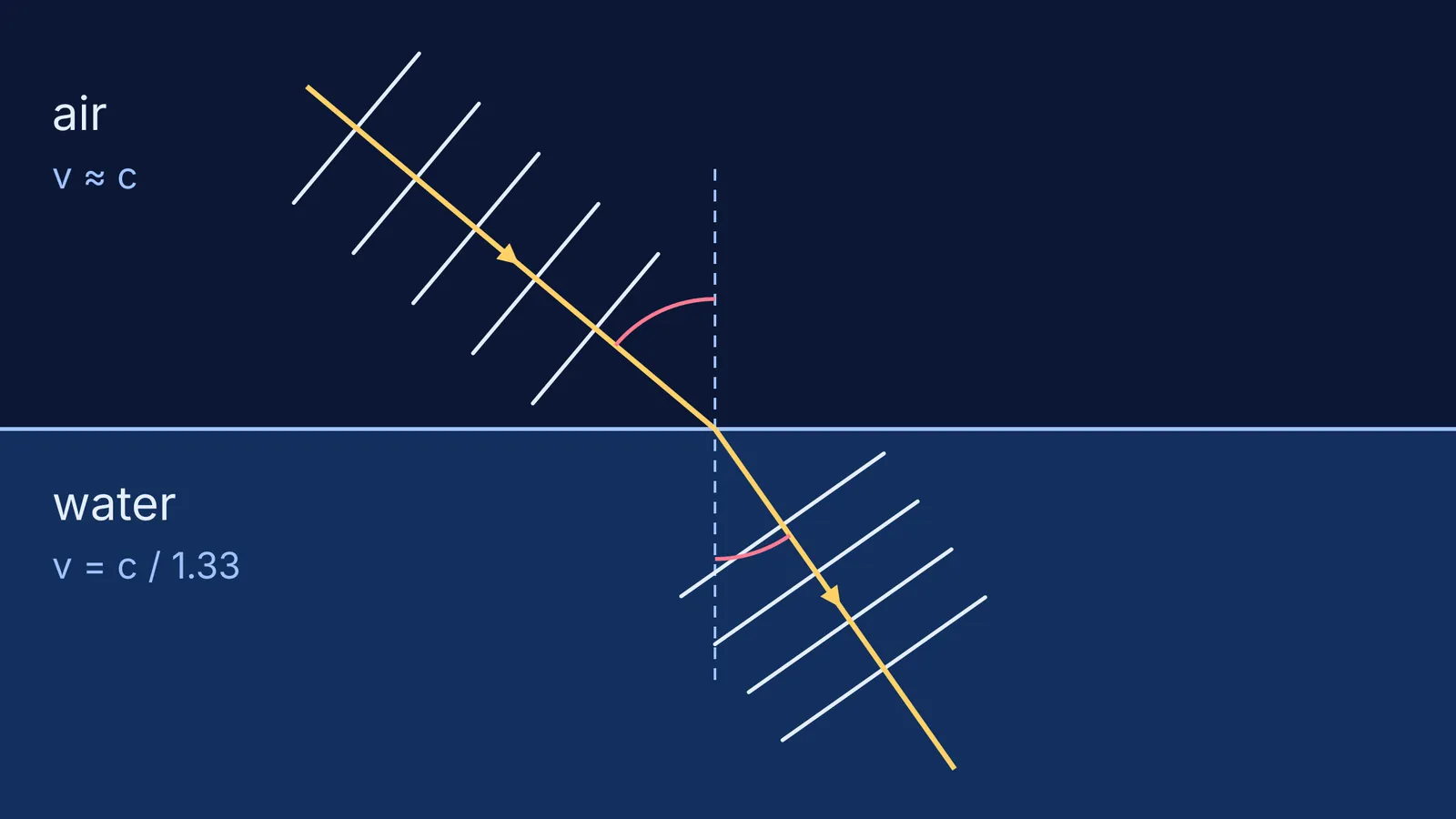
Both theories explained why a ray bends towards the normal in water, but disagreed about the cause. In Newton's particle (corpuscular) picture, water pulls on the arriving light particles and speeds them up. In the wave picture, light must slow down in water. This summary follows the overview of Foucault's measurements.
So measuring the speed in water would decide between them. In a 2023 paper, Olivier Morizot writes that the two theories "predicted inverse results to such a measurement" (Morizot, arXiv 2310.17982). The MacTutor biography notes that François Arago cared about it because it was "a crucial test of whether light was corpuscular or a wave".
How did Foucault's rotating mirror measure the speed of light?
The trick is to use a turning mirror as a clock. As Michael Fowler's University of Virginia lecture notes explain, a beam hits a spinning mirror, travels to a fixed mirror and returns to the spinning mirror, which has meanwhile turned through a small angle. The shift in the returning beam tells you how far the mirror turned during the round trip. Since you know the rotation rate, that gives you the time.
For the water test, Foucault had Paul-Gustave Froment build the rotating mirror. He split the beam so that one part went through a tube of water and the other through air (overview). A slower beam takes longer, so the mirror turns further before it returns and its image lands further off. The beam through water came out below the spot where the air beam came out (Öpik physics textbook). Light was slower in water.
The Académie des sciences quotes the conclusion of Foucault's 1853 doctoral thesis in English translation: "Always, light is delayed as it passes through the most refractive medium."
Worked example: what did each theory predict?
The refractive index of a medium is n = c/v, the speed of light in air divided by the speed of light in the medium (NCERT Class 10 Science, Light: Reflection and Refraction). The same chapter gives water's refractive index as 1.33 and uses 3 × 10⁸ m/s for the speed of light in vacuum.
Compare 1 m of air with 1 m of water:
Air: t = 1 m ÷ (3 × 10⁸ m/s) ≈ 3.33 nanoseconds.
Wave theory: v = c/1.33 ≈ 2.26 × 10⁸ m/s, so t ≈ 4.43 ns. Light arrives about 1.1 ns late.
Particle theory: keep the along-the-surface part of the velocity unchanged, as that picture did, and Snell's law gives v = 1.33c, so t ≈ 2.5 ns. Light arrives about 0.8 ns early.
Rotating mirror (an illustrative speed, not Foucault's): the light crosses the water there and back, so the wave-theory delay is 2.2 ns. At 500 turns per second the mirror turns 2π × 500 × 2.2 × 10⁻⁹ ≈ 6.9 × 10⁻⁶ radians in that time. The reflected beam turns twice that, a shift of about 0.014 mm at one metre.
The two theories push the image in opposite directions, so a tiny shift could still decide the question: you only need to see which way it moves.
Did one experiment really settle the wave versus particle debate?
At the time, mostly yes. The overview says the result was seen as "driving the last nail in the coffin" of Newton's corpuscle theory, and the wave theory dominated until Einstein's 1905 work on the particle behaviour of light. Morizot's paper quotes Foucault declaring "the emission system incompatible with the reality of the facts" (the emission system is the particle theory). Yet Duhem later used this very experiment to argue that a truly "crucial" experiment is impossible in physics, and Morizot argues that the speed in water, taken alone, does not decide what light is (Morizot). Foucault settled the speed question, and that ruled out Newton's version of the particle theory.
How can you use Foucault's result in exams?
Going from a rarer to a denser medium, light slows down and bends towards the normal, as NCERT's "More to Know" box says (NCERT).
"Denser" means optically denser, not heavier. Our post on optical density versus mass density shows how kerosene can be optically denser than water.
For the angles, use Snell's law. Our post on Ibn Sahl's law of refraction covers an earlier chapter of the story, and refraction through parallel layers is a common exam twist.
If wavefronts crowding together in water are hard to picture, the Fermi Simulation Lab has interactive simulations for ideas that are easier to see than read. For n = c/v numericals, the Fermi Problem Library has worked problems with a step-by-step solver that explains the reasoning rather than printing an answer.


