

On this page
Ibn Sahl, a mathematician associated with the Buyid court in Baghdad, wrote a treatise on burning mirrors and lenses around 984 that, on the mainstream reading, contains a fixed ratio for how light bends. Willebrord Snell found an equivalent law in 1621, more than six centuries later. So on the best current evidence Ibn Sahl was first, with one footnote.
Did Ibn Sahl discover Snell's law first?
On the evidence we have, probably yes. Historian Roshdi Rashed reconstructed and analysed the treatise in A Pioneer in Anaclastics: Ibn Sahl on Burning Mirrors and Lenses, published in the journal Isis in 1990. Optics researchers summarising that work write that Rashed credited Ibn Sahl with discovering the law of refraction, usually called Snell's law or the Snell–Descartes law.
The footnote: Ibn Sahl did not state the rule with sines. In Rashed's reading he expressed it as a ratio of two line lengths in a geometric figure, for light passing between crystal and air. Wikipedia's Snell's law article also flags its Ibn Sahl passage as disputed and asks for more on his authorship of the law, so treat "Ibn Sahl discovered it" as the strong mainstream reading rather than a closed case.
What did Ibn Sahl actually write in 984?
Ibn Sahl lived from about 940 to 1000). His treatise survives in two manuscripts: a short one in Damascus titled "On the burning instruments", and a much longer but badly damaged one in Tehran. Rashed put the two parts back together; his edition appeared in 1993, and he translated the treatise into French.
The treatise was practical. Ibn Sahl studied parabolic and ellipsoidal mirrors, biconvex lenses and ways to draw hyperbolic arcs, and he used his refraction rule to work out lens shapes that focus light with no geometric aberration. He is also the first Muslim scholar known to have studied Ptolemy's Optics, some thirty years before the Book of Optics by Ibn al-Haytham.
How does a ratio of lengths become Snell's law?
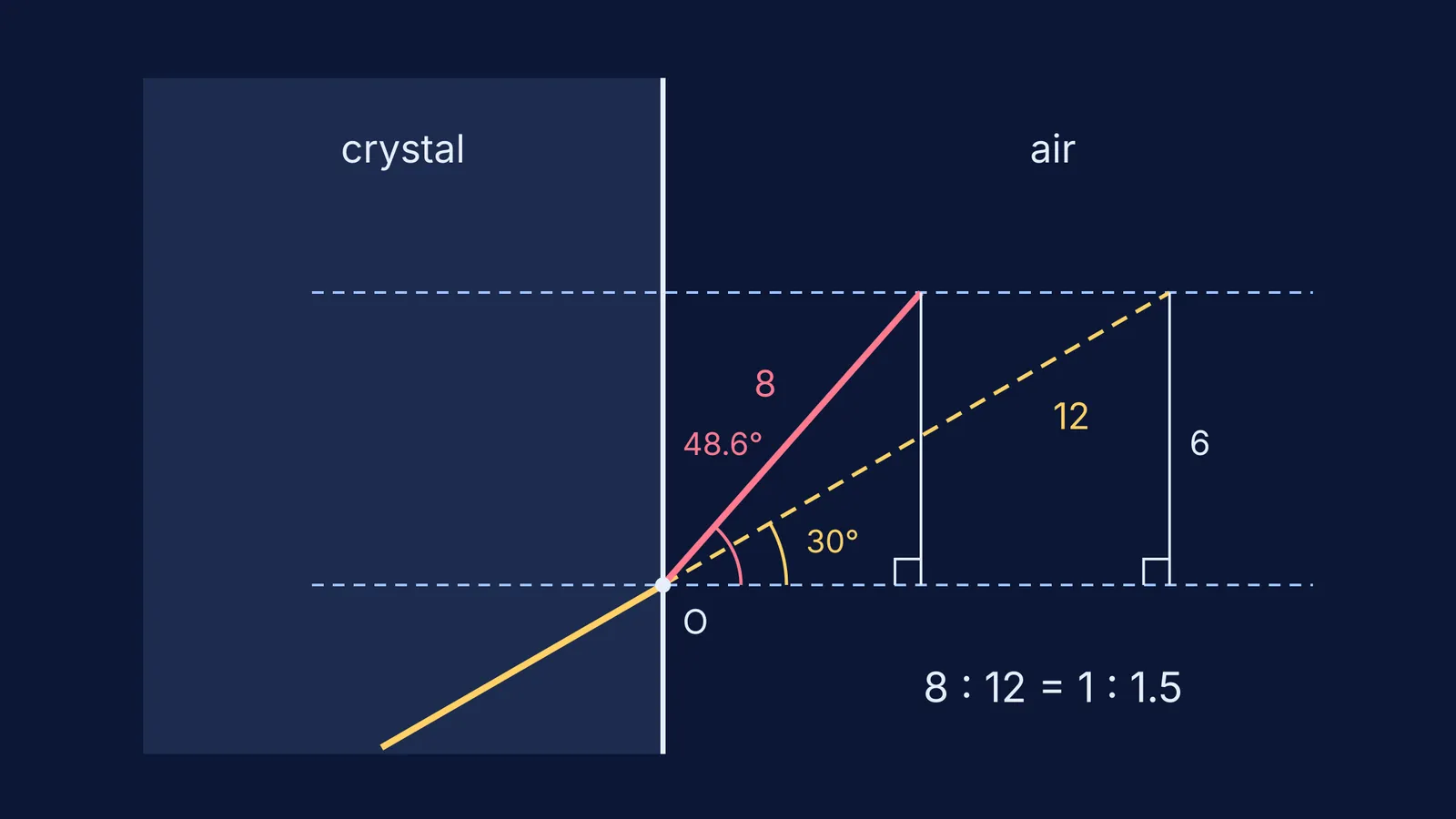
Here is a modern version of the construction, following the way Zghal and colleagues explain Rashed's reading, worked with numbers (it is the diagram above).
Draw the crystal surface as a vertical line, and the normal as a horizontal line through O, the point where the ray crosses.
A ray inside the crystal reaches O at 30° to the normal. Extend it straight on into the air (the dashed line).
The real ray bends away from the normal in air. Suppose the crystal's refractive index is 1.5. Then sin r = 1.5 × sin 30° = 0.75, so r ≈ 48.6°.
Draw a second line parallel to the normal, 6 units above it. The extended ray and the refracted ray both reach it, and each makes a right triangle with a vertical side of 6.
Extended ray: 6 ÷ sin 30° = 12. Refracted ray: 6 ÷ sin 48.6° = 8. The ratio 8 : 12 is 1 : 1.5.
Now repeat at 20°. Then sin r = 1.5 × 0.342 = 0.513, so r ≈ 30.9°. The lengths are 6 ÷ 0.342 ≈ 17.5 and 6 ÷ 0.513 ≈ 11.7, and the ratio is still 0.67. Each length is the same vertical side divided by a sine, so a fixed ratio of lengths is Snell's law in disguise.
Compare a tempting wrong rule, "the angles keep a fixed ratio": 30 ÷ 48.6 ≈ 0.62, but 20 ÷ 30.9 ≈ 0.65. The Snell's law article notes a similar weakness in Ptolemy's earlier relationship: it was inaccurate for angles that were not small.
For ideas like this, which are easier to see than to read, the Fermi Simulation Lab has interactive simulations.
Why is it called Snell's law, then?
Because the law was found again several times, and the name stuck to a later finder. The Snell's law history:
1021: Ibn al-Haytham came close in his Book of Optics but did not take the final step.
1602: Thomas Harriot found the law but did not publish it.
1621: Willebrord Snell derived a mathematically equivalent form, unpublished in his lifetime.
1637: René Descartes published it in terms of sines in La Dioptrique.
A 2002 Physics World piece by Alistair Kwan, John Dudley and Eric Lantz asked the same question: Who really discovered Snell's law? For the Dutch side, read how Willebrord Snell found his version of the law.
What can you take from this into your own physics?
Learn the law as a picture. If you can draw the two triangles, you can rebuild n₁ sin θ₁ = n₂ sin θ₂ when memory slips.
Test any refraction rule at a large angle; one that works near 0° can fail at 50°.
Raise the crystal angle until the refracted ray runs along the surface. That is the critical angle, the start of total internal reflection.
If refraction still feels like a formula you memorised rather than something you can see, the Fermi Concept Library gives every physics concept its own lesson and its place in the map.


