On this page
A home glucose meter relies on a line of work that began with an idea Leland Clark published in 1962. Clark first built an electrode that measures oxygen in blood. Then, with the surgeon Champ Lyons, he coated it with an enzyme that oxidises glucose and uses up oxygen as it does so. Less oxygen reaching the electrode meant more glucose in the sample. For that step, from an oxygen sensor to a glucose sensor, Clark is considered the "father of biosensors".
Who was Leland Clark?
Leland C. Clark Jr. was born in Rochester, New York, on 4 December 1918 and died on 25 September 2005, according to his Wikipedia biography. It lists a chemistry degree from Antioch College in 1941, a 1944 PhD from the University of Rochester, and research on heart-lung machines in the 1940s and 1950s. The journal Biosensors and Bioelectronics published his obituary by William Heineman and William Jensen.
How does the Clark oxygen electrode work?
Clark's 1953 paper was titled Continuous recording of blood oxygen tensions by polarography. Polarography itself began with Jaroslav Heyrovský; see our post on Heyrovský and the dropping mercury electrode.
A history by John Severinghaus and Poul Astrup in the Journal of Clinical Monitoring explains the problem: bare platinum electrodes "became poisoned when immersed in blood". In 1954 Clark built the first membrane-covered oxygen electrode with both anode and cathode behind a polyethylene membrane. Polyethylene's limited permeability to oxygen reduced how much oxygen the electrode drew from the sample, which made quantitative measurements possible.
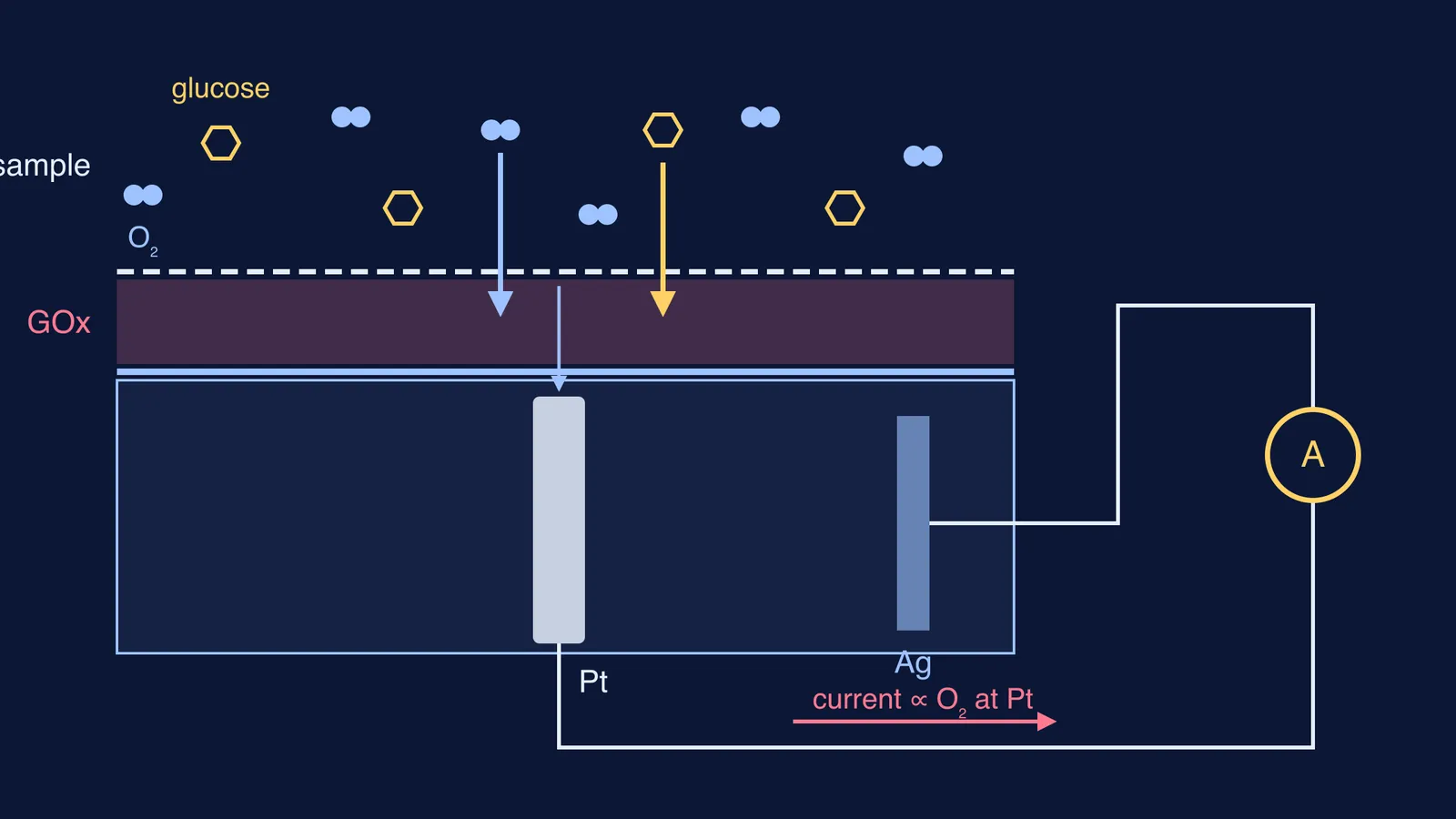
Inside, the Clark electrode has a platinum cathode and a silver anode. Oxygen crosses the membrane and is reduced at the platinum: O₂ + 4H⁺ + 4e⁻ → 2H₂O. Above a certain applied voltage the current levels off and depends only on oxygen diffusing through the membrane, so the current tells you how much oxygen is outside.
What did Clark and Lyons build in 1962?
The paper is Clark and Lyons, "Electrode systems for continuous monitoring in cardiovascular surgery", Annals of the New York Academy of Sciences, volume 102, pages 29–45. Crossref's record counts more than 3,500 citing works. Lyons chaired surgery at the Medical College of Alabama, which Clark joined in 1958 (Annals of Surgery profile).
A review by Eun-Hyung Yoo and Soo-Youn Lee in Sensors (2010) describes the design: an oxygen electrode, an inner membrane that oxygen could cross, a thin layer of the enzyme glucose oxidase (GOx), and an outer dialysis membrane. It measured glucose through "a decrease in the measured oxygen concentration". The review lists what followed:
1967: Updike and Hicks immobilised GOx, stabilising the enzyme and simplifying the test.
1975: the Yellow Springs Instrument Model 23A, which detected hydrogen peroxide, became the first commercially successful glucose analyser using Clark's technology.
1987: MediSense launched the pen-sized ExacTech, the first electrochemical home blood glucose monitor; the review says it transformed diabetes care.
GOx oxidises glucose, then hands the electrons to oxygen, making hydrogen peroxide. First-generation sensors detected that peroxide at the electrode (H₂O₂ → O₂ + 2H⁺ + 2e⁻). How fast GOx works depends on how much glucose it has, the subject of Michaelis and Menten's equation for enzyme speed.
Worked example: from a current to glucose
Take an idealised 1962 sensor, and assume every oxygen molecule the enzyme uses would otherwise have reached the platinum.
In a glucose-free solution, the oxygen current is steady.
Suppose adding glucose makes the current fall by 0.40 µA (0.40 × 10⁻⁶ coulombs per second).
Each O₂ reduced takes 4 electrons. The Faraday constant is 96,485.332 C/mol (NIST), so one mole of O₂ carries about 385,940 C.
Oxygen intercepted = 0.40 × 10⁻⁶ ÷ 385,940 ≈ 1.04 × 10⁻¹² mol/s.
GOx uses one O₂ per glucose, so about 1.04 picomoles of glucose are oxidised each second at the sensor.
Real sensors, like the plain Clark electrode, are calibrated against standard solutions instead. The arithmetic still shows why the signal tracks glucose.
If picturing those stacked layers is the hard part, the Fermi Simulation Lab has interactive simulations for ideas that are easier to see than to read. For what the body does with that glucose, see our guide to how insulin and glucagon control blood sugar.
How do you explain a biosensor in an exam answer?
Use Clark's device as your model and name three parts:
What recognises the target: glucose oxidase, which Yoo and Lee call "the standard enzyme for biosensors" for its relatively high selectivity for glucose.
What turns the reaction into a signal: the oxygen electrode, where O₂ is reduced at platinum.
What you read: a current that falls as glucose rises (or, in peroxide sensors, rises with it).
Then write one line of chemistry for each step. If a link in that chain feels shaky, such as electrode reactions, Faraday's law or enzymes, the Fermi Concept Library gives each concept in chemistry and biology its own lesson.
A note for families: a home meter is a medical device, so ask a doctor or diabetes educator what its readings mean for you.