

On this page
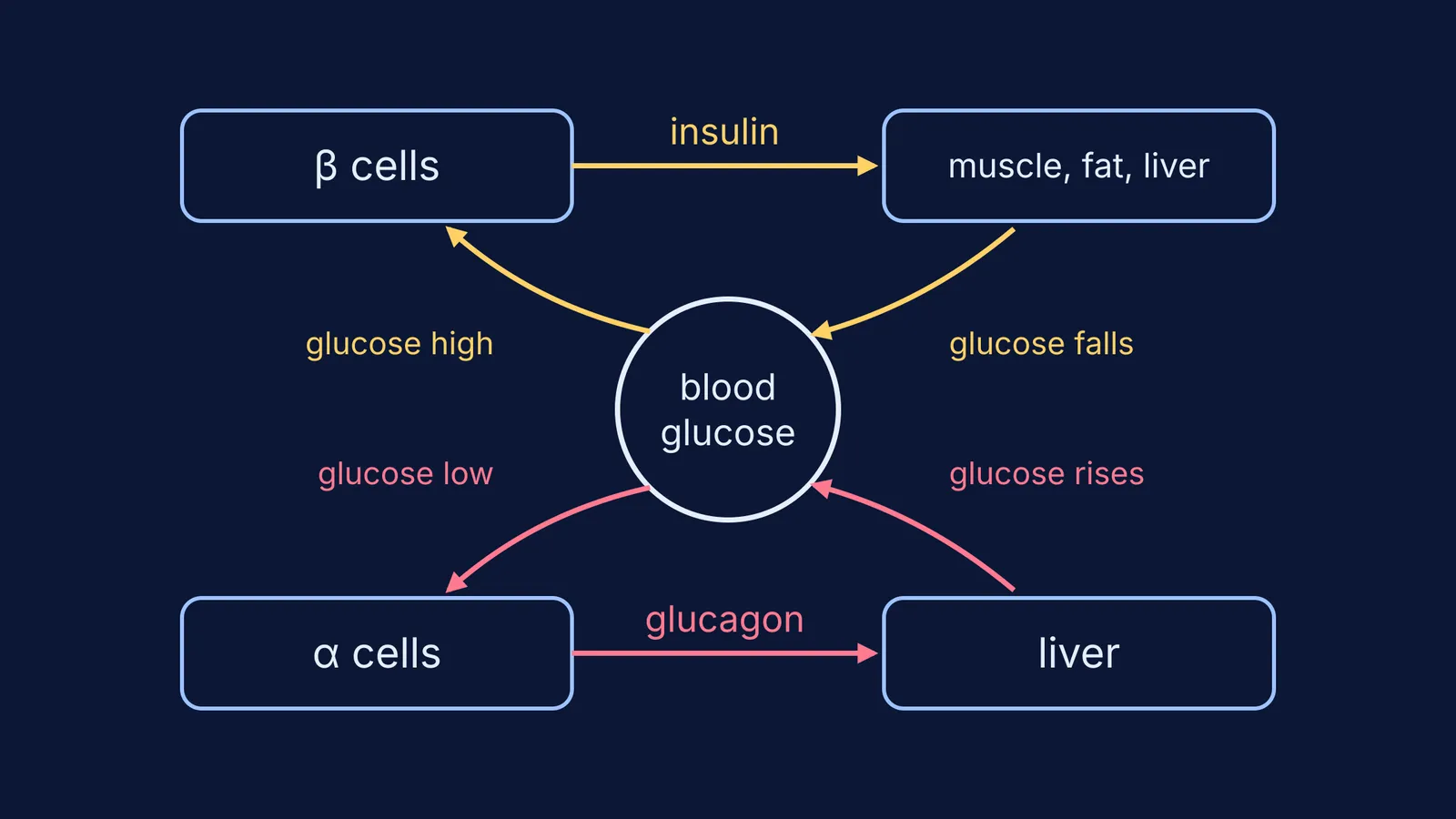
Blood sugar is a textbook feedback loop that is hard to picture from a flat diagram. Two hormones pull in opposite directions. A simulation lets you push the system with a meal, a long gap or a run, and watch it push back. The plan below: predict before each run, then check against the physiology.
What do insulin and glucagon actually do?
Both hormones come from small clusters of cells in the pancreas called islets. In a review of glucagon physiology in the Journal of Diabetes Science and Technology, Gerald Taborsky notes that beta cells make up about 80% of islet volume and the glucagon-making alpha cells only about 10%.
Insulin (from beta cells) lowers blood glucose. The US National Institute of Diabetes and Digestive and Kidney Diseases describes it as a hormone that "helps glucose get into your cells to be used for energy".
Glucagon (from alpha cells) raises blood glucose. It acts mainly on the liver, making it break stored glycogen down into glucose. Taborsky's review reports that even basal glucagon levels are enough to drive about three-fourths of fasting glucose production.
The two are wired together. The same review states that beta-cell products, insulin among them, restrain glucagon secretion. So when glucose climbs, insulin goes up and glucagon comes down; when glucose drops, the reverse happens. That is negative feedback: the response opposes the change. For the same pattern in other glands, see our explainer on hormonal feedback loops and how the body keeps levels steady.
What blood sugar numbers count as normal?
The US Centers for Disease Control and Prevention gives these cut-offs:
Fasting blood sugar: 99 mg/dL or below is normal, 100 to 125 mg/dL is prediabetes, and 126 mg/dL or above is diabetes.
Two hours into a glucose tolerance test: 140 mg/dL or below is normal and 200 mg/dL or above is diabetes.
At the other end, the CDC's page on low blood sugar says blood sugar below 70 mg/dL is considered low, and below 54 mg/dL is severe. In a simulation, these are the lines to watch.
How do you test the loop in a simulation?
Use a glucose model that lets you add a meal, skip meals and switch on exercise. A loop you need to see moving is what the Fermi Simulation Lab is for: interactive simulations for ideas that are easier to see than to read. Before each run, write down which hormone rises, which falls, and where glucose ends up.
Eat a carbohydrate meal. Prediction: glucose and insulin rise, glucagon falls, then glucose heads back down. Check: the CDC's normal two-hour reading of 140 mg/dL or below comes from a glucose drink, not a meal, so treat it as a rough guide.
Fast overnight. Prediction: insulin stays low and glucagon keeps the liver releasing glucose, so the level holds steady instead of sliding. Check: that is the three-fourths share of fasting glucose output Taborsky attributes to glucagon.
Exercise. Prediction: working muscle pulls more glucose out of the blood. Check: in a review in Physiological Reviews, Erik Richter and Mark Hargreaves explain that muscle contraction moves GLUT4 glucose transporters from stores inside the cell to its surface.
Exercise after a dose of insulin. Prediction: two uptake routes add together, so glucose can dip below 70 mg/dL. Check: the CDC lists taking too much insulin and the amount and timing of physical activity among the causes of low blood sugar in diabetes.
What breaks in type 1 and type 2 diabetes?
The WHO reports that the number of people living with diabetes rose from 200 million in 1990 to 830 million in 2022. In India, the national ICMR-INDIAB study00119-5) in The Lancet Diabetes and Endocrinology found a weighted diabetes prevalence of 11.4% and prediabetes prevalence of 15.3%.
Type 1: the brake is missing. The NIDDK explains that the immune system destroys the insulin-making cells, so the body makes little or no insulin. Set insulin output near zero and rerun the meal: glucose climbs and stays high. Taborsky's review adds a second fault: the glucagon response to insulin-induced low blood sugar is impaired soon after type 1 diabetes develops.
Type 2: the signal is weak. Here, says the NIDDK, cells don't use insulin properly, and the pancreas may not make enough to keep glucose in range. Keep insulin output but lower how strongly cells respond: insulin climbs higher, yet glucose comes down more slowly.
To see how insulin was first isolated, read Banting, Best and the discovery of insulin in Toronto.
Can you explain the loop without notes?
Answer these out loud:
Which cells make insulin and which make glucagon?
Why does blood sugar hold steady overnight without food?
In the model, why does a workout just after an insulin dose push glucose lower?
How do the faults in type 1 and type 2 diabetes differ?
If one stalls you, look the idea up in the Fermi Concept Library, then rerun that scenario and predict again.


