On this page
In the summer of 1956, two young Chinese-born physicists asked a question most of their colleagues thought was already settled. Tsung-Dao Lee of Columbia University and Chen-Ning Yang were working as summer guests at Brookhaven National Laboratory, according to the laboratory's history page. Their question was whether nature's weak force, the one behind radioactive beta decay, treats left and right equally. Within months an experiment showed that it does not.
What is parity, in plain words?
Parity is mirror symmetry: a law of physics conserves parity if the mirror image of every process it allows is also allowed. If you filmed an experiment in a mirror, a parity-symmetric world would give you a film of something that could also happen for real. Before 1956, physicists treated this as a basic rule of nature.
Lee and Yang checked the evidence behind the rule. As the Stanford Encyclopedia of Philosophy's account puts it, there was strong evidence that parity was conserved in the strong and electromagnetic interactions, but "there was, in fact, no supporting evidence that it was conserved in the weak interaction."
What did Lee and Yang propose in 1956?
The trigger was the tau-theta puzzle. Two particles, the tau and the theta, had the same mass and lifetime but decayed into states of different parity, so if parity always held they had to be different particles (Stanford Encyclopedia; Brookhaven). Lee and Yang took the other road: perhaps they were one particle, and the weak decay simply did not respect mirror symmetry.
Their paper, "Question of Parity Conservation in Weak Interactions", was received by Physical Review on 22 June 1956 and published on 1 October 1956. Its abstract is modest: "The question of parity conservation in β decays and in hyperon and meson decays is examined. Possible experiments are suggested which might test parity conservation in these interactions."
That modesty is the lesson. They did not announce that parity was broken. They showed that the belief had never been tested for the weak force, and described experiments that could test it, including beta decay of nuclei whose spins all point the same way. (For the basics, see why the beta decay energy spectrum is continuous.)
How did the Wu experiment prove them right?
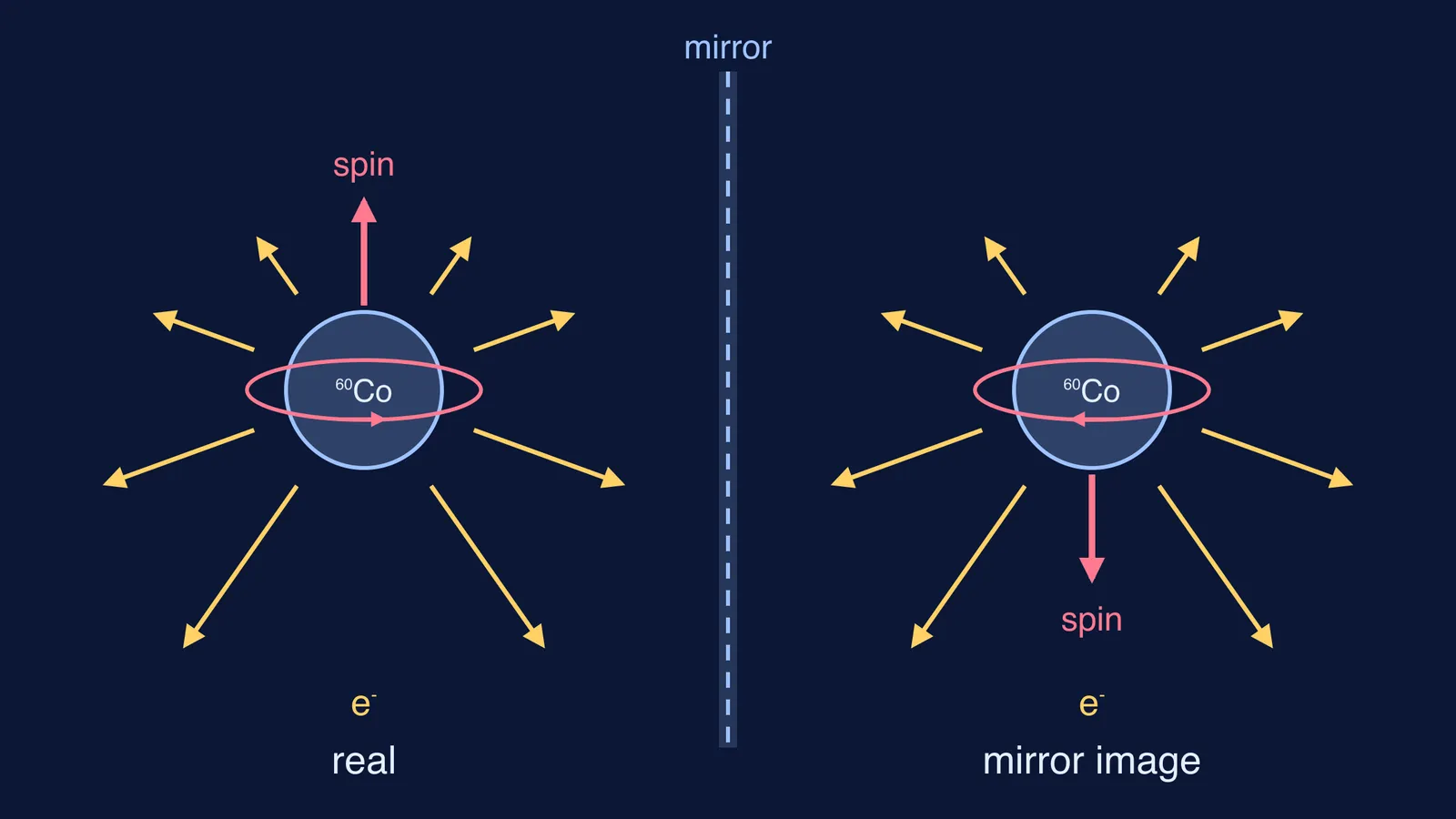
Chien-Shiung Wu, a Columbia colleague, led the test with four co-authors. They aligned cobalt-60 nuclei and counted the beta-decay electrons going along the nuclear spin and opposite to it; more electrons came out opposite to the spin. Their paper, "Experimental Test of Parity Conservation in Beta Decay", was received on 15 January 1957. More in our profile of Chien-Shiung Wu and the parity experiment.
In 1957 Lee and Yang received the Nobel Prize in Physics "for their penetrating investigation of the so-called parity laws which has led to important discoveries regarding the elementary particles" (Nobel Prize citation). Lee was 31, at the time the second-youngest scientist to receive the prize.
How can you check a mirror image yourself?
You need nothing beyond Class 11 vectors and the right-hand rule. Vectors come in two kinds, and a mirror treats them differently.
Ordinary (polar) vectors: position, velocity, momentum, force, electric field. In a mirror, the component pointing into the mirror flips; the components along the mirror's surface stay the same.
Axial vectors: angular velocity, angular momentum, spin, magnetic field. These are defined by a right-hand rule, so in a mirror the opposite happens: the components along the mirror's surface flip and the component into the mirror stays.
Now try it on the Wu experiment, with a mirror standing upright beside the apparatus.
Real world: a cobalt-60 nucleus spins anticlockwise seen from above, so by the right-hand rule its spin points up. Most electrons fly downward, against the spin.
Reflect the spin: in the mirror the nucleus turns clockwise. Spin is axial and lies along the mirror's surface, so it flips to point down.
Reflect the electrons: momentum is polar and also lies along the mirror's surface, so it does not flip. They still fly downward.
Compare: in the mirror, most electrons go along the spin; in reality they go against it. The mirror film shows something nature does not do, so parity is violated.
If polar and axial vectors still feel slippery, the Fermi Simulation Lab has interactive simulations for ideas that are easier to see than to read.
Why does Lee and Yang's work still matter?
Their work overturned the notion that parity is conserved in the weak force, and it showed that a symmetry is only as safe as the experiments that have tested it. Yang is also known for earlier work with Robert Mills: in 1953 they proposed Yang-Mills theory, which Physics World says became a cornerstone of the Standard Model of particle physics; see our piece on Yang-Mills gauge theory. Lee died on 4 August 2024 at 97 (Michigan Public), and Yang died on 18 October 2025 at 103 (Physics World).
The habit to copy is simple: when a rule "everyone knows" blocks your way, ask what evidence supports it and where it was actually tested. Next time you use the right-hand rule in a magnetism problem, ask what its answer would look like in a mirror.