On this page
Physicists in the early 1950s took it for granted that the laws of nature do not care about left and right: run any experiment and its mirror image, and both should be possible. In the winter of 1956 Chien-Shiung Wu tested that assumption for radioactive decay and found it false. This post covers who she was, how the experiment worked, the reasoning that makes the result so clean, and what a physics student can learn from her approach.
Who was Chien-Shiung Wu?
Wu was born in China in 1912, received her PhD from the University of California in 1940, and worked on the Manhattan Project during the Second World War. By 1956 she was a professor at Columbia University and an expert in beta decay. In 1975 she became the first woman president of the American Physical Society.
What is parity, and why was it in doubt?
Parity conservation means that the mirror image of any physical process is also a possible process, obeying the same laws. In the 1950s a puzzle appeared. A particle now called the K meson seemed to come in two versions, one decaying into two pions and the other into three, identical in every other way. The two final states have opposite parity, so if parity always held they had to be different particles.
In 1956 Tsung-Dao Lee and Chen Ning Yang surveyed the evidence in a paper titled Question of Parity Conservation in Weak Interactions. The Nobel presentation speech later summarised their finding: the symmetry assumption had no experimental support at all in weak processes, because every experiment so far had been arranged so that it gave the same result whether parity held or not. They proposed experiments that could tell, and Wu ran the first.
How did the experiment work?
The work was done at the US National Bureau of Standards in Washington by Wu with NBS physicists Ernest Ambler, Raymond Hayward, Dale Hoppes and Ralph Hudson, between Christmas 1956 and New Year. The results appeared in Physical Review in February 1957.
The NIST account of the experiment gives the details. The cobalt-60 sat in a thin surface layer, about 50 micrometres deep, of a crystal of cerous magnesium nitrate. The crystal was cooled by magnetic methods to about 0.003 K, so cold that thermal jiggling could no longer stop the cobalt nuclei lining up. A solenoid then supplied a magnetic field to align the nuclear spins. The team counted beta electrons emitted along and against the field, and then reversed the field and counted again.
The result: more electrons came out in the direction opposite to the nuclear spin. The asymmetry, NIST notes, could have been anywhere from zero to the maximum possible; it was the maximum.
Why does this show nature is not mirror-symmetric?
This is the step worth working through. The Nobel speech describes the set-up as a coil lying on a table with current flowing anticlockwise when viewed from above. By the right-hand rule, the field, and so the cobalt nuclei's north poles, point up. The electrons were found to go preferentially down.
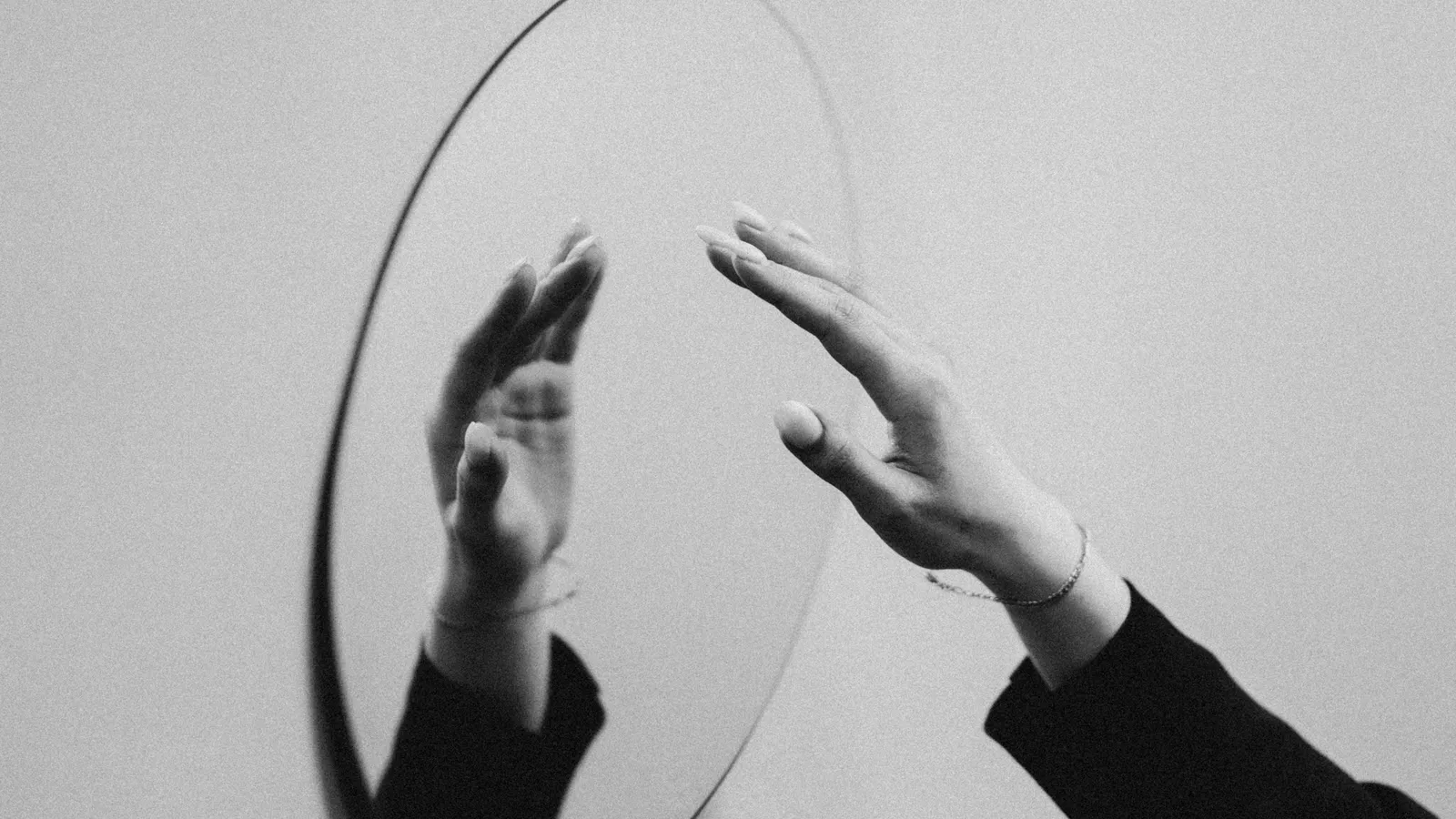
Now imagine a vertical mirror beside the apparatus.
The current loop in the mirror circulates the other way, clockwise seen from above. Apply the right-hand rule to the image and its field, and the nuclear spins, point down.
The electrons' motion is an ordinary direction in space. Up and down are parallel to the mirror, so in the image the electrons still go down.
In the real world, electrons go opposite to the spin. In the mirror world, they go along the spin. If parity held, the mirror world would be just as possible as the real one, so the electrons would have to come out equally in both directions. They do not. The mirror image of Wu's experiment is an experiment that nature does not perform.
Who was recognised for it?
The 1957 Nobel Prize in Physics went to Yang and Lee "for their penetrating investigation of the so-called parity laws which has led to important discoveries regarding the elementary particles". Wu was not included. In 1978 she received the Wolf Prize in Physics, cited "for her persistent and successful exploration of the weak interaction which helped establish the precise form and the non conservation of parity for this new natural force".
Common confusions for students
Parity here is not odd and even numbers. It is about whether a process and its mirror image both obey the laws.
The result applies to the weak interaction. It concerns beta decay and related processes, not your everyday mirror.
Electron direction and spin behave differently in a mirror. Motion is an ordinary vector; spin, like a current loop, flips. Getting this right is the whole argument.
What can a student take from Wu's way of working?
She took a principle everyone assumed and asked whether anyone had actually tested it. She built in a control, the field reversal, that would expose a fake result. And she treated hard engineering, ultracold temperatures and a thin radioactive layer, as part of the physics rather than a side issue. If you are aiming at olympiad physics, our guide to getting started with the physics olympiad is a good next read.
The right-hand rule for a current loop is the part most students stumble on here. The Fermi Simulation Lab has interactive simulations for ideas that are easier to see than read, so you can watch how a loop's field follows the current.
Try it now: sketch Wu's coil and its mirror image, mark the current, the spin and the electron direction in each, and check that you get the asymmetry.