

On this page
In September 2015, the palaeoanthropologist Lee Berger and a large team of co-authors described Homo naledi in the journal eLife as "a previously-unknown species of extinct hominin" found in the Dinaledi Chamber of the Rising Star cave system, in the Cradle of Humankind, South Africa. The name comes from the same paper: *naledi* means "star" in the Sotho language, after the cave.
How was Homo naledi found in the Rising Star cave?
The 2015 paper says hominin fossils were first recognised in the chamber in October 2013. Recreational cavers Steven Tucker and Rick Hunter had worked their way through a constriction called Superman's Crawl, and Tucker then found himself in "a narrow, vertical chute, in some places less than eight inches wide", National Geographic reported. In the chamber below, bones were lying on the floor.
The geology paper by Paul Dirks and colleagues gives the measurements. The Dinaledi Chamber is about 30 m below the surface and about 80 m in a straight line from the nearest entrance. Reaching it means a vertical climb down of about 12 m, with squeezes as tight as about 20 cm.
To excavate, Berger posted on Facebook asking for "skinny individuals" with scientific credentials and caving experience. Within a week and a half he had heard from nearly 60 applicants, and he chose six young women he called his "underground astronauts", according to National Geographic. The 2015 eLife paper records that the fossils were recovered during two expeditions, in November 2013 and March 2014.
How many fossils were found, and why does that matter?
The team recovered 1,550 hominin specimens from at least 15 individuals, including 737 partial or complete anatomical elements, according to the species description in eLife. The authors called it "the largest assemblage of a single species of hominins yet discovered in Africa."
Compare that with the single skull of the Taung child that Raymond Dart described, or the one partial skeleton of Lucy, found by Donald Johanson. With most skeletal elements repeated several times, researchers can compare individuals. The Dirks paper adds that these finds are only "a small portion of the total fossil content" of the chamber.
What made Homo naledi a new species?
No known species had its mix of traits. The 2015 description lists:
Small brain: estimated endocranial volumes of about 560 cc and 465 cc, within the range known for australopiths.
Human-like body size: body mass and height similar to small-bodied human populations.
Human-like hands and feet: a hand and wrist suited to handling objects, and a foot and lower leg suited to walking.
Primitive trunk: a trunk, shoulder, pelvis and upper thigh bone closer to australopiths, plus long, markedly curved fingers.
How old is Homo naledi?
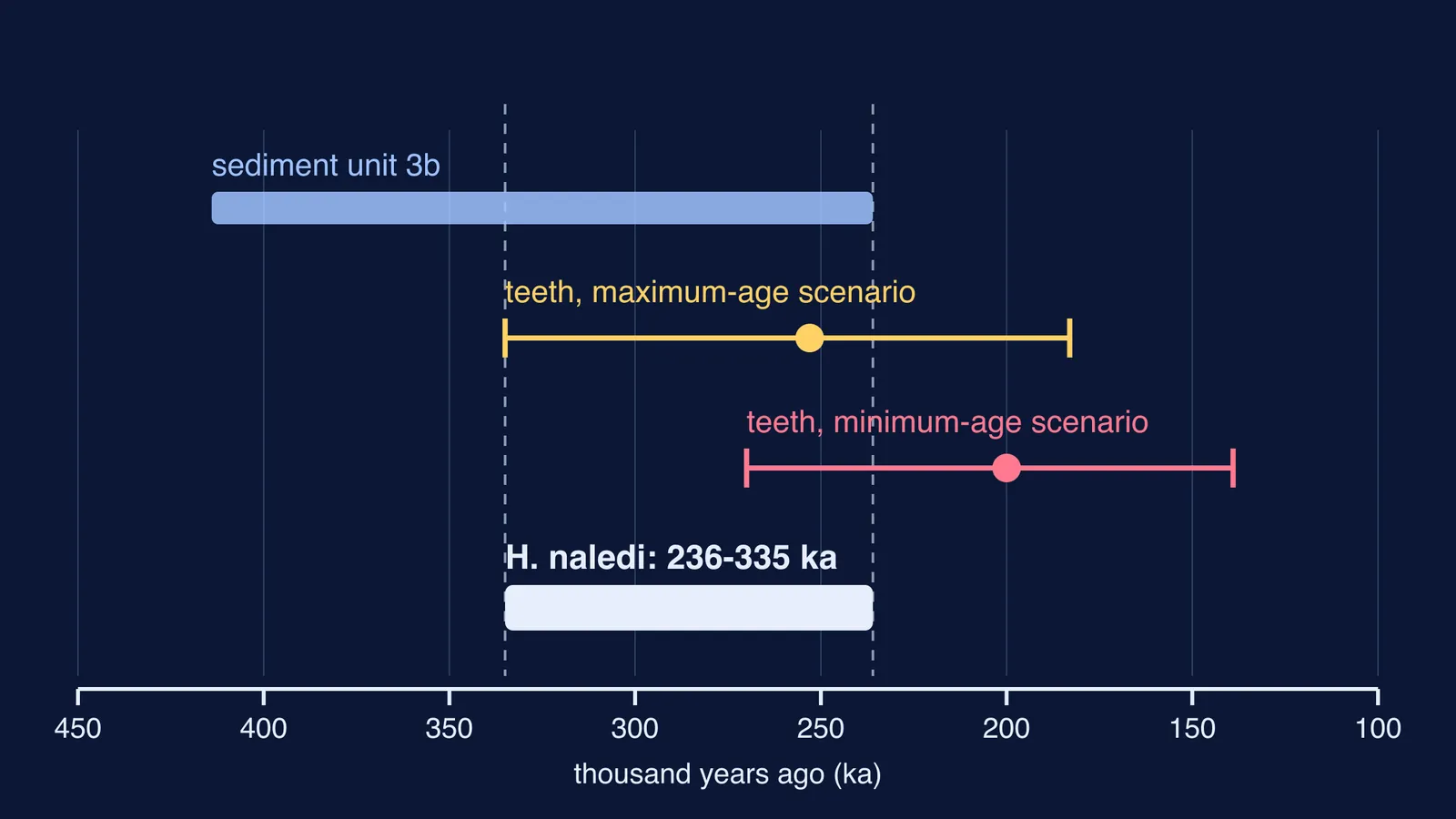
A 2017 dating study in eLife combined several methods, including luminescence dating of sediment, uranium-thorium dating of flowstone, and combined uranium-series and electron spin resonance dating of three teeth. It placed the fossils between 236,000 and 335,000 years ago. That is much younger than earlier guesses based on the anatomy. For the basics of these methods, read how fossils are dated using rock layers and radioactivity.
How do you read a date like 253 +82/−70 ka?
In the scenario the authors favour, the 2017 paper gives the average age of the two least altered teeth as 253 +82/−70 ka.
"ka" means thousand years ago, so 253 ka is 253,000 years ago.
The upper limit is 253 + 82 = 335 ka. The lower limit is 253 − 70 = 183 ka.
The oldest flowstone lying on top of the fossils is dated to 236 ka, so the bones must be at least that old.
Combine the two: older than 236 ka (step 3) and younger than 335 ka (step 2). That gives the published range of 236,000 to 335,000 years.
The skill is combining two limits into one window. If half-life or isotopes still feel shaky, the Fermi Concept Library has a lesson for each concept in physics, chemistry and biology, so you can fill that gap first.
What is still debated about Homo naledi?
The hardest question is how the bodies reached such a dark, hard-to-reach chamber. In 2015, Dirks and colleagues wrote that preliminary evidence was "consistent with deliberate body disposal" by a hominin species other than Homo sapiens. Berger's group later argued for deliberate burial in a further eLife paper, first posted as a reviewed preprint in 2023. Its reviewers were split: one found the evidence convincing, and another called it incomplete. That is how a big claim should be tested: in the open. Use these questions on the next "new human ancestor" story:
How many individuals, and which bones? One tooth supports far less than a chamber of skeletons.
Which traits are primitive and which are modern?
How was it dated, and by more than one method?
What is the error range, and what limits does it come from?
Which claims have reviewers accepted, and which are still disputed?
Next time you revise human evolution, try answering these five questions for Lucy or the Taung child.


