On this page
On 12 November 1894, Lawrence Hargrave sat in a seat fixed to the lowest of four linked box kites, and a strong gust carried him into the air. The kites stayed steady in the buffeting wind because of their box design, as Australian Geographic's account of the flight describes. It happened on Stanwell Park Beach in New South Wales, says his Wikipedia biography, which gives his life as 1850-1915. He patented none of it.
How does a box kite produce lift?
The Powerhouse Museum in Sydney says his kite grew in four stages from a paper cylinder to a two-celled box. The fourth version, finished by the end of 1893, gave a stable surface with the correct ratio of area to weight. The museum says the kite could lift Hargrave sixteen feet (about 5 metres) off the ground.
A box kite is two open boxes joined by a stick. Wind flows through each box. The top and bottom panels, tilted slightly into the wind, deflect air downwards, and the air pushes the kite up.
NASA's kite lift equation is L = Cl × A × ρ × 0.5 × V², where Cl is the lift coefficient, A the surface area, ρ the air density and V the wind speed (NASA Glenn Research Center). Lift grows with the square of wind speed, so doubling the wind gives four times the lift.
Hargrave knew the angle mattered. Quoted in Octave Chanute's 1894 book Progress in Flying Machines, he wrote that the kites of his youth flew at about 45°, "in which position the lift and the drift are about equal," while a fine angle "makes the lift largely exceed the drift." Drift meant drag. The book also reports that a kite with curved top and bottom surfaces pulled about twice as hard as a flat one of the same size and weight.
Why was the box kite so stable?
A flat kite has one surface and needs a tail. A box kite gets its stability from its shape. Chanute lists "placing several surfaces behind each other" as one way to keep a flying machine level from nose to tail, naming Hargrave's cellular kites as an example (Progress in Flying Machines).
The vertical side panels act like a tail fin, resisting sideways swings. The Powerhouse notes that Hargrave used a cell with a reverse curve "to obtain both lateral and longitudinal stability" (Powerhouse Collection).
Worked example: how much lift does a box kite give?
Use the formulas on the NASA kite lift page. Assume one box kite with 1 m² of lifting surface, a 10° angle of attack, panels three times as wide as they are deep (aspect ratio 3), and sea-level air at 1.229 kg/m³.
Thin-plate lift coefficient: Clo = 2π × 0.1745 rad = 1.10.
Correct for downwash: Cl = 1.10 / (1 + 1.10 / (π × 3)) = 0.98.
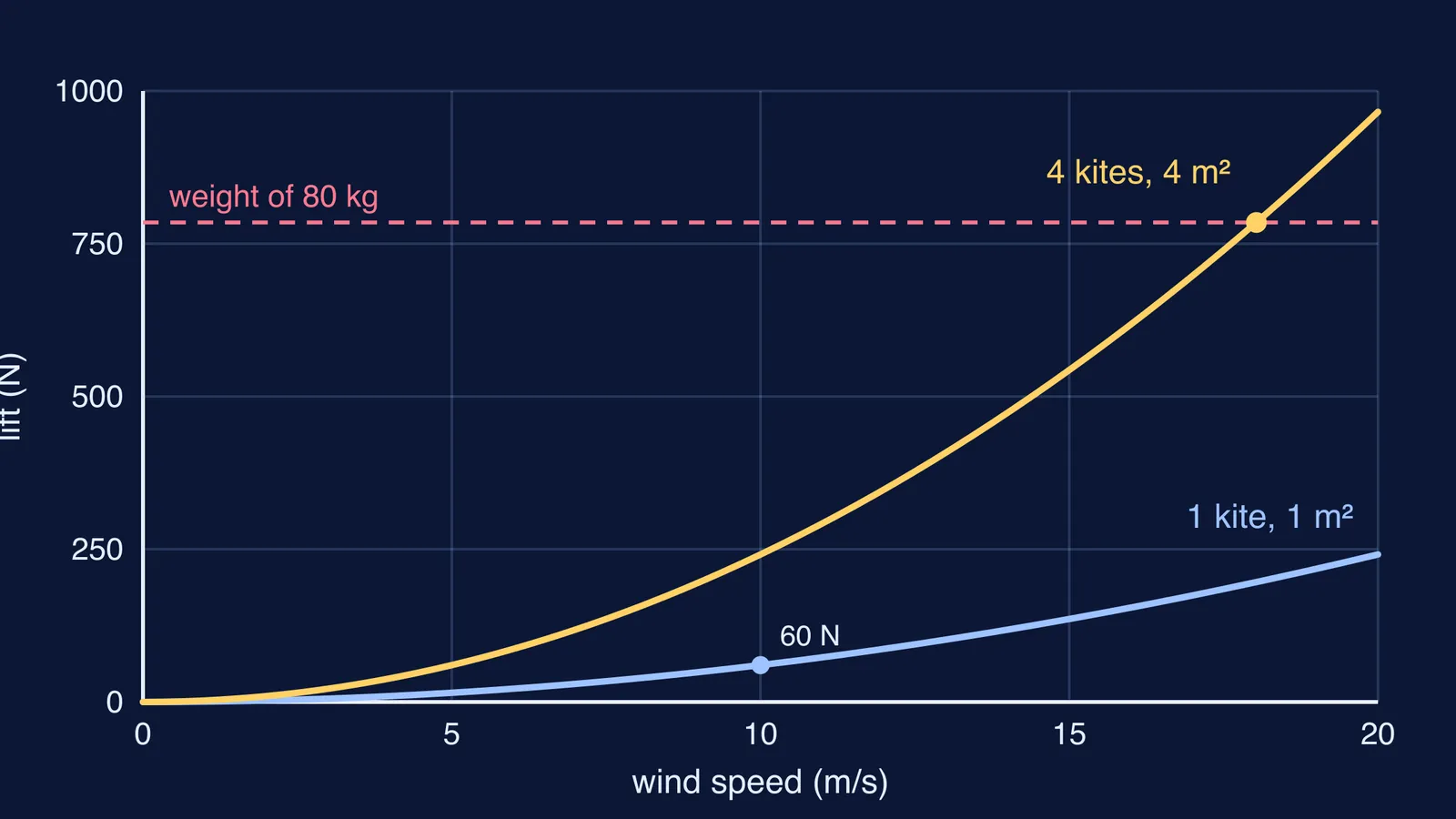
In a 10 m/s breeze (36 km/h): L = 0.98 × 1 × 1.229 × 0.5 × 10² ≈ 60 N, enough to hold up about 6 kg.
Double the wind to 20 m/s: lift rises four times, to about 240 N.
To hold up 80 kg (about 785 N) at 10 m/s, you need 785 ÷ 60 ≈ 13 m² of surface. Four such kites (4 m²) need about 18 m/s.
This flat-plate estimate ignores the kite's own weight and the extra pull of curved surfaces. Wikipedia says Hargrave rose in a wind of 21 mph (about 9.4 m/s), so his real kites must have had more surface, or more lift per square metre, than this model. More kites help too: he noted that "any number of kites may be strung together on the same line" (Progress in Flying Machines).
To see V² at work, the Fermi Simulation Lab has interactive simulations for the ideas that are easier to see than to read. For the everyday version, see how a kite flies on Makar Sankranti.
Why did Hargrave refuse to patent the box kite?
Chanute wrote that Hargrave "takes out no patents for any of his aerial inventions" and published full accounts so inventors could share ideas. In Hargrave's own words, from the same book: "Patent fees are so much wasted money. The flying machine of the future will not be born fully fledged." Once a machine flew, "a full description should be published as an aid to others."
The Powerhouse says he opposed patents "for fear of stifling the development of aviation" and published through the Royal Society of New South Wales (Powerhouse Collection).
How did the box kite shape early aeroplanes?
The Powerhouse says Hargrave's box kite appears to have inspired Alberto Santos-Dumont's 14-bis of 1906, and that Gabriel Voisin credited a Hargrave box kite for his and his brother's aircraft. It also points to evidence, through letters with Chanute, of influence on the Wright brothers' 1903 aircraft (Powerhouse Collection).
A biplane's two stacked, strut-braced wings look a lot like a Hargrave cell. Follow the story forward with Santos-Dumont's 14-bis and the first official flight in Paris, or back to Otto Lilienthal's gliders.