

On this page
In 1551 a Zurich doctor published the first volume of a book that tried to gather everything known about animals in one place. Conrad Gessner's *Historia animalium* (History of Animals) was not modern science yet, but it changed how people stored and looked up knowledge about living things, and its method still helps a Class 11 biology student.
What was Conrad Gessner's Historia animalium?
Gessner was born in Zurich in 1516 and died there of plague in 1565, according to his Wikipedia biography. He studied theology, medicine, Greek, Latin and Hebrew, and earned a doctorate in medicine in 1541, notes the University of Toronto's Centre for Reformation and Renaissance Studies.
The volumes came out in stages: four-footed animals that give live birth in 1551, egg-laying reptiles in 1554, birds in 1555 and fish in 1558, with a volume on snakes and scorpions printed in 1587, after his death (CRRS, University of Toronto).
The University of Zurich describes the finished work as an encyclopedia of over 1,000 animals with around 1,000 woodcuts, placing "as much value on illustrations as it does on text" (University of Zurich press release, 2016). The whole set runs to more than 4,500 pages (Wikipedia)).
How was Historia animalium organised?
Following Aristotle, Gessner split animals into four groups (quadrupeds, amphibians, birds and fishes), gave each group a volume, listed animals alphabetically and divided every animal's information into eight subsections (University of Zurich).
Lukas Keller, Director of the University of Zurich's Zoological Museum, put it this way: "This combination of alphabetical order and structured portraits was an innovation that enabled scholars to find specific information quickly and easily within in a vast compendium and then compare it with the entries on various other animals."
Gessner had no means to travel, so he sent detailed search lists to correspondents across Europe and gathered specimens such as a lizard skin and a toucan beak. He also drew many animals himself.
Why did Gessner include unicorns and sea monsters?
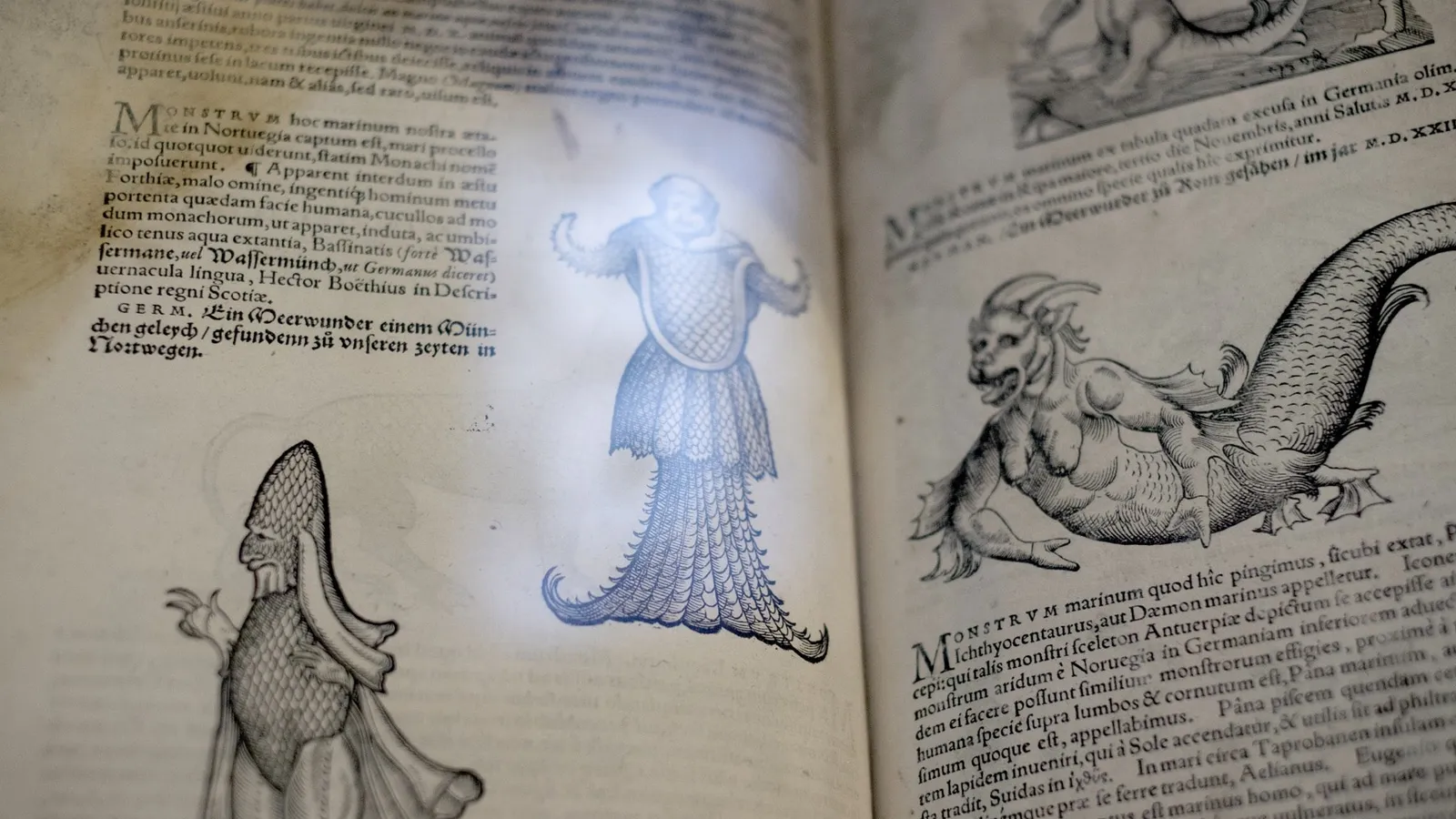
Alongside accurate animals, the book included fictional ones such as the unicorn and the basilisk, though Gessner said so when he doubted a report or a picture (Wikipedia). The fish volume also pictures sea creatures such as the sea monk and the sea bishop (Wikipedia)). Of the 25 mythical creatures he described, he cast doubt on 21 but accepted the unicorn; his own specimen "unicorn horn" was later identified as a narwhal tooth (University of Zurich).
Historian Sachiko Kusukawa explains why in a 2010 paper in *Annals of Science*. Gessner tried to collect everything ever written about animals, so he kept contradictory or false descriptions as part of the record, and he included several pictures of the same animal, false or badly drawn ones among them (Kusukawa 2010, PubMed abstract; DOI).
Because Gessner was a Protestant, he was placed on the Vatican's list of banned books, and in the University of Toronto's copy of the bird volume every instance of his name is struck through (CRRS, University of Toronto).
Why is it called an early step in zoology?
Three things moved the subject forward. The layout turned a pile of stories into a work you could consult. The woodcuts let readers check what an animal looked like. And the method: the University of Zurich summarises Gessner's view that a scholar should gather all texts and drawings, then "observe, dissect, describe, and illustrate the animals himself" (University of Zurich).
What it lacked was a system based on how animals are related. That came later, with naturalists such as Carl Linnaeus and his two-part scientific names, who named the tulip species *Tulipa gesneriana* after Gessner in 1753 (Wikipedia). Careful drawing from life also shaped the work of Maria Sibylla Merian on insect metamorphosis.
How can you use Gessner's method to study animals today?
Borrow his best idea, the same fixed slots for every organism. Here is an eight-slot card for any animal in your syllabus:
Name: common name and scientific name, written correctly.
Classification: phylum and class, and the feature that puts it there.
Body plan: symmetry, body cavity, segmentation.
Habitat: where it lives and one adaptation to that place.
Feeding and digestion.
Breathing and circulation.
Reproduction and development.
One labelled diagram, drawn from memory, then checked against your textbook.
How to use it:
Make cards for two animals in one chapter, say an earthworm and a cockroach.
Fill in the same slot for both from memory.
Compare slot by slot and mark gaps in red for revision.
Write "not sure" rather than guessing, as Gessner flagged doubtful reports.
If a slot such as "body cavity" keeps going blank, the idea behind it may be the problem. The Fermi Concept Library has a lesson for every concept in biology, each with its place in the map, so you can fix that one idea and return to the card. For the terms behind the classification slot, see our explainer on taxonomy, systematics and classification.


