

On this page
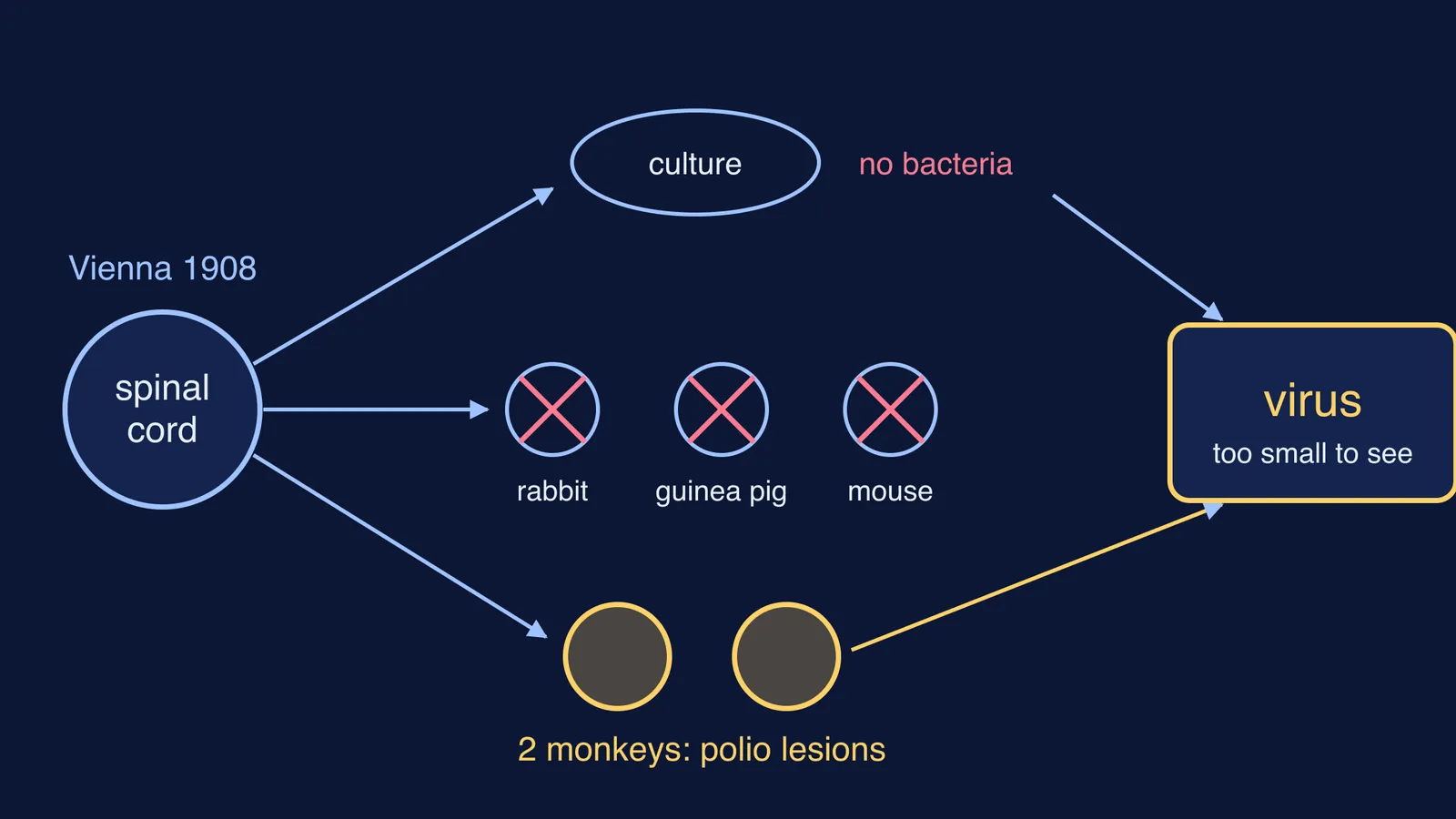
On 18 December 1908, Karl Landsteiner stood up at the Society of Physicians in Vienna and reported that he had given polio to monkeys, according to a history from the American Association of Immunologists. He had done the work with Erwin Popper. No bacteria could be grown from the material they injected, which pointed to a cause that could not be seen or cultured like a microbe. That cause is what we now call poliovirus.
Who were Karl Landsteiner and Erwin Popper?
Landsteiner was born on 14 June 1868 near Vienna and later won the 1930 Nobel Prize for his work on human blood groups (Wikipedia summary of his life). If you know his name from biology class, it is probably from how Landsteiner discovered the ABO blood groups.
Erwin Popper (1879-1955) was the physician who worked with him on polio; the History of Vaccines polio timeline credits the two of them together with announcing that the infectious agent in polio was a virus.
How did Landsteiner and Popper prove polio was caused by a virus?
The clearest account is Hans Eggers' review Milestones in early poliomyelitis research, published in the Journal of Virology in 1999. The steps went like this:
A 9-year-old boy died of severe polio after four days of illness; Eggers dates his death to 18 November 1908.
Bacterial cultures of his spinal cord grew nothing. The material was bacteriologically sterile.
A suspension of the spinal cord was injected into rabbits, guinea pigs and mice. None became ill.
The same suspension was injected into the abdomen of two Old World monkeys, a hamadryas baboon (then called Cynocephalus) and a rhesus macaque.
Both monkeys showed lesions in the spinal cord and brain stem that Eggers describes as indistinguishable from human polio. The rhesus monkey developed complete flaccid paralysis of both legs.
Virologist Vincent Racaniello's centenary post on the isolation of poliovirus adds that the baboon died after eight days. The full paper appeared in 1909 in the Zeitschrift für Immunitätsforschung, as cited by Eggers.
The logic is elimination: nothing grew in culture, yet the disease clearly transferred.
Did they filter the virus in 1908?
Here popular accounts and the detailed history differ. The History of Vaccines timeline says the pair filtered the material before injecting monkeys. Eggers' review describes the 1908 material as bacteriologically sterile and does not mention a filter. It also notes that Landsteiner and Popper could not pass the agent from one monkey to the next.
The filter step is documented in 1909. Simon Flexner and Paul Lewis in New York reported that the polio agent "can be passed through a Berkefeld filter" and withstands pure glycerine for at least a week (Flexner and Lewis, 1909). They also passed it from monkey to monkey, with incubation periods of four to thirty-three days. Eggers notes that several groups, Flexner and Lewis among them, achieved this passage independently in 1909.
The same idea had already been used for a plant disease, which you can read about in how Ivanovsky and Beijerinck discovered viruses.
Why did a monkey experiment matter for polio vaccines?
Once polio could be given to monkeys, it could be studied, and that road led to vaccines. In 1955, Thomas Francis Jr. and Jonas Salk announced that the inactivated vaccine was 80-90% effective against paralytic polio (History of Vaccines). The rest of that story is in how Salk and Sabin's two vaccines beat polio.
The WHO polio fact sheet says wild poliovirus cases have fallen by over 99% since 1988, from an estimated 350,000 cases in more than 125 endemic countries then to two endemic countries now, Afghanistan and Pakistan. India's region, WHO South-East Asia, was certified polio-free on 27 March 2014.
How can you use Landsteiner's reasoning in a biology answer?
When a question asks how scientists knew a disease was caused by a virus, use this four-check frame.
Can you see it? No. Racaniello recounts that the pair suggested polio might be caused by an "invisible virus".
Does it grow on its own? Bacterial cultures of the spinal cord stayed sterile.
Does it pass a bacteria-proof filter? Yes, shown by Flexner and Lewis in 1909.
Does it still cause disease in a host? Yes, in monkeys, though not in rabbits, guinea pigs or mice.
A short answer you could write: "Spinal cord from a polio patient contained no culturable bacteria, yet it produced polio in monkeys. Filtered material later did the same, so the agent was smaller than a bacterium: a virus." Each sentence is tied to one piece of evidence. Avoid writing that Landsteiner saw the virus: the case was built from what the agent did, not what it looked like.
If the difference between bacteria and viruses still feels blurry, the Fermi Concept Library gives every biology concept its own lesson and its place in the map, so you can see where viruses sit next to cells and microbes.
Next time you read about a discovery, try the four checks on it before you read how it ends.


