On this page
In March 2019 the Abel Prize in mathematics went to Karen Uhlenbeck, whose work changed how mathematicians understand shapes like soap films. Here is what she proved, why a soap film is serious mathematics, and an experiment you can do with two rings.
Who is Karen Uhlenbeck and why did she win the Abel Prize?
Karen Keskulla Uhlenbeck, of the University of Texas at Austin, won the 2019 Abel Prize "for her pioneering achievements in geometric partial differential equations, gauge theory and integrable systems, and for the fundamental impact of her work on analysis, geometry and mathematical physics", according to the Abel Prize press release. The same release is headed "first woman to win the Abel Prize" and gives the prize amount as NOK 6 million.
Hans Munthe-Kaas, chair of the Abel Committee, said in that release: "Her theories have revolutionized our understanding of minimal surfaces, such as those formed by soap bubbles, and more general minimization problems in higher dimensions."
The release also notes that her 1990 plenary lecture at the International Congress of Mathematicians made her only the second woman to give one, after Emmy Noether in 1932.
What is a minimal surface?
Dip a bent wire loop in soapy water and the film that forms pulls itself tight. Plus Magazine's explainer puts it simply: the soap film that forms within the frame has the smallest area possible. A minimal surface is a surface where, around any point, a small loop dipped in soapy water would give a film matching that bit of the surface, the same article explains.
In calculus language, minimal surfaces are critical points of area, notes the London Mathematical Society. That is setting a derivative to zero, except what you vary is a whole surface, not a number. The physics behind the tightening is the surface-tension force a soap film exerts on a wire frame.
What is bubbling in the Sacks–Uhlenbeck work?
In the 1970s Uhlenbeck met Jonathan Sacks and turned to minimal surfaces. In a 2018 interview with Allyn Jackson, quoted by Plus Magazine, she said: "I didn't know very much about minimal surfaces, but we talked about them and worked together. He brought the knowledge of the subject of minimal surfaces, and I brought the main idea [of the work]." Their paper, The Existence of Minimal Immersions of 2-Spheres, appeared in the Annals of Mathematics in 1981.
The hard part: you build a sequence of maps that minimise energy, hoping they settle on a best shape, but at some points they may not converge. Plus explains that there are at most finitely many such points, and rescaling small regions around each one reveals what you might call a "bubble". The failure itself has a shape you can describe.
Uhlenbeck also became interested in gauge theory, inspired by Sir Michael Atiyah, says the Abel press release, which calls gauge theory the mathematical language of theoretical physics. Our explainer on Yang-Mills gauge theory covers the physics side.
How far apart can two rings hold a soap film?
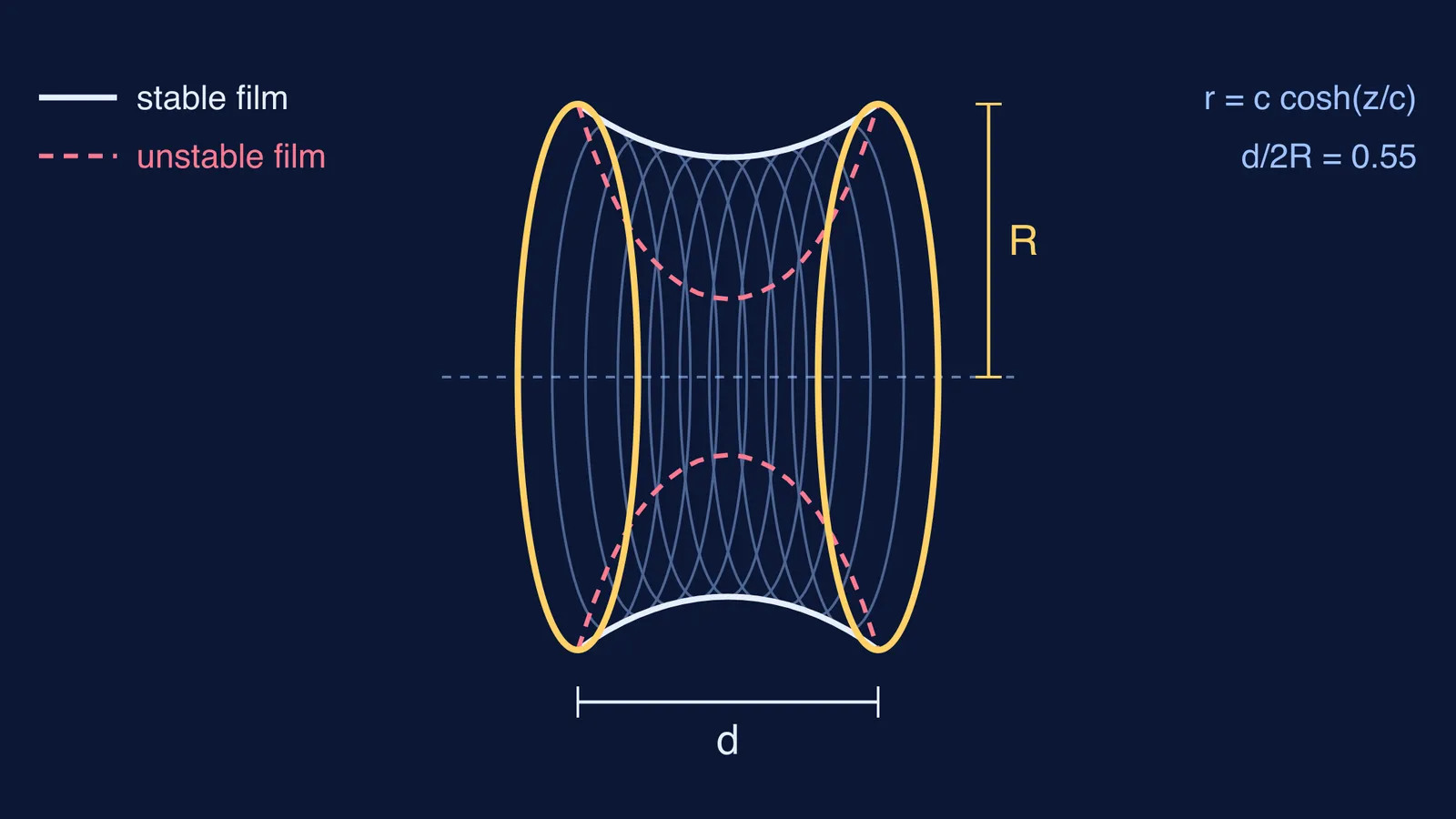
Dip two equal rings together and pull them apart: the film between them forms a waisted tube called a catenoid. Wolfram MathWorld defines the catenoid as the surface you get by spinning a catenary, the hanging-chain curve, about an axis, and notes that the catenoid and the plane are the only minimal surfaces of revolution. (For how a catenary differs from a parabola, see our hanging-chain comparison.)
The film cannot stretch forever. According to Ken Brakke's Surface Evolver notes, when the separation-to-diameter ratio is under 0.66274 there are two catenoids, a thick-necked stable one and a thin-necked unstable one; above that ratio there are none. The hero image shows both at a ratio of 0.55.
Worked example, with two rings 6 cm across (bend them from wire, or use a pair of bangles):
Predict: maximum gap = 0.66274 × 6 cm, which is about 4.0 cm.
Dip both rings in a mix of water and washing-up liquid, touching face to face.
Pull them apart slowly along a ruler, keeping them parallel.
Watch the waist narrow. Note the gap when the film snaps into two flat discs, one in each ring.
Compare with 4.0 cm. Real films can break early as they drain and dry, so repeat three times and take the largest gap.
If cosh and the hanging-chain curve are new to you, the Fermi Concept Library gives every concept in mathematics its own lesson, so you can fill that gap first. For shapes that are easier to see than to read, the Fermi Simulation Lab has interactive simulations.
What can students take from Uhlenbeck's story?
Collaboration counts: by her own account, Sacks knew the subject and she brought the main idea.
A method that breaks at a few points is not a dead end. Looking closely at where it breaks is how bubbling was found.
Everyday objects hold deep questions: a soap film and two rings lead to prize-winning mathematics.
Try the two-ring test this week and see whether your gap lands near 4 cm.