

On this page
In June 1892, two children were murdered in the Argentine town of Necochea. The police suspected a man who lived nearby. A single bloody fingerprint pointed to someone else, and it could be checked because Juan Vucetich had spent the year before building a way to file and compare fingerprints. Here is how his system worked, and how to try it on your own hands.
Who was Juan Vucetich?
Vucetich was born on 20 July 1858 on the island of Hvar, in today's Croatia, and moved to Argentina in 1884, according to his Wikipedia biography. He joined the identification office of the Buenos Aires provincial police and set up Argentina's fingerprint files in 1891, as JSTOR Daily records. He built on the ideas of Francis Galton; see our post on how Galton showed that fingerprints are unique.
Vucetich thought of fingerprints as a way to identify individuals, and after the 1892 case he refined his method and named it "comparative dactyloscopy" (NLM).
What happened in the Rojas case in 1892?
On 29 June 1892, Francisca Rojas's two children, aged six and four, were killed in Necochea, as the Wikipedia account of the case sets out. Rojas had cut her own throat and blamed a neighbour, Pedro Ramón Velázquez. According to the US National Library of Medicine, suspicion fell on Velázquez, but the police could not get a confession out of him.
Then Eduardo Álvarez, a policeman Vucetich had trained, found a bloody fingerprint on a door at the scene, JSTOR Daily reports. Rojas was fingerprinted, and the print matched hers, although she had denied touching the bloody bodies. Shown the evidence, she confessed: she had cut her own throat to cover up the crime.
The National Library of Medicine calls it "the first successful use of fingerprint identification in a murder investigation" (NLM).
How did the Vucetich fingerprint system work?
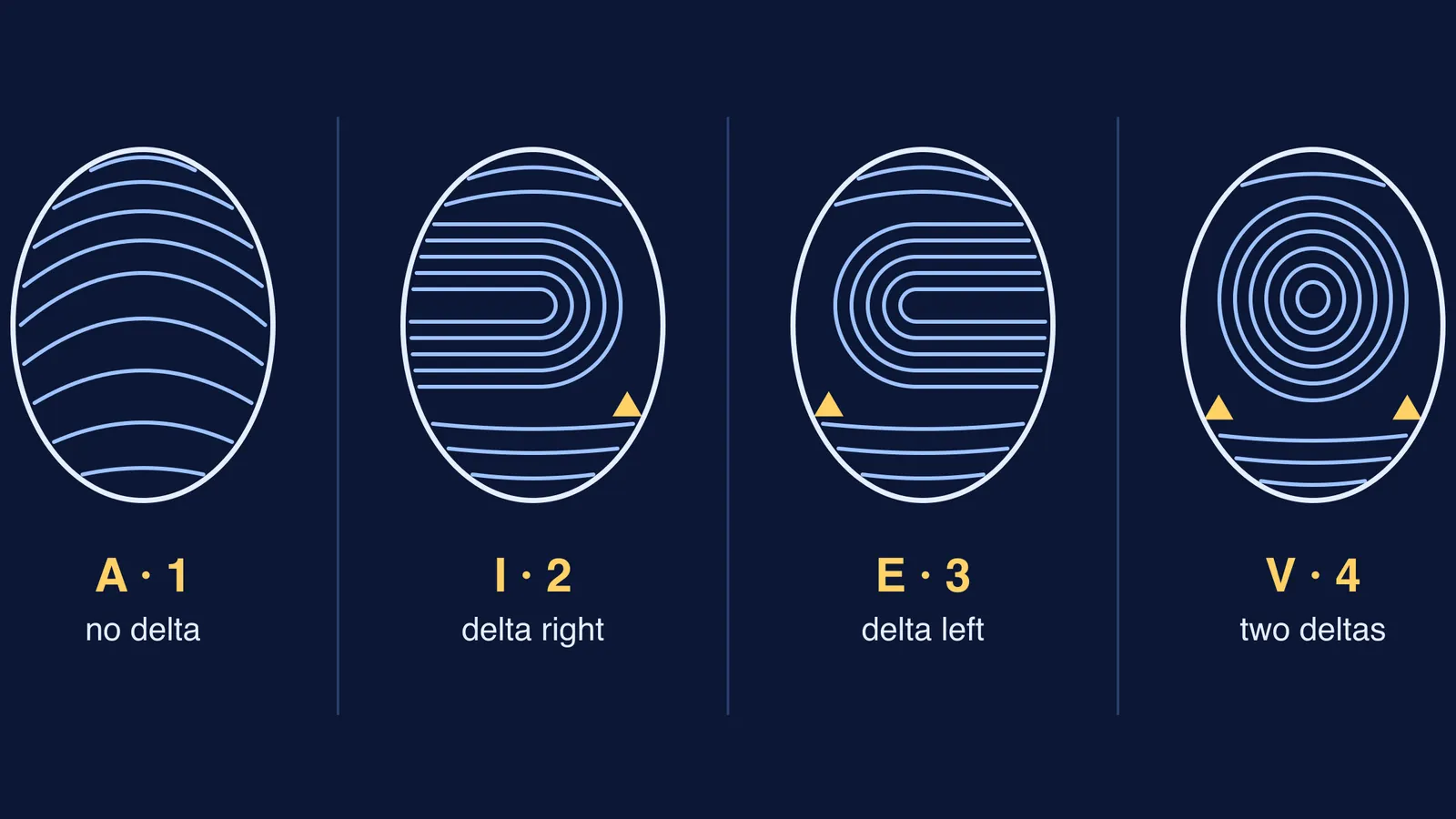
Vucetich sorted every fingerprint into four basic types: arch, internal loop, external loop and whorl (arco, presilla interna, presilla externa and verticilo), as Spanish-language manuals of the system describe (Derecho Ecuador). The key to telling them apart is the delta, a small triangle where ridges flowing in different directions meet.
Arch: no delta. Ridges enter on one side, rise in the middle and leave on the other.
Internal loop: one delta, on the observer's right.
External loop: one delta, on the observer's left.
Whorl: two or more deltas, with ridges circling a centre.
The filing code is short. A thumb is written as a letter (A, I, E or V) and each of the other four fingers as a number (1, 2, 3 or 4), and the formula puts the right hand above the left, like a fraction (Derecho Ecuador).
How do you write a Vucetich formula?
Say your right hand reads: thumb whorl, index arch, middle external loop, ring whorl, little external loop. That is V 1343. Your left hand reads: thumb internal loop, then internal loop, internal loop, whorl, internal loop. That is I 2242. Your formula is V 1343 over I 2242 (Derecho Ecuador).
How many formulas are possible? Each finger has 4 choices, so one hand has 4 × 4 × 4 × 4 × 4 = 1,024 and two hands have 1,024 × 1,024 = 1,048,576. That is enough to split a huge collection into small drawers. It does not prove identity, because two people can share a formula, so the final match still means comparing fine ridge details. If counting problems like this one trip you up, the Fermi Problem Library has worked problems with a step-by-step solver that explains the reasoning rather than printing an answer.
Can you classify your own fingerprints at home?
Yes. You need a soft pencil, clear tape and white paper.
Shade a dark patch of paper with the pencil and roll a fingertip across it.
Press clear tape onto the fingertip, peel it off, stick it on white paper and label the finger.
Repeat for all ten fingers.
On each print, count deltas: none is an arch, one on your right as you look is an internal loop, one on your left is an external loop, two or more is a whorl.
Write your formula, right hand over left.
Compare with a parent or sibling. Do you share a formula? Do your prints still differ in detail?
Our explainer on why every person's fingerprint is unique covers the biology behind those details.
Why does the Vucetich case still matter?
Buenos Aires province officially adopted Vucetich's "comparative dactyloscopy" in 1903, and it spread rapidly through the Spanish-speaking world (NLM). Vucetich published *Dactiloscopía comparada* in 1904 (Wikipedia). Argentina became the first country to drop body measurement (anthropometry) and file its criminal records by fingerprints alone (Wikipedia). By comparison, the United States had its first fingerprint-based conviction only in 1912 (JSTOR Daily).
A separate system was built in British India; our post on Azizul Haque, Hem Chandra Bose and the Henry fingerprint system tells that side of the story.
Try the tape method this week and see whether your formula matches anyone else's at home.


