

On this page
Before the 1890s, police forces relied on measuring body parts—head length, arm span, and foot size—to identify repeat offenders. This system, known as anthropometry, was slow and prone to human error. While others had noticed that fingerprints varied from person to person, it was the English polymath Francis Galton who provided the rigorous mathematics needed to turn them into a trusted tool for identification.
In his landmark 1892 book, *Finger Prints* 1, Galton established the first scientific footing for the study of fingerprints. He explored their heritability and estimated that the odds of finding two identical prints are infinitesimally small. His rigorous statistical analysis assisted the acceptance of fingerprint evidence by the courts and laid the foundation for modern forensic science and biometric security.
How did Galton prove fingerprints stay the same?
To be useful for identification, a physical trait must be permanent. Galton gathered sets of fingerprints taken from the same individuals over several decades. He observed that while the hands grew larger from childhood to adulthood, the specific arrangement of ridges, endings, and bifurcations (splits) remained constant.
He confirmed that these tiny details—now known in forensics as minutiae—persist unchanged until the body breaks down after death. Modern biological science shows that these unique friction ridge features actually begin to develop in the fetus around the 15th week of fetal development 2. This absolute permanence made fingerprints a far more reliable marker than body measurements, which naturally change with age, diet, and weight.
What is the Galton fingerprint classification system?
Having proved that prints stay the same, Galton needed a way to organize them so police could search through thousands of records without computers. He developed a systematic method to categorize fingerprints based on their general shape.
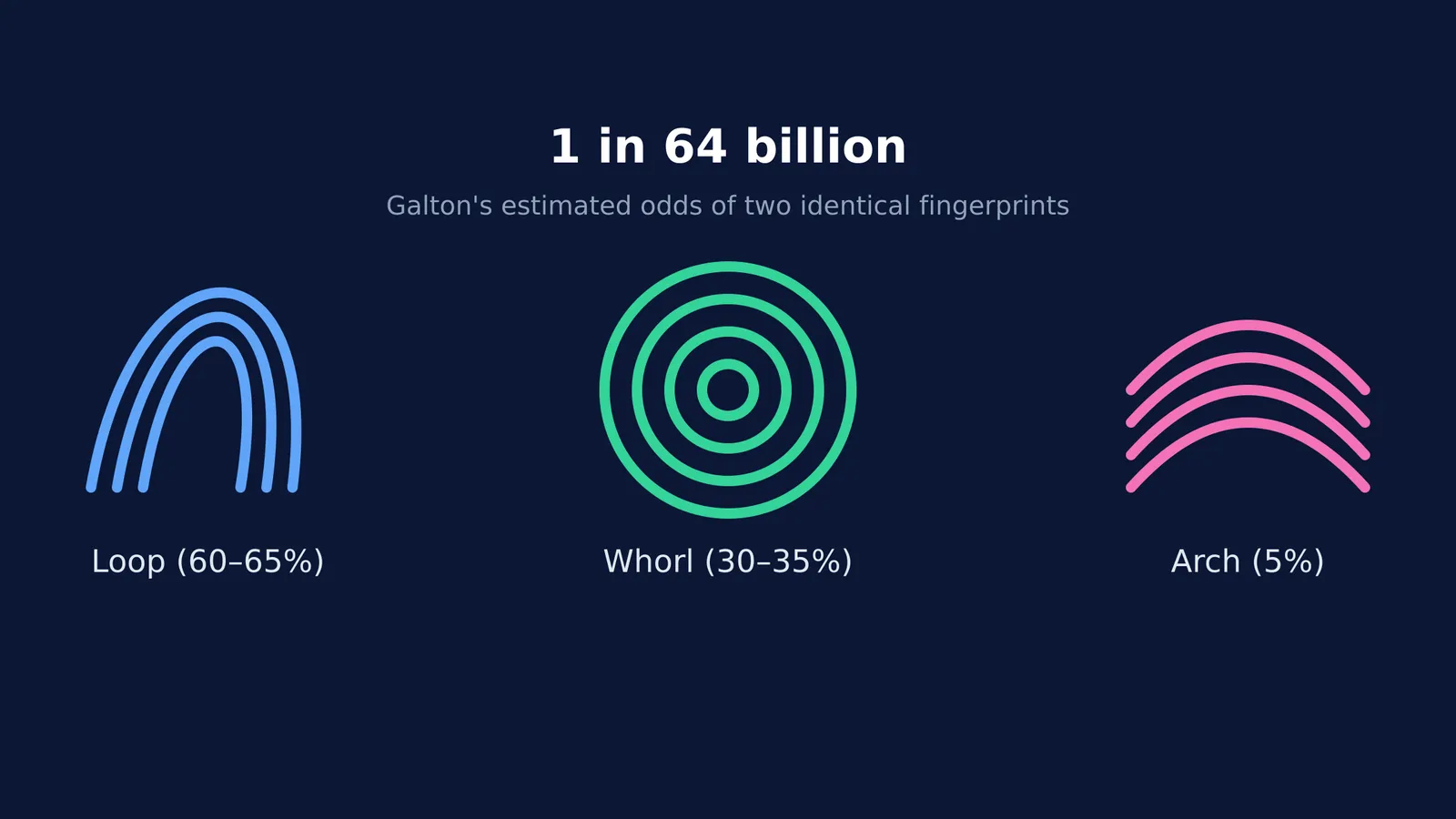
He identified eight broad categories of fingerprints: plain arch, tented arch, simple loop, central pocket loop, double loop, lateral pocket loop, plain whorl, and accidental 3. These eight classifications laid the groundwork for the modern forensic systems used today, which generally group all fingerprints into three main patterns 4:
Loops: Ridges enter from one side, curve back, and exit on the same side. They constitute 60 to 65% of all fingerprints.
Whorls: Ridges form circular or spiral patterns, making up 30 to 35% of all fingerprints.
Arches: Ridges enter from one side and exit the other, found in roughly 5% of all fingerprints.
By labeling each of a person's ten fingers with its specific pattern type, Galton created a unique formula for filing and retrieving records, which eventually evolved into the classification systems used by law enforcement worldwide.
How did Galton calculate the odds of a match?
Galton was the first to apply statistical probability to fingerprints. He estimated that the odds of two different individuals having the exact same fingerprint were 1 in 64 billion 5.
At the time he published his findings in the late nineteenth century, the global population was roughly 1.5 billion 6. Since 64 billion was vastly larger than the number of fingers on Earth, Galton's estimate effectively demonstrated that fingerprints are mathematically unique to every individual.
Probability and combinatorics can be tricky to apply to real-world scenarios. If you are struggling to set up equations for probability questions, the Fermi Problem Library holds worked problems with a step-by-step solver that explains the reasoning rather than printing an answer.
Today, we know that Galton's calculation was a simplified model. Modern statisticians often cite the "Birthday Paradox" to show that coincidental matches in a massive database are more likely than his initial formula suggests. However, his core assertion—that the sheer mathematical complexity of ridge patterns makes them unique—still stands as a pillar of modern identification.
Just as Galton used patterns to identify people, geneticists later learned to read the patterns in DNA. You can read more about how Alec Jeffreys and the first genetic fingerprint brought a similar leap to modern forensics, or explore the mathematics of probability with Andrey Markov and the chains that link random events. Understanding how foundational traits are inherited requires clear biological knowledge; the Fermi Concept Library contains every concept in physics, chemistry, biology, mathematics and computing, each with its own lesson and its place in the map.


