

On this page
The Henry Classification System is an innovative method that sorts human fingerprints into 1,024 primary groups based entirely on whorl patterns. For decades, the world used various physical measurements—such as head length, arm span, and foot size—to identify repeat criminal offenders. This early anthropometric system, known widely as Bertillonage, was notoriously slow and prone to measurement errors. Fingerprints were already known to be biologically unique to every individual, but there was a fatal flaw in using them practically: without modern computers, how do you quickly search a massive database of millions of printed records to find an exact match?
In 1897, the definitive answer came from the Calcutta Anthropometric Bureau. Under the direction of Sir Edward Henry, two Indian sub-inspectors, Qazi Azizul Haque and Hem Chandra Bose, were tasked with solving the fingerprint sorting problem. What they created became the global standard for criminal identification for nearly a century.
How did Azizul Haque sort millions of fingerprints?
Haque recognised that to effectively search a large database, you need to group the records systematically. He noticed that fingerprint patterns generally fell into clear categories: loops, arches, and whorls. By focusing only on the presence of whorls, he designed a mathematical formula that functioned much like a binary code—a strictly logical approach echoing the mathematical foundations laid decades earlier by George Boole and the Laws of Thought of 1854.
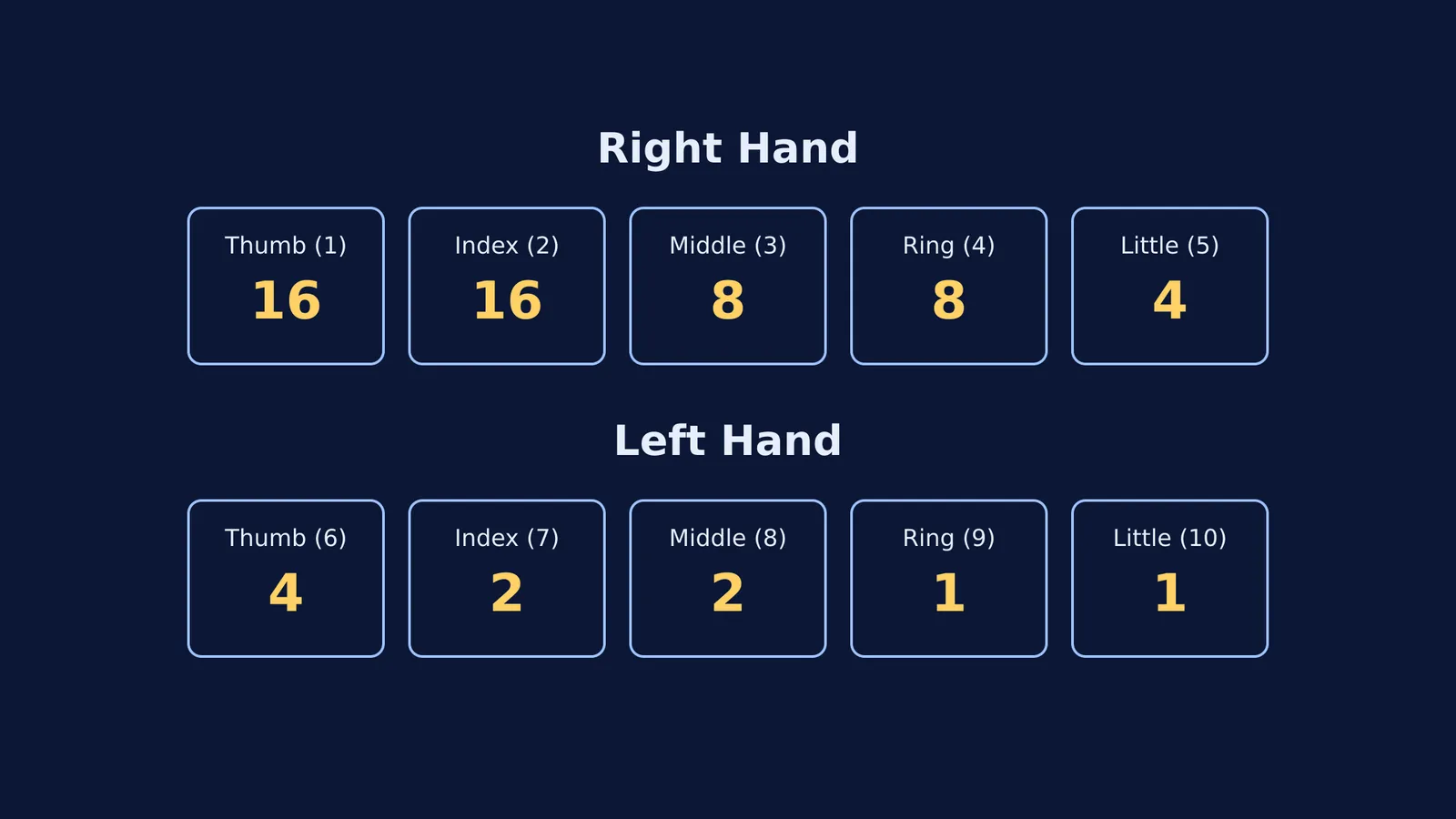
Haque assigned a specific numerical weight to each of a person's ten fingers, but only if that particular finger had a whorl pattern. If the finger had a loop or an arch, its assigned value was simply zero, a standard outlined in the Henry Classification System.
The weights decreased in pairs, creating a beautifully elegant system:
Fingers 1 and 2 (Right thumb and index): 16
Fingers 3 and 4 (Right middle and ring): 8
Fingers 5 and 6 (Right pinky and left thumb): 4
Fingers 7 and 8 (Left index and middle): 2
Fingers 9 and 10 (Left ring and pinky): 1
To find a person's classification, Haque created a fraction. The numerator was the sum of the values from the even-numbered fingers, plus one. The denominator was the sum of the values from the odd-numbered fingers, plus one.
Why are there exactly 1,024 classification groups?
Because the maximum sum for both the numerator and denominator is 31 (16 + 8 + 4 + 2 + 1), adding the constant 1 gives a range from 1 to 32. With 32 possible numerators and 32 possible denominators, there are exactly 1,024 primary groups (32 × 32 = 1,024), as detailed in the Henry Classification System.
Instead of searching millions of records, a clerk only had to look inside one of 1,024 specific "pigeon holes" to find a suspect's print. Much like the later invention of the genetic fingerprint by Alec Jeffreys, the breakthrough was not just seeing the pattern, but making it searchable. This kind of systematic thinking is how Fermi's AI tutor builds a plan for a session—it works out what a student knows and teaches through the steps.
Who actually invented the Henry Classification System?
While the system was named after Sir Edward Henry, the mathematical heavy lifting was performed by Haque, as reported by The Quint. Hem Chandra Bose focused on the telegraphic code and the intricate sub-classification of loops and arches, which helped narrow down searches even further within Haque's 1,024 groups.
For years, Henry took sole credit for the invention. It was only much later that the British government formally acknowledged the vital contributions of Haque and Bose, awarding them honorariums and the respective titles of Khan Bahadur and Rai Bahadur. Their brilliance turned a biological curiosity into a mathematical system that transformed forensic science.
Whether you are designing a database or trying to solve a tricky algebra question, mathematical logic remains a timeless tool. You can practice with worked problems and a step-by-step solver that explains the reasoning in the Fermi Problem Library.


