On this page
Every time you write v_rms = √(3RT/M) in a kinetic theory answer, you are building on an idea that a Scottish engineer working in Bombay tried to publish in 1845. The Royal Society turned him down, and his paper sat unnoticed in its archives until after his death. Here is what happened, and how to use his idea today.
Who was John Waterston?
John James Waterston was born in Edinburgh in 1811 and died near Edinburgh on 18 June 1883, according to historian Stephen Brush's Dictionary of Scientific Biography entry. A trained civil engineer, in 1839 he took a post teaching navigation and gunnery to the East India Company's cadets in Bombay, with time to read at the Grant College there.
From India he sent home a short book, published anonymously in 1843, which already said that elastic atoms striking each other exert a pressure "proportional to the square of this velocity and to this density" (Brush, DSB).
Why did the Royal Society reject Waterston's kinetic theory paper?
In December 1845 Waterston presented his full paper, "On the Physics of Media That Are Composed of Free and Perfectly Elastic Molecules in a State of Motion" (Brush, DSB). It was read before the Society in March 1846, and both referees advised against publishing it (Royal Society's own blog). Oxford geometry professor Baden Powell called the basic principle "very difficult to admit, and by no means a satisfactory basis for a mathematical theory." The astronomer Sir John William Lubbock wrote: "The paper is nothing but nonsense, unfit even for reading before the Society."
Only a brief abstract was printed in 1846. Waterston had kept no copy and could not get his manuscript back. The same Royal Society blog says the full paper stayed unpublished for 47 years.
How was Waterston's paper found again?
In 1891, eight years after Waterston's death, Lord Rayleigh, then secretary of the Royal Society, followed a reference to the manuscript and retrieved it (Brush, DSB). It appeared in Philosophical Transactions in 1892 with Rayleigh's introduction, which says the paper, "though always accessible in the Archives of the Royal Society, has remained absolutely unnoticed."
Rayleigh wrote that the memoir "marks an immense advance in the direction of the now generally received theory" and that the failure to publish it "probably retarded the development of the subject by ten or fifteen years" (MacTutor). Waterston never knew: in 1883 he went for a walk by the water near Edinburgh and was never seen again (MacTutor biography).
What is rms speed, and what did Waterston get right?
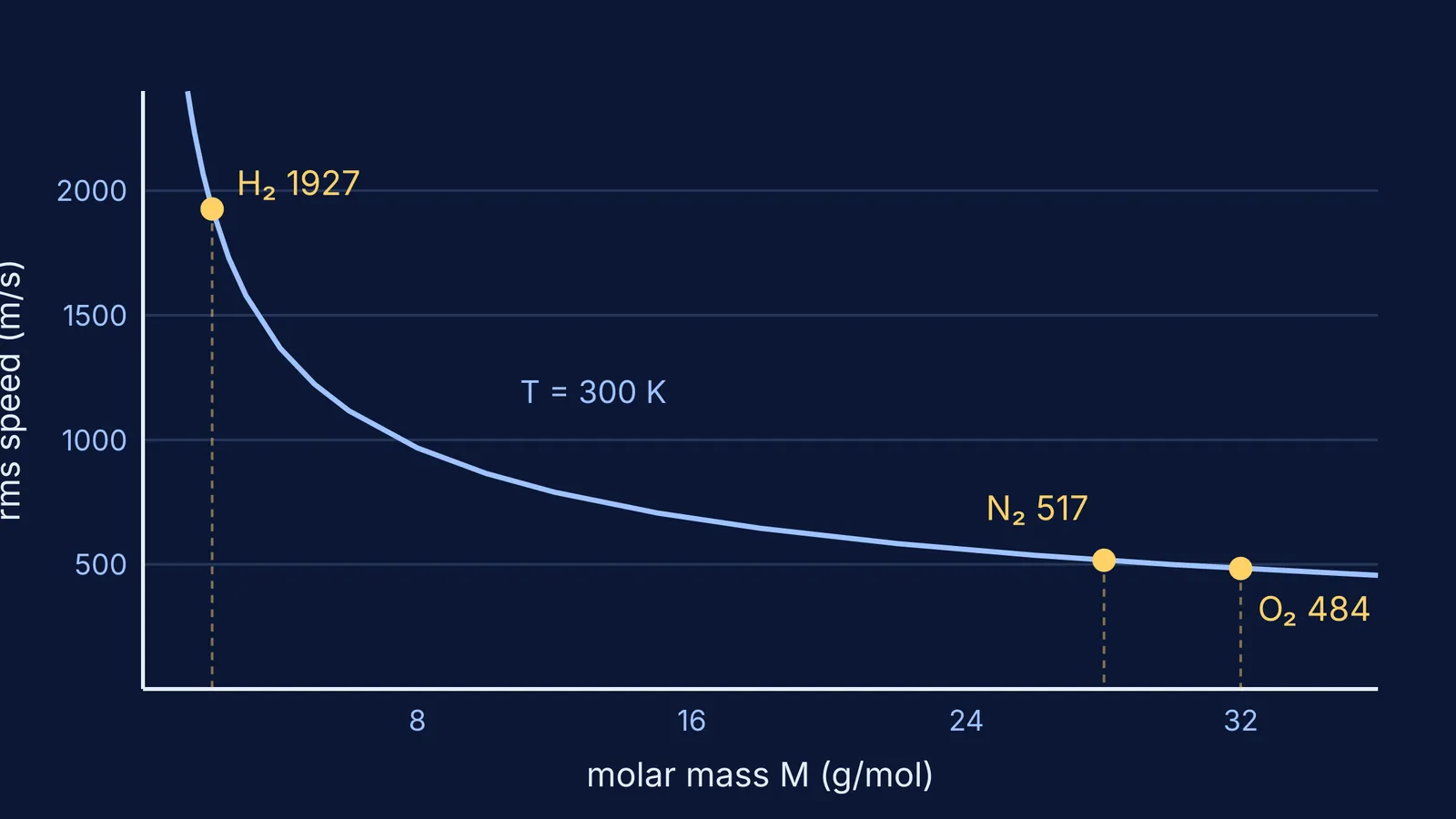
The root mean square (rms) speed is the square root of the average of the squared molecular speeds, and for an ideal gas it equals √(3RT/M), where M is the molar mass (HyperPhysics).
Waterston's sharpest result was this: "in mixed media the mean square molecular velocity is inversely proportional to the specific weight of the molecules" (Brush, DSB). So at one temperature every kind of molecule has the same average translational kinetic energy, which Brush calls the first statement of the equipartition theorem.
Worked example: hydrogen and oxygen in the same room
Use R = 8.314 J mol⁻¹ K⁻¹ (NIST) and atomic weights of about 1.008 for hydrogen and 16.00 for oxygen (CIAAW), so M(H₂) ≈ 2.016 g/mol and M(O₂) ≈ 32.00 g/mol.
Convert to SI: M(O₂) = 0.03200 kg/mol, T = 300 K.
Oxygen: v_rms = √(3 × 8.314 × 300 ÷ 0.03200) ≈ 484 m/s. Nitrogen (about 28.01 g/mol) gives about 517 m/s the same way.
Hydrogen: v_rms = √(3 × 8.314 × 300 ÷ 0.002016) ≈ 1927 m/s.
Check with Waterston's rule: speed ratio = √(32.00 ÷ 2.016) ≈ 3.98, so hydrogen moves about four times faster.
What can you learn from Waterston's story?
Rayleigh's own lesson was that an unknown author should first win recognition with "work whose scope is limited, and whose value is easily judged" (Brush, DSB). For you, the lesson is to make your work easy to check. Before you hand in a kinetic theory answer:
Temperature is in kelvin, not °C.
Molar mass is in kg/mol, not g/mol.
You used rms speed, not average speed, if the question says rms.
Your answer passes a ratio check like step 4 above.
For more practice, see how rms speed behaves when pressure changes at constant temperature and how gas pressure comes from molecular collisions.
If molecules bouncing in a box are hard to picture, the Fermi Simulation Lab has interactive simulations for ideas that are easier to see than to read. If your numbers go wrong, the Fermi Problem Library has worked problems with a step-by-step solver that explains the reasoning rather than printing an answer.