

On this page
When you compress a gas in a cylinder without letting it heat up or cool down, the pressure gauge spikes. It is natural to imagine that the gas molecules are now zipping around faster, hitting the walls with more speed.
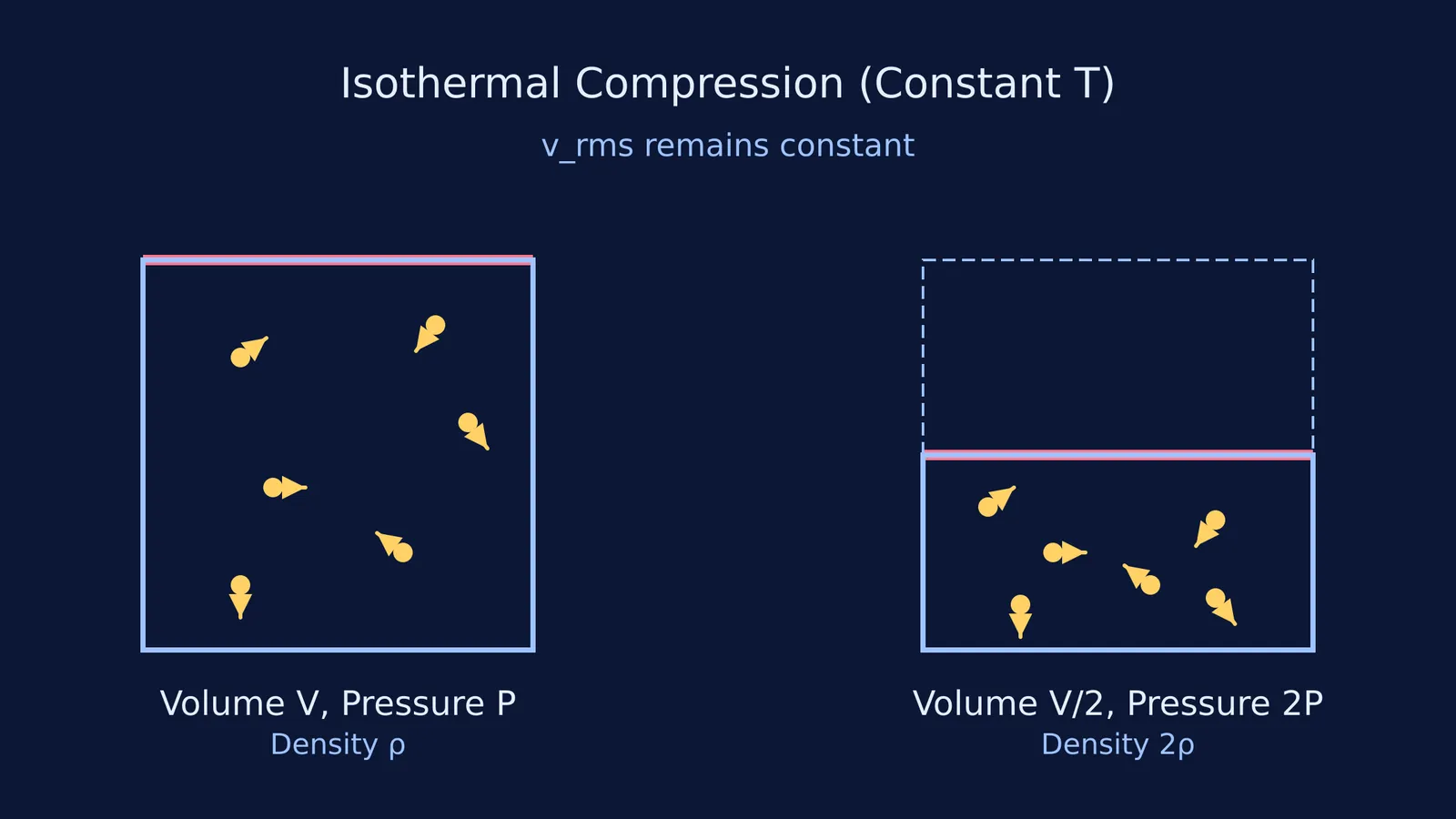
However, at a constant temperature, the root-mean-square (RMS) speed of an ideal gas does not change with pressure. Pushing the plunger in simply crowds the same molecules into a smaller space. They hit the walls more often, which raises the pressure, but they do not travel any faster.
Here is why molecular speed ignores pressure, and how to unpick the two formulas that usually cause confusion on exam day.
Does RMS speed depend on pressure?
The kinetic theory of gases links the macroscopic properties we can measure—like pressure and temperature—to the microscopic motion of molecules. According to the standard derivation in the kinetic theory of gases, the root-mean-square speed of an ideal gas is:
v_rms = √(3RT/M)
Where R is the universal gas constant (approximately 8.314 J/(mol·K)), T is the absolute temperature in Kelvin, and M is the molar mass of the gas.
Notice what is missing from this equation: pressure. For any specific gas, the molar mass is fixed. That means the RMS speed depends solely on the absolute temperature. If you hold the temperature constant, the average kinetic energy of the molecules is locked, and the speed cannot change.
Why does the pressure formula cause confusion?
The confusion arises because there is a second way to write the RMS speed equation, derived directly from the pressure of the gas:
v_rms = √(3P/ρ)
Where P is the pressure and ρ is the density of the gas.
Looking at this formula, it is tempting to conclude that increasing the pressure P must increase the RMS speed. But you cannot change the pressure of a fixed mass of gas at constant temperature without also changing its volume—and therefore its density.
According to Boyle's Law, at a constant temperature, the pressure of a fixed amount of gas is inversely proportional to its volume (P ∝ 1/V). If you halve the volume to double the pressure, you are packing the same mass of gas into half the space. This means the density ρ also doubles.
Because pressure and density increase by the exact same factor, the ratio P/ρ remains perfectly constant. The numerator and denominator cancel each other out, leaving the RMS speed exactly where it started.
A worked example: what happens to the ratio?
Imagine 1 mole of helium gas (M ≈ 0.004 kg/mol) at 300 K in a 20-litre container.
Initial state:
We calculate the speed using temperature: v_rms = √(3 × 8.314 × 300 / 0.004) ≈ 1368 m/s. The gas has a certain pressure P₁ and density ρ₁.
Final state:
You compress the gas to 10 litres, keeping it at 300 K. The volume has halved, so the density ρ₂ is now 2ρ₁. Because the temperature is constant, Boyle's Law tells us the pressure P₂ is now 2P₁. If we check our second formula: v_rms = √(3 × 2P₁ / 2ρ₁). The 2s cancel out. We are back to √(3P₁/ρ₁), and the speed is still approximately 1368 m/s.
When an exam question gives you a pressure change and asks for the new RMS speed, check the temperature first. If the process is isothermal (constant temperature), the answer is always a 1:1 ratio—the speed does not change. If keeping these conditions straight is a challenge and you have concept gaps, the Fermi Concept Library has every concept in physics, chemistry, biology, mathematics and computing, each with its own lesson and its place in the map.


