

On this page
When you inflate a tyre, it grows firm because invisible gas particles are constantly hammering against the rubber walls. Individually, these impacts are tiny, but together they create the steady macroscopic force we measure as gas pressure.
The kinetic theory of gases bridges this gap between the invisible microscopic world and the measurable macroscopic world. By tracking the momentum of single molecules, physicists derive a fundamental equation: P = 1/3 ρ v_rms².
Why does a gas exert pressure on container walls?
To understand the origin of pressure, imagine a gas trapped in a cubic box of length L. The gas consists of a vast number of identical molecules, each with mass m, moving randomly at high speeds.
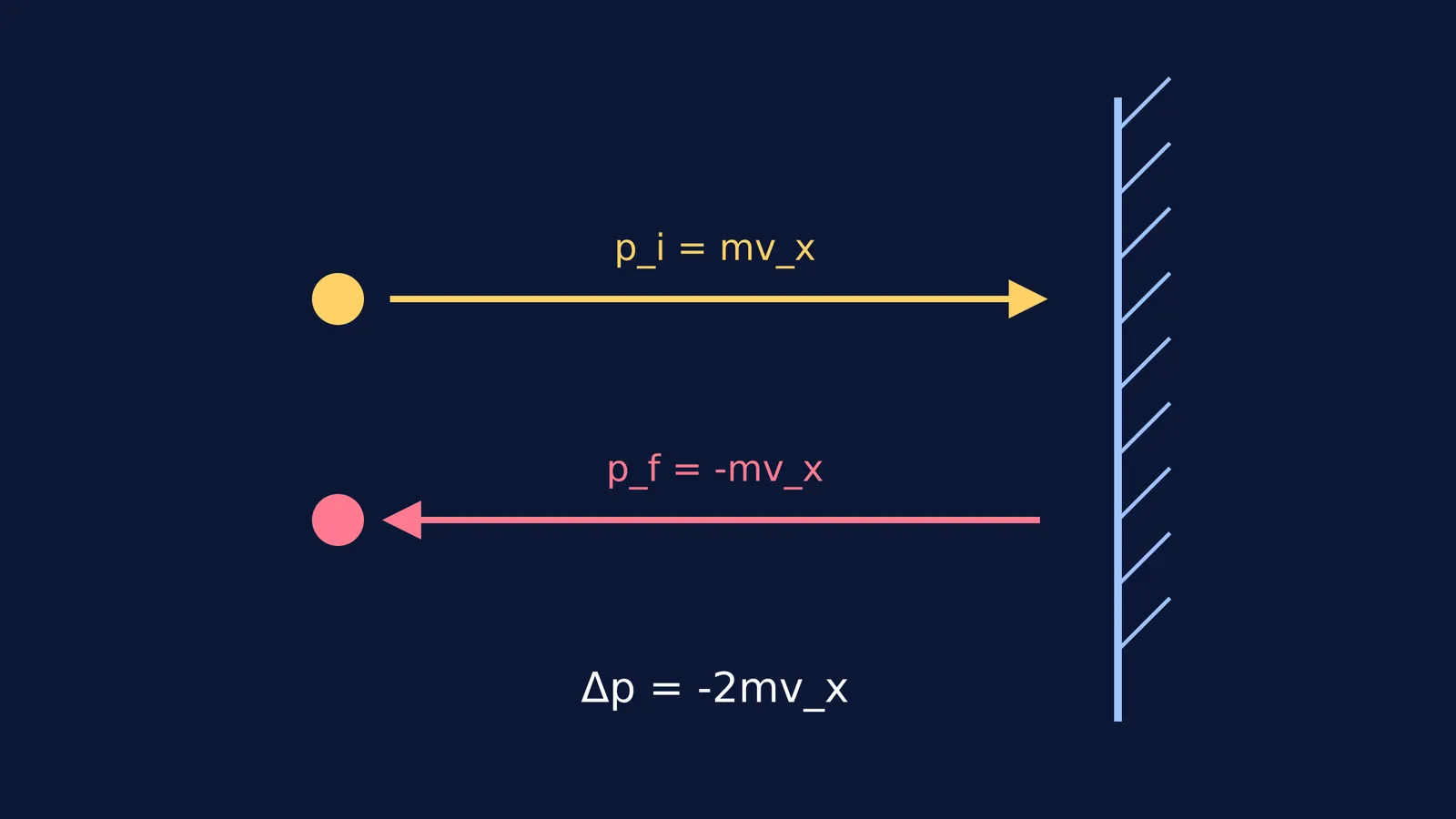
According to OpenStax University Physics, when a single molecule strikes a wall perpendicular to the x-axis, it undergoes a perfectly elastic collision. Its velocity in the x-direction reverses from +v_x to -v_x. The change in the molecule's momentum is -2mv_x. Consequently, the momentum transferred to the wall during this single hit is exactly 2mv_x.
How does momentum change become pressure?
A single hit transfers momentum, but pressure is a continuous force spread over an area. To find this continuous force, we look at the rate of collisions.
The time it takes for our molecule to cross the box, hit the opposite wall, and return is Δt = 2L/v_x. By Newton's second law, force is the rate of change of momentum (F = Δp/Δt). For one molecule, this average force is (2mv_x) / (2L/v_x), which simplifies to mv_x² / L.
To find the total pressure, we sum this force across all the molecules in the container and divide by the wall's area, L². Since the volume of the box is V = L³, the total pressure is (N × m / V) multiplied by the average of v_x².
Where does the one-third factor come from?
The term for the average of v_x² only accounts for motion along one axis. However, gas molecules move freely in three-dimensional space, and their motion is entirely random, or isotropic.
Because there is no preferred direction, the average speeds along the x, y, and z axes are identical. Therefore, the average squared velocity along just the x-axis is exactly one third of the overall average squared velocity (v_rms²). Substituting this into our pressure equation gives the fundamental result: P = 1/3 (N × m / V) v_rms².
Since the total mass of the gas is N × m, and density (ρ) is mass divided by volume, we arrive at our final formula: P = 1/3 ρ v_rms². This demonstrates how macroscopic gas density and microscopic particle speeds directly generate the physical pressure pushing against the walls of the container.
How is pressure linked to kinetic energy and temperature?
This derivation does not just explain pressure; it reveals what temperature actually is. If we multiply both sides of our pressure equation by volume (V), we get P V = 1/3 N m v_rms².
The ideal gas law tells us that P V = N k_B T, where k_B is the Boltzmann constant. Setting these two equations equal to each other shows that 1/3 m v_rms² = k_B T. By multiplying by 3/2, physicists find that the average translational kinetic energy (½ m v_rms²) equals 3/2 k_B T.
This shows what temperature means at a microscopic level. It means that the absolute temperature of a gas is a direct measure of the average kinetic energy of its molecules. When you heat a gas, you are making its molecules fly faster, causing harder and more frequent collisions with the walls. For instance, OpenStax University Physics calculates that for helium atoms to reach Earth's escape velocity of 11,100 m/s, the gas would need to be heated to 19,800 K.
How do you solve kinetic theory problems?
Let us see this in action. The speed of gas molecules is very fast. For example, according to OpenStax, a nitrogen molecule at a standard room temperature of 20 °C has a root-mean-square speed of 511 m/s. When approaching problems in the kinetic theory of gases, you can reach the solution by following these steps:
Identify the given variables: Note the pressure, volume, temperature, and type of gas provided in the question.
Choose the right constant: Use the Boltzmann constant (k_B) when working with single molecules, or the universal gas constant (R) when dealing with moles.
Convert to SI units: Ensure temperatures are strictly in Kelvin, masses are converted to kilograms, and velocities are in meters per second.
Apply the kinetic energy relation: Use the ½ m v_rms² = 3/2 k_B T equation to find the root-mean-square speeds from the given absolute temperature.
If you get stuck on exactly how velocity components sum up during these derivations, Fermi's AI tutor can work out what you already know and build a plan for the session. To explore how these equations fit into the broader physics landscape, the Fermi Concept Library contains every concept in physics, chemistry, biology, mathematics and computing, each with its own lesson and its place in the map.
Mastering this microscopic view makes it much easier to tackle macroscopic thermodynamics, such as converting PV, PT and VT graphs of ideal gas processes. If you want to practise applying the pressure formulas, the Fermi Problem Library has worked problems with a step-by-step solver that explains the reasoning rather than printing an answer. You can then move on to more advanced applications, like exploring the free expansion of an ideal gas: why work and ΔU are both zero.


