

On this page
In May 1783, the clergyman John Michell wrote to the scientist Henry Cavendish. The letter was read to the Royal Society of London on 27 November 1783 and printed in the Philosophical Transactions, volume 74 (1784). In it, Michell used nothing more than Newton's law of gravity to imagine a star whose light could never reach us. You already know his tool: escape speed, from the Class 11 chapter on gravitation. His real aim was to measure stars by how much their gravity slowed their light; the dark star came out along the way.
What did John Michell propose in 1783?
Michell started from one assumption, stated in his 1784 paper: that particles of light are attracted "in the same manner as all other bodies with which we are acquainted".
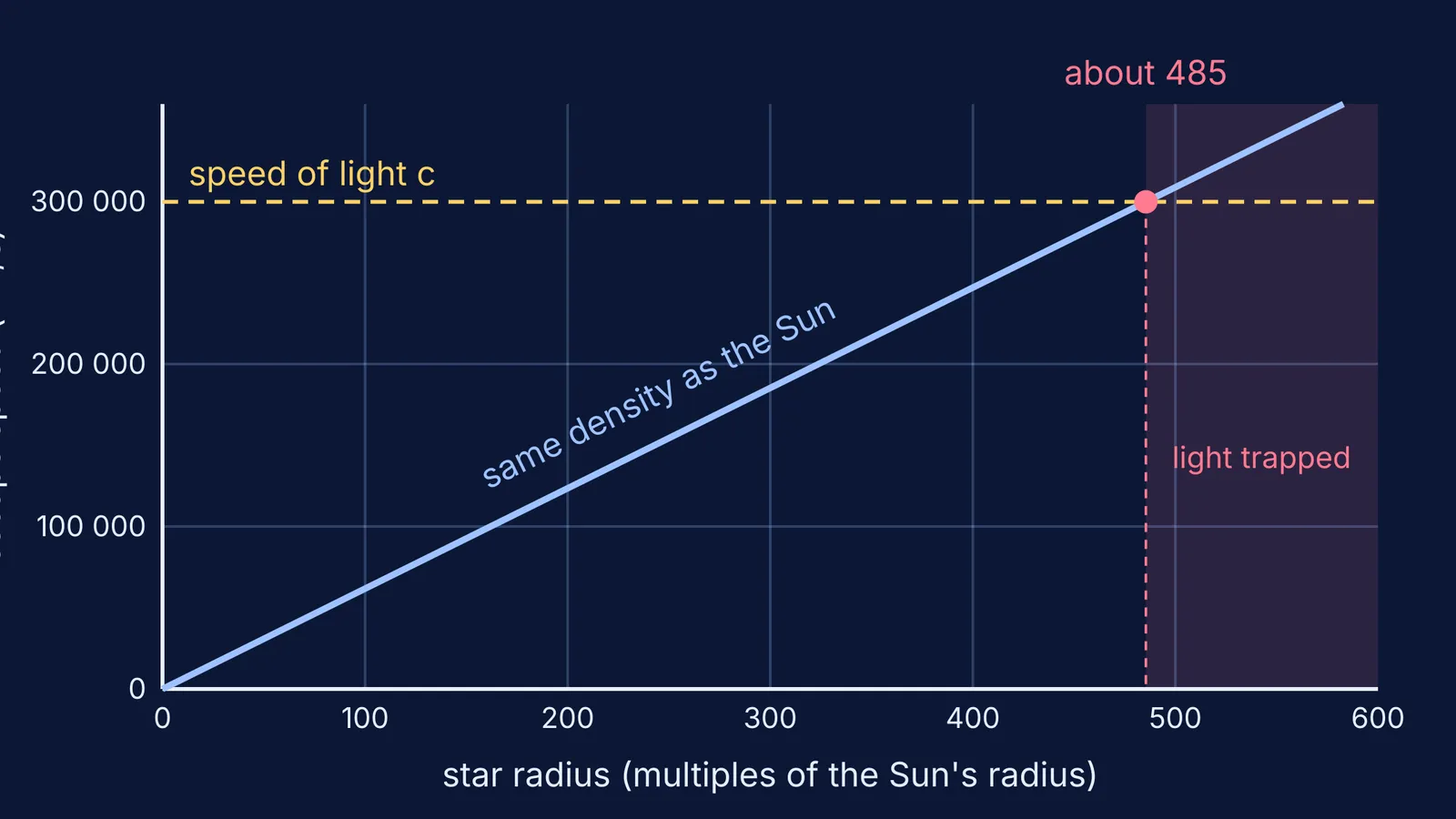
Then came the key passage. If a sphere had the same density as the Sun but a radius bigger "in the proportion of 500 to 1", Michell wrote, a body falling onto it from very far away would reach "a greater velocity than that of light". So, he concluded, "all light emitted from such a body would be made to return towards it, by its own proper gravity" (Michell, 1784).
He even saw how to find one. We could get "no information from sight" about it, he wrote, but "if any other luminous bodies should happen to revolve about them", we might infer the hidden central body from how those companions move.
How does escape velocity explain a dark star?
Your NCERT textbook defines escape speed as the minimum speed an object needs to reach infinity, and derives it from conservation of energy: v = √(2GM/R), which is about 11.2 km/s for Earth (NCERT Class 11 Physics, Chapter 7, section 7.8).
Michell described the same quantity in older language: the speed a body gains by "falling from an infinite height" onto a star. By energy conservation, that is the same as the speed needed to climb all the way out, and it does not matter which way you launch, as we explain in why escape velocity does not depend on the angle of projection.
If that speed exceeds the speed of light, light behaves like a ball thrown up too slowly: it rises, slows and falls back.
Can you redo Michell's calculation with Class 11 physics?
Yes, in five steps with today's numbers.
Keep the density ρ fixed. Then M = (4/3)πρR³, so v = √(2GM/R) becomes v = R√(8πGρ/3). Escape speed grows in direct proportion to the radius. Michell stated the same rule in article 10 of his paper, and you can practise it with a planet of double radius and the same density.
The Sun's escape speed is 617.6 km/s, according to the NASA Sun fact sheet.
The speed of light in vacuum is exactly 299,792,458 m/s, or about 299,792 km/s (NIST, CODATA 2022).
Divide: 299,792 ÷ 617.6 ≈ 485. A star with the Sun's density needs a radius about 485 times the Sun's for its escape speed to reach the speed of light.
Compare with Michell. He took light to be about 10,310 times faster than Earth in its orbit, and the Sun's escape speed to be 20.72 times Earth's orbital speed. His quotient was 497, "in round numbers", and his dark-star passage uses the round figure of 500 (Michell, 1784).
With 18th-century data, he was within about 2.5 percent of the modern answer.
Now reverse it. Keep the Sun's mass, 1.9884 × 10³⁰ kg (NASA), and shrink the radius until v = c. That gives R = 2GM/c². With G = 6.67 × 10⁻¹¹ N m²/kg² from NCERT, R comes out at about 2.95 km. One paper notes that this Newtonian radius is "exactly the same as the Schwarzschild radius" of general relativity, and adds that "this exact result is a coincidence" (Martínez-Merino, Obregón and Ryan, arXiv:1611.09654).
Was Michell's dark star a black hole?
Not quite. In Michell's picture, light slows down and falls back like a stone. Today's black holes come from a different theory, in which gravity bends spacetime itself; our post on how Einstein's general relativity showed gravity bends spacetime explains that shift.
What Michell got right was the habit: push a trusted law to an extreme and ask what you would see.
How can you use Michell's idea to study gravitation?
Close the book and try these:
Derive v = √(2GM/R) from energy conservation without looking.
Show that, at fixed density, doubling the radius doubles the escape speed.
Find the radius at which a body of the Sun's mass would trap light, and check it against the answer above.
Explain in one sentence why Michell's answer (497) differs from ours (485).
If the step from fixed density to v ∝ R feels slippery, the Fermi Problem Library has worked problems with a step-by-step solver that explains the reasoning rather than printing an answer. For the ideas that are easier to see than to read, try the interactive simulations in the Fermi Simulation Lab. Then reread Michell's 500-to-1 sentence and rebuild it yourself.


