

On this page
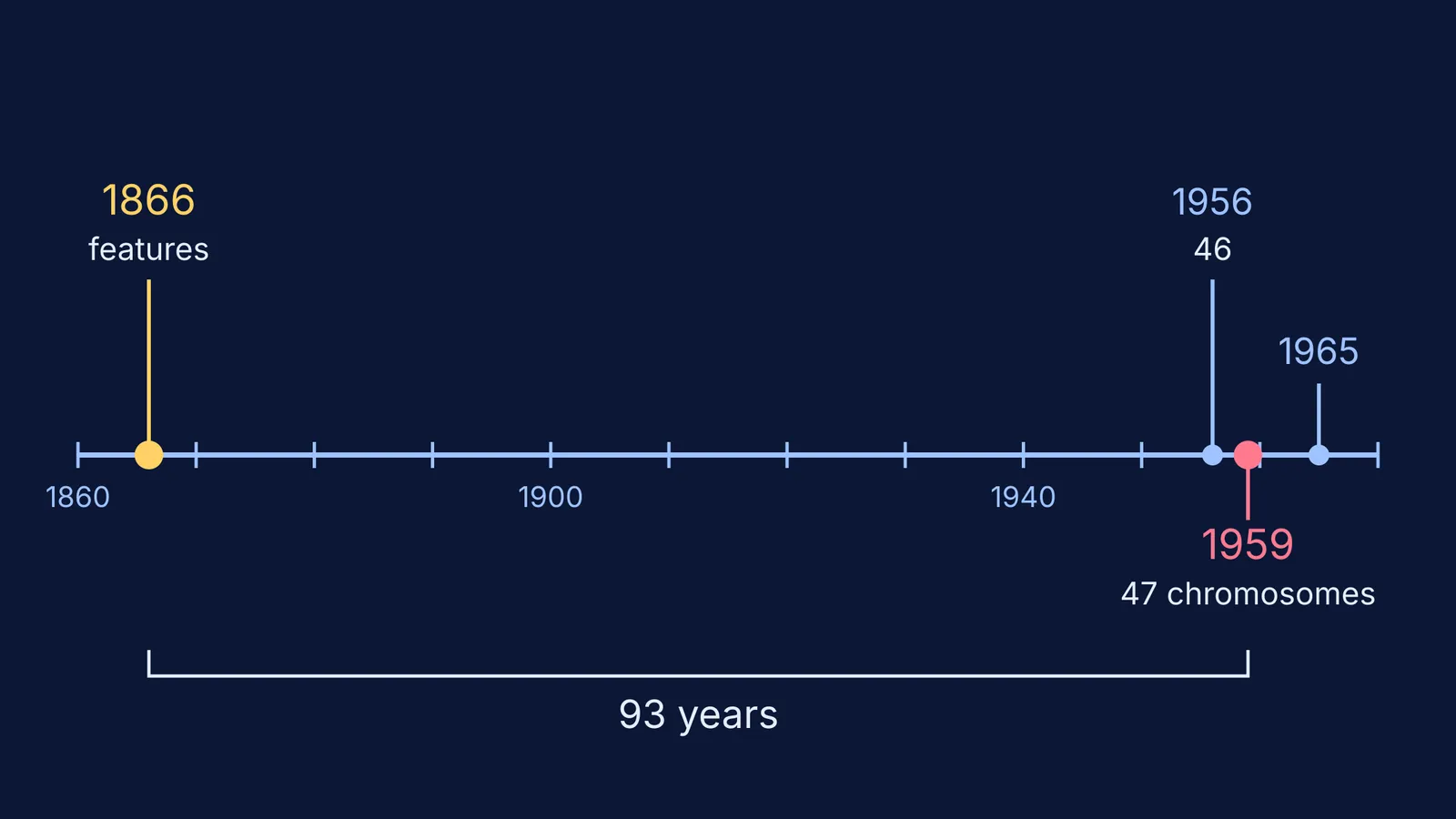
John Langdon Down looked closely at his patients and wrote down what he saw. That part of his 1866 paper still holds. His explanation of why did not, and it took 93 years and a new laboratory technique to find the real cause. The gap between the two is a good lesson in how science works.
What did John Langdon Down describe in 1866?
Down was medical superintendent of the Earlswood Asylum in England from 1858 to 1868, according to the Embryo Project Encyclopedia at Arizona State University. In 1866 he published "Observations on an Ethnic Classification of Idiots" in London Hospital Reports, volume 3, pages 259 to 262, which you can read in full on the UNSW Embryology site. Much of its wording is offensive today.
His description of the physical features is careful and specific. From the original text:
The face is "flat and broad, and destitute of prominence", with roundish cheeks.
The eyes are "obliquely placed", the inner corners further apart than usual, and the eyelid opening very narrow.
The lips are large and thick, the nose small, and the tongue "long, thick, and is much roughened".
The hair is straight and scanty, and the skin is "deficient in elasticity".
Speech is "thick and indistinct", and he noted a considerable power of imitation and a sense of humour.
He also wrote that these cases are always congenital, present from birth, and "never result from accidents after uterine life". That observation was right too.
What did Down get wrong?
His explanation. Down sorted his patients by supposed racial types, and he took more than two hundred photographs of residents partly to do this, the Embryo Project records. In the 1866 paper he called these cases, "for the most part, instances of degeneracy arising from tuberculosis in the parents". Neither race nor tuberculosis in the parents causes the syndrome; the cause turned out to be a chromosome.
The racial label he used stuck for nearly a century. A 1961 letter from a group of genetics experts in The Lancet urged doctors to drop it, the journal's editor chose the name Down syndrome, and the World Health Organization confirmed the change in 1965, according to the Embryo Project.
When was the cause of Down syndrome found?
First, scientists needed the right count. In 1956 Joe Hin Tjio and Albert Levan reported that humans have 46 chromosomes, in The chromosome number of man in Hereditas. Our story on how Joe Hin Tjio found that humans have 46 chromosomes tells that part.
In Paris, Marthe Gautier ran the cell culture work in Raymond Turpin's lab, Scientific American reports, and her Wikipedia biography says she saw an additional chromosome in the cells of a boy with the syndrome in May 1958. Who made that observation is disputed: the Jérôme Lejeune Foundation credits Lejeune. Lejeune, Gautier and Turpin published the finding in the journal of the Académie des Sciences on 26 January 1959: an extra copy of chromosome 21, for a total of 47 chromosomes, according to the Embryo Project's Lejeune entry. Gautier was listed second and her name was misspelled, Scientific American notes; she gave her own account 50 years later in Human Genetics. Read more in how Marthe Gautier helped find the extra chromosome.
Today, about 95% of people with Down syndrome have a separate third copy of chromosome 21 in every cell, about 3% have translocation Down syndrome and about 2% have mosaic Down syndrome, according to the US CDC. How an extra copy can arise is explained in our post on nondisjunction in meiosis.
How can you use Down's paper to think like a scientist?
Any historical claim can be split into three layers. Try it on Down.
Observation: what was seen. Flat face, oblique eyes, small nose, thick tongue. Could someone else check it by looking? Yes. It held up.
Pattern: what goes together. The features occur together and are present from birth. Does it hold across many cases? Yes. It held up.
Explanation: why it happens. A racial type, mostly put down to tuberculosis in the parents. Did he have evidence that could prove it? No. Chromosome counting replaced it.
This maps onto assertion-reason questions in biology. Assertion: Down described the features of the syndrome in 1866. Reason: Down showed that it is caused by an extra chromosome 21. The assertion is true and the reason is false, because the cause came 93 years later from a different team.
If chromosome pairing and meiosis still feel hazy, the Fermi Concept Library covers every concept in biology, each with its own lesson and its place in the map, so you can go back over how chromosomes separate at cell division.
A note for families: this post is history, not medical guidance. If your family has questions about a diagnosis, a paediatrician or genetic counsellor is the right person to ask.
Next time you meet a famous name in a textbook, ask which of the three layers they got right.


