

On this page
In January 1949, three researchers in Boston published a three-page paper in Science: "Cultivation of the Lansing strain of poliomyelitis virus in cultures of various human embryonic tissues", by John F. Enders, Thomas H. Weller and Frederick C. Robbins of Children's Hospital and Harvard Medical School (Science 109: 85-87, via Crossref). It showed that poliovirus could multiply in ordinary human cells kept alive in glass, not only in nerve tissue. If you are studying viruses and vaccines for your boards or NEET-UG, this is the experiment that connects the two chapters.
Why was poliovirus so hard to grow in a lab?
Bacteria grow on a dish of nutrients. Viruses cannot: they multiply only inside living cells, as Professor S. Gard explained when presenting the 1954 Nobel Prize (Nobel Prize presentation speech, 1954). Before 1949, virologists studying polio mostly had to inject material into animals and watch for disease, a method Gard called slower, more expensive and harder to interpret than culturing bacteria.
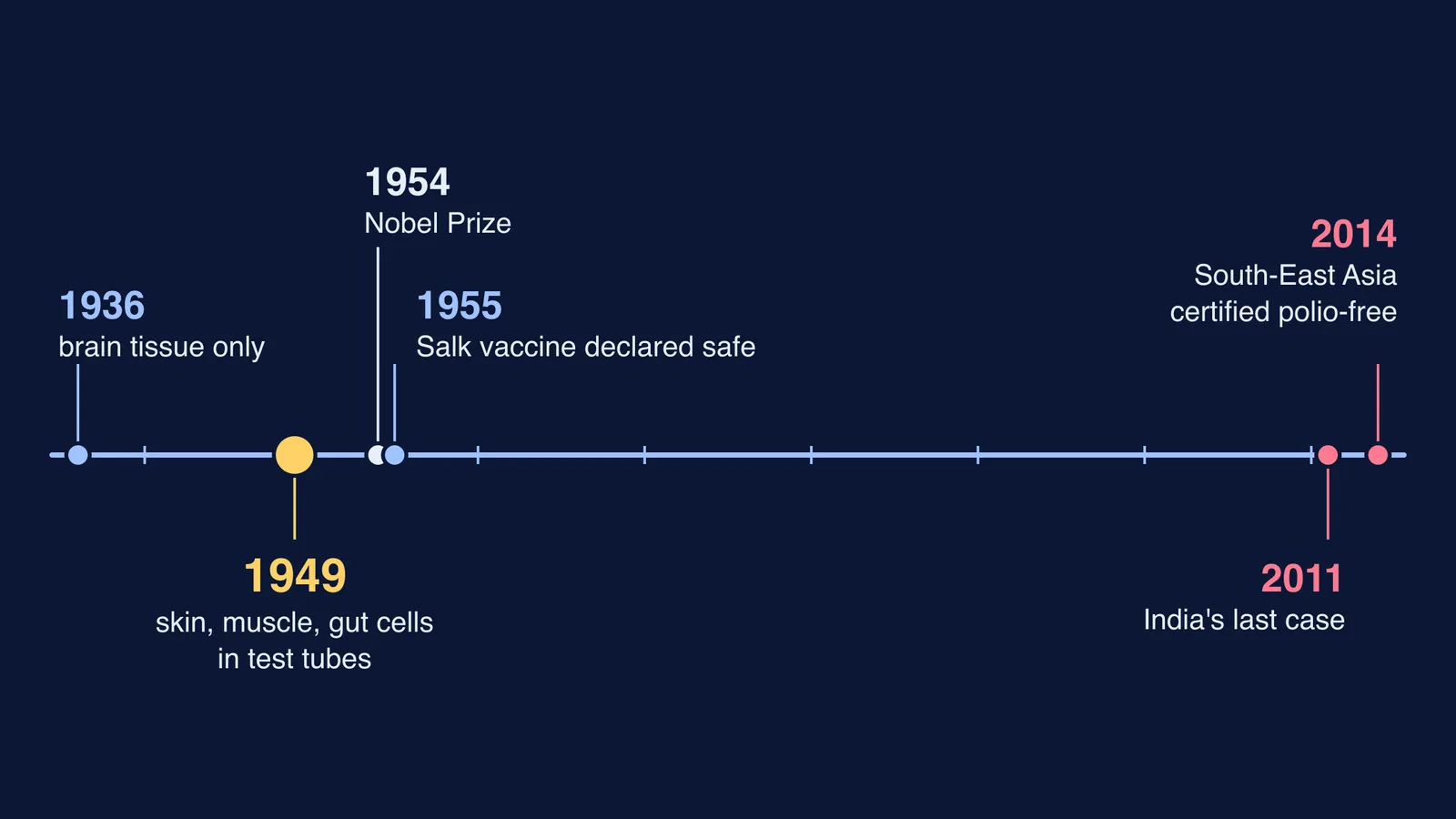
There was a second problem. In 1936, Sabin and Olitsky tried to grow poliovirus in tissues from chick embryos, mice, monkeys and human embryos. Only in human embryonic brain tissue did the virus even seem to stay active, which was taken as proof that polio was "strictly neurotropic", able to multiply only in nerve cells (same speech). Nerve tissue is the most difficult tissue to culture, so hopes of producing the virus in bulk were shelved.
How did Enders, Weller and Robbins grow poliovirus?
By the 1940s, doubts about the nerve-only idea were growing, and the Boston team decided to repeat the 1936 experiment with better technique. The Nobel presentation speech describes what they did and found:
They grew human embryonic tissue in test-tube cultures, a method Enders and Weller had already used on mumps, influenza and vaccinia viruses.
They added the Lansing strain of poliovirus.
On their first attempt, the virus grew not only in brain tissue but "equally well" in cells from skin, muscle and intestine.
Infected cells showed typical changes and were finally destroyed, which was easy to recognise under a microscope.
Immune serum blocked the growth, which showed the agent was poliovirus and gave a new way to test for immunity.
Later they found that tissue removed during operations on children and adults also worked, and that every tissue except bone and cartilage seemed suitable. They could even isolate the virus directly from specimens in tissue culture.
How did growing poliovirus in cells lead to vaccines?
A vaccine needs large amounts of virus. Jonas Salk built on the work of Enders, Weller and Robbins, according to the American Association of Immunologists history. He grew large quantities of poliovirus in cultures of monkey kidney cells, killed it with formaldehyde and tested this inactivated polio vaccine, or IPV. The 1954 field trial enrolled nearly two million child volunteers, and on 12 April 1955 the vaccine was declared safe and effective (same AAI page). Sabin's later oral vaccine used live virus weakened by repeated passage through monkey tissue. Read more on how Jonas Salk and Albert Sabin built the polio vaccines and in toxoid, killed and live vaccines compared.
In 1954 the three men shared the Nobel Prize in Physiology or Medicine "for their discovery of the ability of poliomyelitis viruses to grow in cultures of various types of tissue" (Nobel Prize summary). The method spread: Weller went on to grow the viruses of chickenpox and shingles, and Enders grew measles (presentation speech). Tissue culture became a standard method in virology; the story of George Gey and the HeLa cell line is another chapter.
What does this mean for polio in India?
India's last case of wild polio was a two-year-old girl in West Bengal on 13 January 2011 (Healio). On 27 March 2014, WHO certified the South-East Asia Region, home to a quarter of the world's population, as polio-free (WHO South-East Asia). Both polio vaccines built on the Boston culture method (AAI history).
How do you write about this experiment in an exam?
Any question on a classic experiment, such as "Why was the 1949 work on poliovirus important?", can be answered with a five-part frame. Here it is filled in:
Belief: poliovirus was thought to grow only in nerve cells.
Test: grow it in test-tube cultures of non-nerve human tissue.
Readout: infected cells are visibly destroyed under a microscope.
Check: immune serum stops the growth, so it really is poliovirus.
Use: virus can now be grown in quantity, so vaccines and lab diagnosis become possible.
Write one line for each and you have a clear five-mark answer.
If words like attenuated or neurotropic still blur together, the Fermi Concept Library gives every concept in biology its own lesson and shows its place in the map. If you are not sure where to begin on immunity, Fermi's AI tutor works out what you already know and builds a plan for the session.
Pick one experiment from your biology textbook tonight and write its five lines.


