

On this page
For decades, biologists faced a frustrating barrier in the laboratory. If they took human cells and placed them in a culture dish, the cells divided a few times and then simply died. Researchers could not study human biology reliably outside the body, which severely restricted the development of new treatments, vaccines, and genetic tests.
George Otto Gey, the head of tissue culture research at Johns Hopkins Hospital, was determined to change this. He spent years trying to establish an "immortal" cell line—a culture that would continue dividing indefinitely. Gey even engineered a device called a roller drum, which rotated culture tubes in constant, slow motion to bathe the cells continuously in nutrients and mimic the flow of fluids inside the human body. Yet, despite his careful engineering and constant tweaking of the growth medium, his cultures still died. The breakthrough he was looking for arrived in 1951, though it came at a profound ethical cost.
Where did HeLa cells come from?
In 1951, Henrietta Lacks, a 30-year-old African-American mother of five, visited The Johns Hopkins Hospital in Baltimore with abdominal pain and vaginal bleeding (Johns Hopkins Medicine). Johns Hopkins was one of the few hospitals in the area that treated Black patients at the time (Wikipedia). She was diagnosed with a malignant, aggressive epidermoid carcinoma of the cervix.
On 8 February 1951, during her radium cancer treatment, a surgeon took a biopsy of her tumour and sent tissue fragments to Gey's laboratory (Wikipedia). This procedure was carried out without Lacks's knowledge or consent, a standard medical practice in the 1950s that disregarded patient autonomy.
When Gey and his laboratory assistant Mary Kubicek placed Lacks's cells into their culture medium, the results were unprecedented. Rather than dying after a few days, the cells thrived, doubling in number every 20 to 24 hours (Johns Hopkins Medicine). Gey assigned the culture the code name "HeLa", using the first two letters of Henrietta Lacks's first and last names. Henrietta Lacks died from advanced cancer on 4 October 1951 at the age of 31, but her cells continued to multiply (Wikipedia).
Why did George Gey's HeLa cells not die?
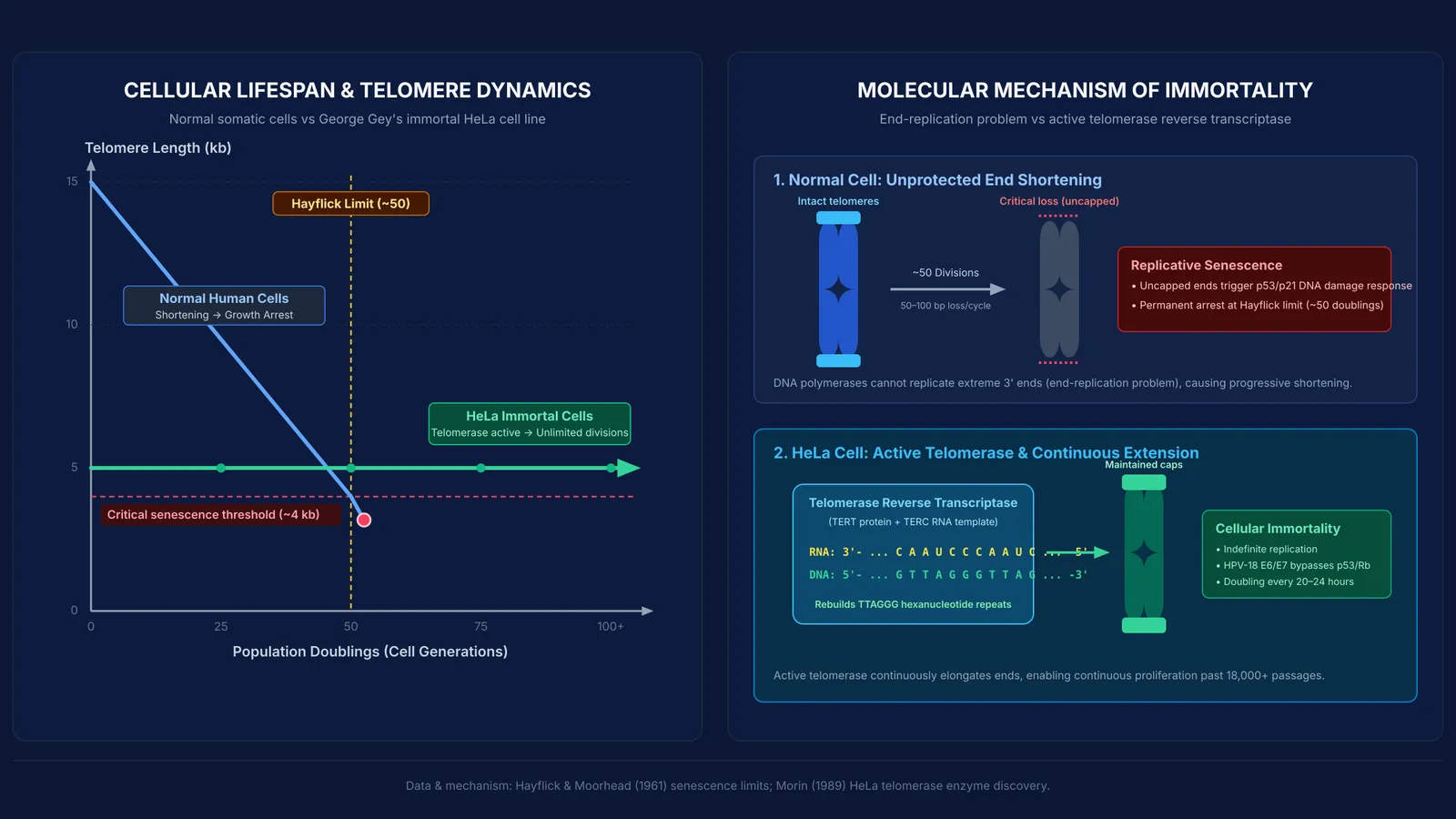
Normal human somatic cells possess a finite replicative lifespan, known as the Hayflick limit (Hayflick & Moorhead, 196190192-6)). Each time a normal cell divides, the protective nucleoprotein caps at the ends of its chromosomes—called telomeres—shorten by 50 to 100 base pairs. Once telomeres wear down past a critical threshold, the cell enters permanent growth arrest, known as replicative senescence, and eventually dies.
HeLa cells bypass this barrier completely. They express an active form of telomerase, a specialized ribonucleoprotein enzyme that continuously synthesizes and elongates terminal TTAGGG repeats (Morin, 198990035-4)). In addition, HeLa cells carry a heavily altered genome. Whereas healthy human cells contain 46 chromosomes, HeLa cells typically contain a hypertriploid count of 76 to 80 chromosomes, driven by the integration of Human Papillomavirus 18 DNA near the *MYC* oncogene on chromosome 8 (Boshart et al., 1984).
What medical breakthroughs came from HeLa cells?
George Gey freely distributed HeLa samples to laboratories worldwide. Because the cells grew vigorously in simple suspension and survived shipping by postal mail, they became the world's first standardized human cell culture system.
The scientific impact was immediate. In 1953, researchers proved that HeLa cells could support the propagation of all three known types of poliomyelitis virus (Scherer, Syverton & Gey, 1953). Jonas Salk used massive cultures of HeLa cells to test and evaluate the first inactivated polio vaccine, helping eradicate a disease that paralysed tens of thousands of children annually.
Over subsequent decades, HeLa cells supported thousands of biological breakthroughs. They allowed geneticists such as Sydney Brenner to examine cellular RNA and protein synthesis, travelled on early space missions to measure the biological effects of radiation and microgravity, and provided the foundation for discovering how autophagy clears damaged cellular debris.
What happened to Henrietta Lacks and her family?
While HeLa cells became the cornerstone of a multi-billion-dollar global biotechnology sector, Henrietta Lacks's family received no compensation and lived in poverty without basic health insurance. Researchers did not inform the family that Henrietta's cells had survived and were being propagated worldwide until 1975, when scientists contacted her adult children to collect genetic blood samples (Wikipedia).
The publication of Rebecca Skloot's 2010 book *The Immortal Life of Henrietta Lacks* brought the story to international attention. The case forced the scientific community to confront uncomfortable realities about racial disparities in medicine, commercial exploitation of human tissue, and the fundamental right of patients to control their own bodies.
How does modern research enforce informed consent?
The legacy of Henrietta Lacks spurred comprehensive reforms in research ethics and federal regulations. Today, any clinical trial or biospecimen collection protocol must satisfy strict informed consent requirements:
Full disclosure: Researchers must clearly explain the purpose, procedures, potential commercial uses, and risks of the study before collecting any tissue.
Voluntary participation: Donors must give voluntary, written consent without coercion, financial exploitation, or misleading promises.
Right to withdraw: Participants retain the right to withdraw from a study or revoke permission for their stored samples at any time without penalty.
De-identification and privacy: Genomic data and personal identifying details must be coded and protected against unauthorized disclosure.
Today, the intertwined stories of George Gey and Henrietta Lacks remain a foundational case study in medical training, demonstrating that scientific achievement cannot be separated from ethical responsibility.
If you are exploring the complex biology of human cells and need a clear path forward, Fermi's AI tutor can work out what you already know and build a plan for the session, so you sit down to a clear next step.


