On this page
In 1820 a wire carrying a small current barely moved a compass needle. A German professor fixed that with a simple idea: if one pass of wire nudges the needle, wind the wire around it again and again.
Who made the first galvanometer with a coil of wire?
It was Johann Salomo Christoph Schweigger (1779-1857), who had moved to the University of Halle in 1819 (Wikipedia: Johann Schweigger). In 1820, Hans Christian Oersted described how a current in a wire deflects a nearby compass needle (Wikipedia: Galvanometer). You can read that story in our post on Hans Christian Oersted and the compass needle that moved.
The earliest galvanometer was reported by Schweigger at the University of Halle on 16 September 1820 (Wikipedia: Galvanometer). Instead of one straight wire, he turned the wire into a coil around the needle, which "greatly multiplied the effect", so he called the device a multiplier (Museum of Technology). The effect grew as the number of turns grew (ETHW). The later name, galvanometer, honours Luigi Galvani.
Why do more turns give more torque?
Every turn of the coil carries the same current, and each one makes its own small magnetic field at the centre. Those fields point the same way, so they add. For a flat circular coil of n turns and radius a carrying current I, the field at the centre is B = μ0nI/2a (Virtual Labs, tangent galvanometer theory). Double the turns and you double the field.
With the coil lined up north-south, its field at the centre points east-west, across the needle. The turning force (torque) on a magnet is its magnetic moment times the field times the sine of the angle between them. At the start that angle is 90°, so the torque is simply proportional to the coil's field, and therefore to the number of turns.
Earth's horizontal field pulls the needle back towards north, so it settles where the two torques balance. This is the tangent law, B = Bh tan θ, where Bh is the horizontal part of Earth's field and θ is the deflection (Virtual Labs).
How far does the needle swing as you add turns?
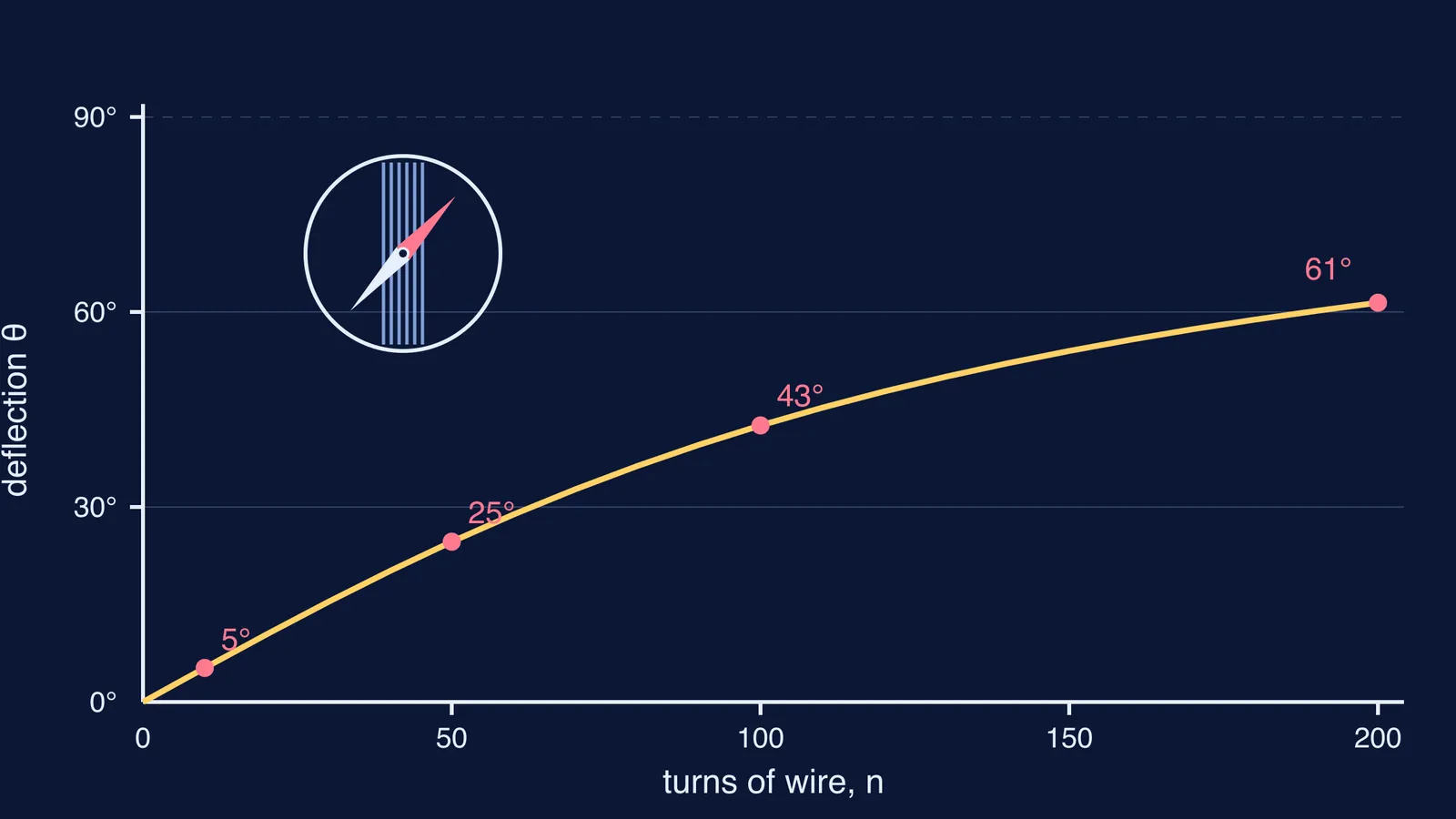
Take a coil of radius 3 cm wound around a compass in Delhi. The World Magnetic Model gives Delhi a horizontal field of 34,224 nT (about 34.2 µT) for November 2026 (BGS geomagnetic calculator, WMM2025). Drive it with a 1.5 V cell through a 100 Ω resistor, about 15 mA if you ignore the small resistance of the cell and wire.
One turn gives B = (4π × 10⁻⁷ × 0.015) / (2 × 0.03) ≈ 0.31 µT. Then tan θ = n × 0.31 / 34.2:
1 turn: about 0.5°, too small to see
10 turns: about 5°
50 turns: about 25°
100 turns: about 43°
200 turns: about 61°
200 turns do not give twice the angle of 100: the field doubles, but the angle follows the tangent, which flattens near 90°. Extra wire also adds resistance, lowering the real current.
How to build a coil-and-compass galvanometer at home
Get a flat magnetic compass, a few metres of thin enamelled copper wire, a 1.5 V AA cell and a 100 Ω resistor.
Cut a strip of card into a frame slightly wider than the compass.
Wind 10 turns around the frame, lying north-south, and slip the compass inside so the needle sits at the centre.
Scrape the enamel off both wire ends with sandpaper.
Turn the frame so the wires lie along the resting needle.
Connect the cell through the resistor for a few seconds and note the angle.
Reverse the cell. The needle should swing the other way.
Add turns in steps (25, 50, 100) and record the angle each time. Plot tan θ against n. It should be close to a straight line.
A square frame of a different size will not match the table exactly; look for the straight line.
If the coil's field is still hard to picture, the Fermi Simulation Lab has interactive simulations for ideas that are easier to see than to read. The Fermi Concept Library gives every concept in physics its own lesson and its place in the map, so you can see how related ideas connect.
What happened to the multiplier after 1820?
Johann Poggendorff and James Cumming built similar instruments on their own in 1821 (ETHW). Leopoldo Nobili's 1825 astatic design used two needles with opposite poles to cancel Earth's pull, and Poggendorff made an early mirror galvanometer in 1826 (Wikipedia: Galvanometer). Later designs kept Schweigger's coil but moved it instead of the magnet, which is the story of how Arsène d'Arsonval invented the moving-coil galvanometer. Your school lab has its descendant: see the moving coil galvanometer and how to convert it to an ammeter.
Wind your first 10 turns tonight and see the needle move.