On this page
Johann Rudolf Glauber turned a by-product of acid-making into a famous medicine. His story is also good practice for mole calculations and hydrates.
Who was Johann Rudolf Glauber?
Glauber was born in Karlstadt, Germany, in 1604, the son of a barber, and he never went to university; instead he learned by visiting laboratories in Paris, Basel, Salzburg and Vienna, according to the Dictionary of Scientific Biography entry on Glauber. The same entry says he worked as a court apothecary in Giessen from 1635, left Germany around 1639 because of the Thirty Years' War, and later worked in Amsterdam. There he fitted out what the entry calls "surely the most impressive laboratory in Europe". He died in Amsterdam in March 1670, says his Neue Deutsche Biographie entry.
How did Glauber make sodium sulfate?
The story starts with a spring. In 1625–26 Glauber was in the area around Vienna and Wiener Neustadt, and that is where his work on "sal mirabile" began, says the Neue Deutsche Biographie. A chapter in Rethinking the Scientific Revolution says the water of a spring cured him of "a long and difficult fever". After years of reading and experimenting, he claimed to have found the salt that gave the spring its powers, and to make it from common salt and sulfuric acid. He first announced it in 1658, in a book about the nature of salts.
The salt came out of his secret process for making hydrochloric acid "from common salt and sulfuric acid" (Dictionary of Scientific Biography). You heat table salt with oil of vitriol, the old name for sulfuric acid. Hydrochloric acid ("spirits of salt") comes off, and sodium sulfate is left behind (The Chemical Engineer). In modern notation:
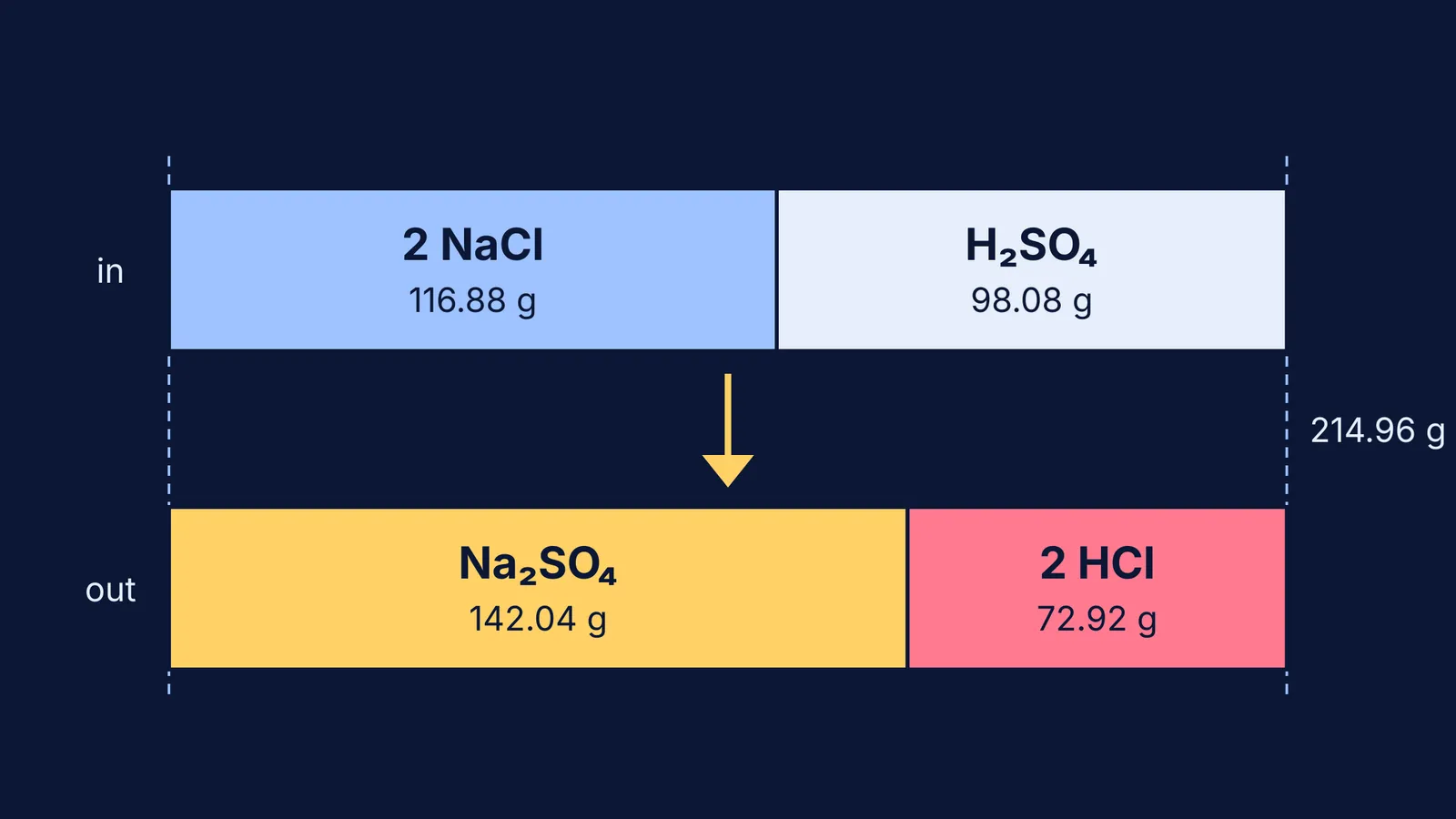
2 NaCl + H₂SO₄ → Na₂SO₄ + 2 HCl
Glauber's salt is sodium sulfate decahydrate, Na₂SO₄·10H₂O (PubChem).
Why was Glauber's salt sold as a medicine?
Sodium sulfate is a laxative. In Glauber's time, purging was a popular treatment for many diseases, and his salt was an effective and relatively safe way to do it (Wikipedia summary of Glauber's work). The same article says his business making pharmaceuticals brought him great financial success and then, in 1649, bankruptcy. The Dictionary of Scientific Biography says he had to live entirely on the sale of his products, that his writings were his main way of attracting customers and were full of "exaggerated claims", and that he set aside one hour each day to give out free medicines.
Until better options came along in the 1900s, Glauber's salt was the world's go-to purgative. Meriwether Lewis ordered six pounds of the salt for the Lewis and Clark expedition of 1804–1806 (Australian Pharmacist). The same article notes that today sodium sulfate is an ingredient in bowel-preparation kits used before gut procedures. Treat all this as history, not a home remedy: for a stomach problem, see a doctor or pharmacist. For chemicals as medicines, see Paracelsus and the idea that the dose makes the poison.
How did Glauber improve the making of acids?
His new furnaces, described in Furni novi philosophici (1646–1649), greatly widened what he could distil. With them he prepared hydrochloric, nitric and sulfuric acids in concentrated form (Dictionary of Scientific Biography). In 1648 he improved the process for nitric acid by heating potassium nitrate (saltpetre) with concentrated sulfuric acid (Wikipedia).
Both methods use the same idea. Heat a salt with sulfuric acid, which does not boil off easily, and a more volatile acid escapes as a gas: HCl from NaCl, HNO₃ from KNO₃. For a later chemist who also started from salt, see how Nicolas Leblanc made soda ash from common salt in 1791.
Worked example: how much Glauber's salt does one batch make?
Use PubChem molar masses: NaCl 58.44, H₂SO₄ 98.08, Na₂SO₄ 142.04, HCl 36.46 and H₂O 18.015 g/mol (NaCl, H₂SO₄, Na₂SO₄, HCl, H₂O).
Balance the equation: 2 NaCl + H₂SO₄ → Na₂SO₄ + 2 HCl.
Take 1 mol of sulfuric acid, 98.08 g. It needs 2 mol of NaCl, 2 × 58.44 = 116.88 g.
Products: 1 mol Na₂SO₄ (142.04 g) and 2 mol HCl (72.92 g).
Check mass balance: 116.88 + 98.08 = 214.96 g in, and 142.04 + 72.92 = 214.96 g out.
Crystallise from water. Each mole takes up 10 × 18.015 = 180.15 g of water, giving about 322.2 g of Glauber's salt (PubChem lists 322.20 g/mol).
Water fraction: 180.15 ÷ 322.20 = 0.559, so 55.9% of the crystal's mass is water.
Before you answer, check:
Did you convert grams to moles before using the ratio?
Does the question want anhydrous Na₂SO₄ or the decahydrate?
Do the masses in and out match?
For more practice on hydrates, see how to find the formula of a hydrate from water of crystallisation. If you get stuck at the mole-ratio step, the Fermi Problem Library has worked problems with a step-by-step solver that explains the reasoning rather than printing an answer. If water of crystallisation itself feels shaky, the Fermi Concept Library gives each chemistry concept its own lesson.
Next time you see "Glauber's salt" in a question, write Na₂SO₄·10H₂O, then run the six steps.