On this page
In 1772 a 25-year-old German astronomer, Johann Elert Bode, printed a footnote that made the solar system look like a number puzzle. The pattern, now called the Titius-Bode law, seemed to point astronomers to something real, then failed in public.
What is the Titius-Bode law?
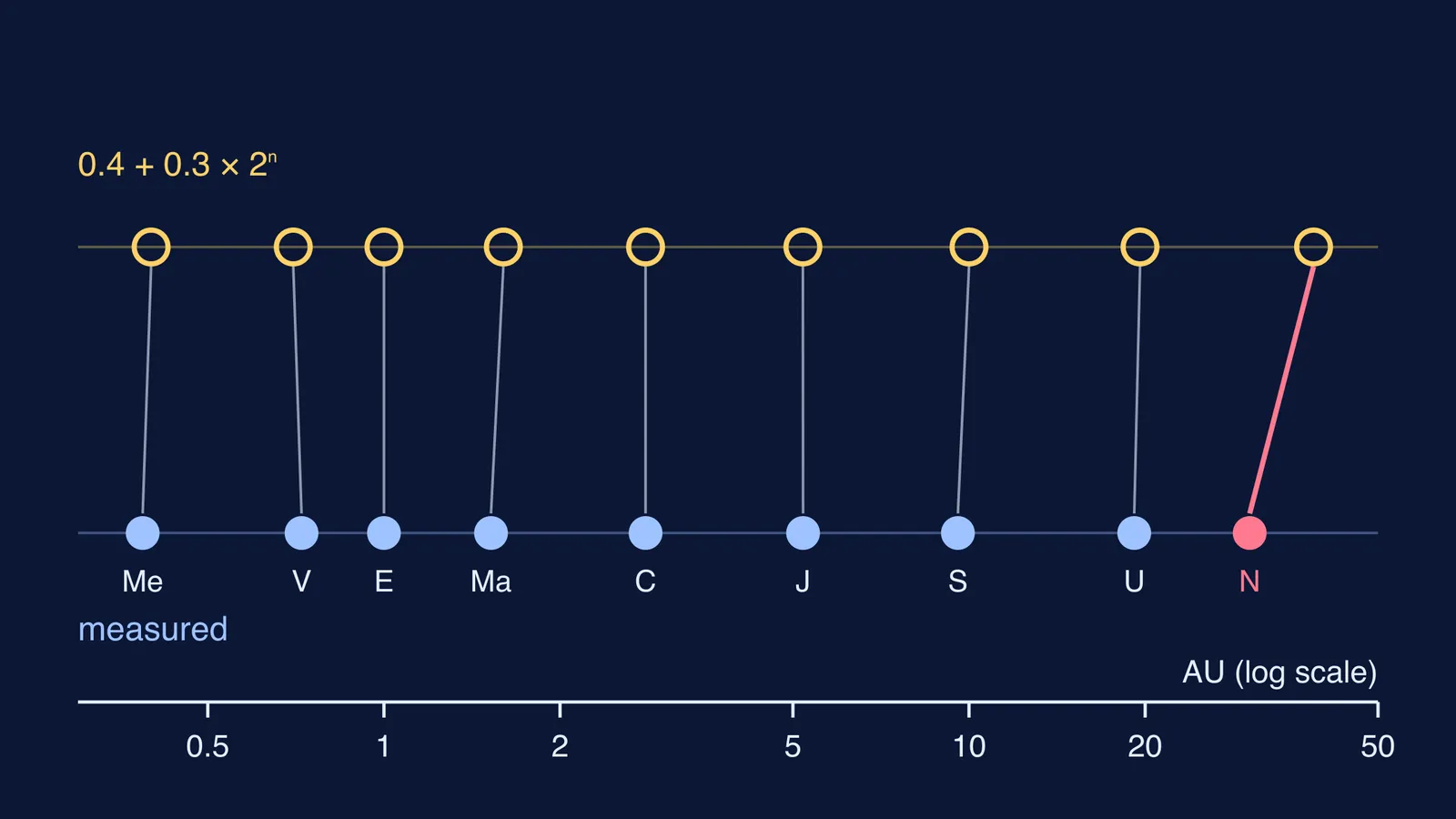
The Titius-Bode law says a planet's average distance from the Sun is about 0.4 + 0.3 × 2ⁿ AU, where n = 0 for Venus, 1 for Earth, 2 for Mars and so on, according to the Wikipedia summary of the Titius-Bode law. One AU is the Earth-Sun distance.
The idea first appeared in 1766, when Johann Daniel Titius slipped two paragraphs into his German translation of Charles Bonnet's *Contemplation de la Nature*. Bode repeated it in 1772 in the second edition of his astronomy handbook, and his footnote spelled out the gap. In the English translation quoted on that Wikipedia page: "After Mars there follows a space of 4+24=28 parts, in which no planet has yet been seen." Bode, born in Hamburg in 1747, later directed the Berlin Observatory from 1786 to 1825 and suggested the name Uranus, according to his Wikipedia biography.
How well does the pattern fit the planets?
Take each distance from the NASA Planetary Fact Sheet, divide by Earth's 149.6 million km to get AU, and compare it with the rule. Ceres comes from NASA's Ceres facts page, which gives 2.8 AU.
Mercury: rule 0.4 (only if you drop the doubling term), measured 0.39, off by about 3%
Venus (n = 0): rule 0.7, measured 0.72, off by about 3%
Earth (n = 1): rule 1.0, measured 1.00
Mars (n = 2): rule 1.6, measured 1.52, off by about 5%
The gap (n = 3): rule 2.8, Ceres at 2.8
Jupiter (n = 4): rule 5.2, measured 5.20
Saturn (n = 5): rule 10.0, measured 9.57, off by about 4%
Uranus (n = 6): rule 19.6, measured 19.16, off by about 2%
Neptune (n = 7): rule 38.8, measured 30.18, off by about 29%
For Neptune, (38.8 − 30.18) ÷ 30.18 × 100 gives about 29%.
Why did it predict the asteroid belt but fail for Neptune?
William Herschel found Uranus in 1781, close to the 19.6 AU the rule asked for. After that, Bode urged other astronomers to search the empty slot at 2.8 AU, as the Titius-Bode law page describes.
In 1801 Giuseppe Piazzi found Ceres, the first member of the asteroid belt to be discovered, according to NASA, right in the rule's 2.8 AU gap. Read more on Giuseppe Piazzi and the discovery of Ceres.
The failure came in 1846. Urbain Le Verrier predicted Neptune's position from the way Uranus was being pulled off course, and Johann Galle found it at the Berlin Observatory on his first night of searching, as NASA's Neptune facts page records. Neptune is 30 AU from the Sun, nowhere near 38.8 AU. Gravity worked where the pattern did not; see how Le Verrier found Neptune with mathematics.
Is the Titius-Bode law real physics or a coincidence?
No accepted theory explains it. The astrophysicist Alan Boss has called it just a coincidence, and the journal Icarus no longer accepts papers proposing improved versions, as the Titius-Bode law page notes. Pluto, found in 1930, sits near the 38.8 AU slot the rule had given to Neptune, which made things more confusing, not less.
The idea got a fresh, fair test with planets around other stars. In 2013, Timothy Bovaird and Charles Lineweaver used a generalised version of the relation to predict 141 extra planets in 68 multi-planet systems, in their paper in Monthly Notices of the Royal Astronomical Society. Chelsea Huang and Gáspár Bakos then searched 3.5 years of Kepler telescope data for 97 of those predicted planets and found only five candidates near the predicted periods, concluding that the relation's "prediction power" is "questionable" (Huang and Bakos, MNRAS).
How can you test a number pattern yourself?
The same habit helps in a physics lab or a JEE Main data question. Before you trust a pattern, run these four checks.
Count the knobs. The Titius-Bode rule has three chosen numbers: 0.4, 0.3 and the base 2.
Count the special cases. Mercury needs one, and each exception weakens the fit.
Ask for data that arrived after the rule. Uranus and Ceres counted; the six planets the rule was built from did not.
Ask for a reason. Kepler's third law follows from gravity, which is why it still holds; see how Johannes Kepler found his three laws. The Titius-Bode rule never had one.
If you want to see how gravity shapes an orbit, the Fermi Simulation Lab has interactive simulations for ideas easier to see than read. For practice with orbit calculations, the Fermi Problem Library has worked problems with a step-by-step solver that explains the reasoning rather than printing an answer.
Try the worked check with a calculator tonight and see where the pattern breaks.