

On this page
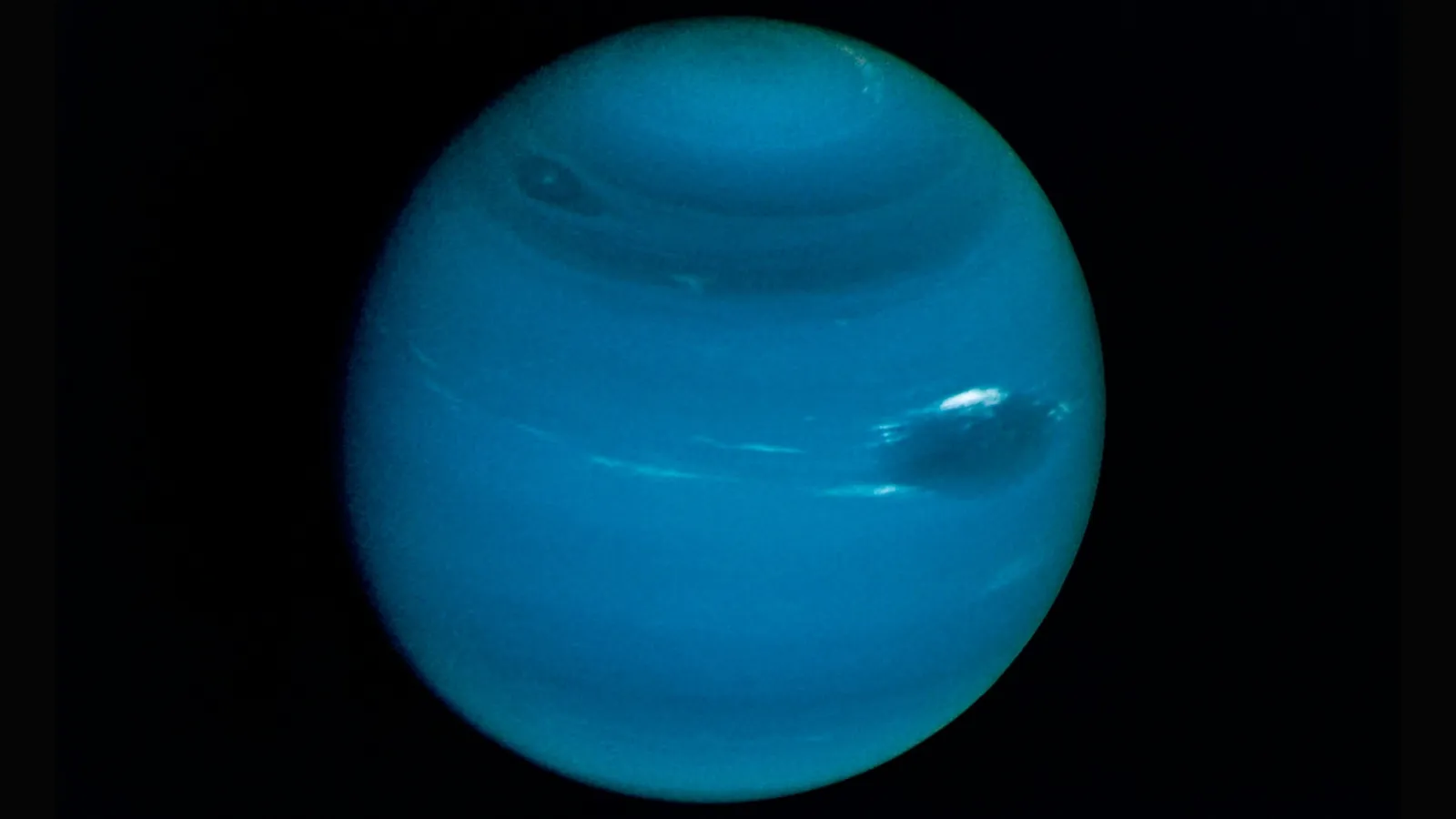
Most planets were found by looking. Neptune was found by calculating. A French mathematician sat with Newton's law of gravitation and decades of measurements of Uranus, and worked out where a planet nobody had seen must be. This post covers how Urbain Le Verrier did it, checks the key numbers with Kepler's third law, and shows how the same ideas appear in JEE gravitation.
Who was Urbain Le Verrier?
The MacTutor biography of Le Verrier gives his dates as 11 March 1811, Saint-Lô, to 23 September 1877, Paris. He taught astronomy at the École Polytechnique from 1837. His first astronomy paper, in 1839, was on the long-term stability of planetary orbits, and he showed that some comets thought to be different were one comet pushed into a new orbit by Jupiter's pull. He was elected to the Academy of Sciences on 19 January 1846, months before his most famous result.
What was wrong with Uranus?
Uranus did not follow the path predicted from the Sun's gravity plus the pull of the known planets. MacTutor describes the sequence. François Arago asked Le Verrier to study the irregularities in 1845. Le Verrier published a first memoir in December 1845. A second, in June 1846, proved that the known planets could not explain them, and he proposed a further planet beyond Uranus. In August 1846 he published its predicted position. The calculation, MacTutor notes, was taken to the seventh order of approximation and involved 469 distinct terms.
How was Neptune found?
On 18 September 1846 Le Verrier wrote to Johann Galle at the Berlin Observatory asking him to look. Galle received the letter five days later, searched the same evening, and found the planet within one degree of the predicted position. After confirming it the next night, he wrote back, as MacTutor quotes: "The Planet whose position you indicated really exists."
NASA's Neptune facts page puts it in one line: Neptune "became the first planet located through mathematical predictions rather than through regular observations of the sky." It adds that Galileo had recorded Neptune as a fixed star in 1612 and 1613 without realising what it was.
MacTutor also notes that John Couch Adams in England made similar calculations independently, and that recent research suggests his results were considerably less accurate than Le Verrier's.
Worked example 1: Neptune's year from Kepler's third law
For planets around the Sun, T² is proportional to a³. In years and astronomical units (AU), T = a^(3/2). NASA's fact sheets give Earth's semimajor axis as 149.598 million km and Neptune's as 4,514.953 million km.
Convert to AU. a = 4514.953 / 149.598 = 30.18 AU.
Apply Kepler. T = 30.18^(3/2) = 30.18 x √30.18 = 30.18 x 5.494 = 165.8 years.
Compare. The same sheet gives Neptune's orbital period as 60,189 days, which is 60,189 / 365.256 = 164.8 years. The simple formula is within about 1 per cent.
That fits NASA's note that in 2011 Neptune completed its first 165-year orbit since its discovery.
Worked example 2: how small was Neptune's pull?
Why did it take precise maths to find Neptune? Compare the pull of Neptune on Uranus, when the two are closest, with the pull of the Sun on Uranus. Use the NASA values: Uranus at 19.165 AU, Neptune at 30.18 AU, Neptune's mass 102.409 x 10^24 kg and the Sun's mass 1,988,400 x 10^24 kg.
Distance Uranus to Neptune at closest. 30.18 - 19.165 = 11.02 AU.
Ratio of forces. F(Neptune)/F(Sun) = (M_N / M_Sun) x (r_Sun / r_N)² = (102.409 / 1,988,400) x (19.165 / 11.02)².
Work it out. 102.409 / 1,988,400 = 5.15 x 10^-5. (19.165 / 11.02)² = (1.739)² = 3.02. Product = 1.56 x 10^-4.
So at its strongest, Neptune's pull on Uranus is about 1/6,400 of the Sun's. Le Verrier found a planet from a tug that small.
Which mistakes should you avoid?
Using T = a^(3/2) in SI units. That shortcut only works in years and AU for bodies orbiting the Sun. In SI, use T² = 4π²a³/(GM).
Forgetting to square the distance ratio. Gravity goes as 1/r², so a distance ratio of 1.739 becomes a force factor of 3.02.
Adding distances when planets are on the same side of the Sun. At closest approach, subtract the orbit radii.
The JEE (Main) 2026 syllabus lists Kepler's laws of planetary motion under gravitation. For more practice, see our guides to Kepler's laws of planetary motion and gravitation and satellite problems.
Did the same method always work?
No, and that is part of the lesson. MacTutor describes how Le Verrier later found that Mercury's perihelion advanced faster than Newtonian theory allowed, and in 1859 proposed an unseen planet inside Mercury's orbit, which he called Vulcan. No such planet exists. Einstein's general theory of relativity explained Mercury's orbit in 1915, long after Le Verrier's death. The same reasoning that found Neptune pointed to a planet that was not there, because this time the theory itself needed changing.
What can a student take from Le Verrier's way of working?
Trust small differences. The gap between prediction and observation for Uranus was tiny. He treated it as information, not noise.
Rule things out first. His second memoir proved the known planets were not enough before he proposed a new one.
Know when a method has limits. Neptune and Vulcan used the same logic. Only checking against the sky told them apart.
When an orbit problem stalls at the set-up, the Fermi Problem Library has worked problems with a step-by-step solver that explains the reasoning rather than printing an answer.
Next step: use NASA's fact sheet values to check Kepler's third law for Uranus, and see how close you get to its 84-year period.


