

On this page
Why did some patients' blood attack other people's white blood cells? Jean Dausset's answer, published in 1958, was the first HLA antigen: the tissue type transplant teams still check before matching a donor kidney or bone marrow to a patient.
Who was Jean Dausset?
Dausset was born in Toulouse on 19 October 1916, according to his Collège de France biography. He served as a wartime blood transfuser and died on 6 June 2009. Red blood cells already had their groups, as told in Karl Landsteiner and the discovery of the ABO blood groups. Dausset showed that white blood cells have groups too.
What did Jean Dausset discover in 1958?
In 1952, at the transfusion centre of the Hôpital Saint-Antoine in Paris, Dausset studied patients with very low white blood cell counts. Their serum held antibodies, made after many transfusions, that clumped other people's white blood cells, Edgardo Carosella recounts in an Académie des sciences history of the discovery.
Unlike anti-A and anti-B, antibodies against white blood cells do not occur naturally; they appear only after a transfusion or a pregnancy. So Dausset gave a patient blood from one single donor, so the patient could react only against that donor's white cells. A few weeks later, the patient's serum clumped the white cells of half of a panel of volunteer donors.
So a white-cell group existed. Dausset named it MAC, after the initials of three panel donors, and published it in Acta Haematologica in 1958. MAC is known today as HLA-A2, according to a 2009 Haematologica tribute by Laurent Degos. In that first paper Dausset already suggested the groups might matter for transplants.
How did white blood cell groups become tissue types?
Dausset then tested 50 sera against the white cells of 50 people and found at least 8 groups belonging to one genetic system, which he named Hu-1 (Académie des sciences). Hu-1 was later renamed HLA, for human leukocyte antigens (Degos, Haematologica).
In 1964, with the American surgeon Felix Rapaport, Dausset grafted skin between volunteers and showed that graft survival tracked Hu-1 compatibility. In kidney transplants, graft survival tracked the number of HLA mismatches, with the best results when the donor was a sibling carrying the same HLA set. For patients with unrelated donors, Dausset founded France-Transplant, an organ-exchange organisation, in 1969 (Collège de France).
He shared the 1980 Nobel Prize in Physiology or Medicine with George Snell and Baruj Benacerraf (Degos, Haematologica). In his first Collège de France lecture in 1978, Dausset said: "I had the opportunity to be in the most exciting adventure of modern biology, deciphering a new world, the world of the intercellular language." Read about his co-laureate in Baruj Benacerraf and the immune response genes in the MHC.
Why do HLA antigens matter for transplant matching?
HLA genes sit in the major histocompatibility complex, which covers about 4 million DNA base pairs on the short arm of chromosome 6, according to a 2018 Scientific Reports study of sibling transplant pairs. HLA molecules present fragments of foreign proteins, which is how the immune system tells self from non-self (Académie des sciences).
A donor organ with different HLA looks foreign, so the recipient's immune system attacks it. In a bone marrow transplant, donor immune cells can also attack the patient; the 2018 study calls this graft-versus-host disease "a major life-threatening complication" and says HLA matching is crucial to reduce it. See How E. Donnall Thomas made bone marrow transplants work.
Almost every person's HLA combination is unique (Académie des sciences), so families are often tested first. If your family faces a transplant, the transplant team decides who is tested and what counts as a match.
What are the odds a sibling is an HLA match?
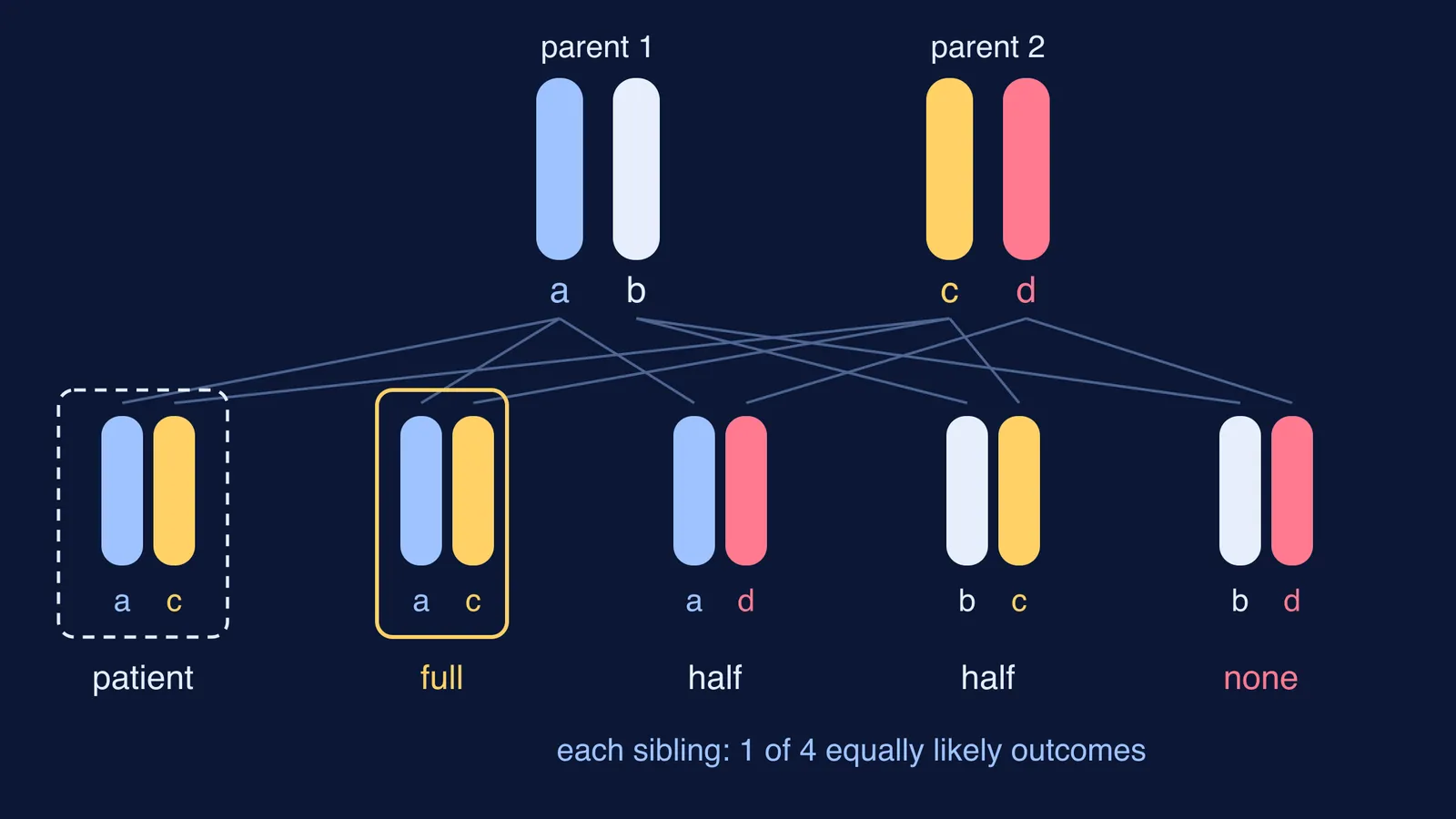
HLA genes are inherited as a block, called a haplotype, one from each parent. The 2018 Scientific Reports paper states that a patient and a sibling have a 25% chance of being HLA identical. Here is why:
Label parent 1's two haplotypes a and b, and parent 2's c and d.
Each child gets one from each, so four combinations are equally likely: ac, ad, bc, bd.
If the patient is ac, each sibling is a full match (ac) in 1 of 4 cases, a half match (ad or bc) in 2 of 4, and no match (bd) in 1 of 4: 25%, 50% and 25%.
With two siblings, the chance that neither matches is 3/4 x 3/4 = 9/16, so the chance at least one does is 7/16, about 44%.
How should you revise HLA for a biology exam?
Define HLA in one sentence: what it is, where it is coded, what it does.
Explain why repeated transfusion was Dausset's clue.
Redo the sibling cross from a blank page, then with three siblings.
If antigens, antibodies and the MHC still blur together, the Fermi Concept Library has a lesson for every concept in biology, each with its place in the map. For probability crosses like the one above, the Fermi Problem Library has worked problems with a step-by-step solver that explains the reasoning rather than printing an answer.


