On this page
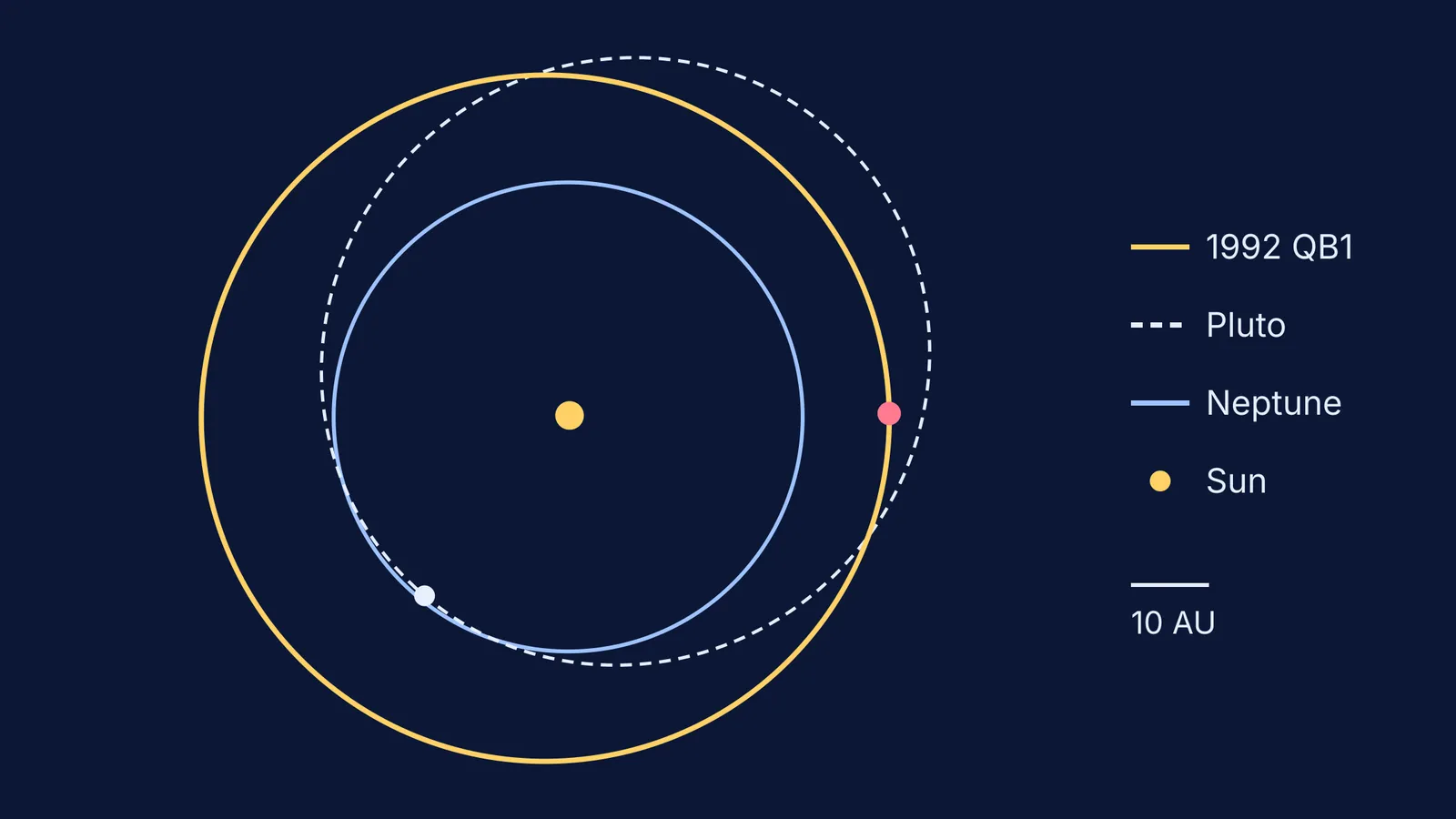
On 30 August 1992, two astronomers in Hawaii compared pictures of a patch of Pisces and saw a faint speck shifted slightly west. “We were just blown away,” David Jewitt later told Science News. The speck was 1992 QB1, the first object found beyond Neptune since Pluto and Charon, and the start of what we now call the Kuiper belt.
Who found the first Kuiper belt object, and when?
Jane Luu and David Jewitt found 1992 QB1 in CCD images taken from 30 August to 1 September 1992 with the University of Hawaii's 2.2-metre telescope on Mauna Kea, according to the IAU circular that announced it. They published the full result in Nature in 1993 as “Discovery of the candidate Kuiper belt object 1992 QB1”.
Luu was born in Saigon in 1963, reached the United States as a refugee in 1975, took her physics degree at Stanford in 1984 and earned her PhD at MIT in 1992 (biography). In 1986 Jewitt, then at MIT, enlisted her, a graduate student in his department looking for a new project, says the Kavli Prize page.
Her biography counts five years of observation before the find; the Kavli page says the whole survey lasted almost a decade. The object is now named 15760 Albion, and its designation gave astronomers the word “cubewano” for objects like it.
How did Jewitt and Luu search for it?
Their method was simple and slow: image a patch of sky, wait an hour or so, image it again, as Science News describes it. Stars stay put; solar-system objects shift. Flicking between images to spot the mover is called “blinking”, and by 1992 Jewitt did it on a computer rather than with a blink comparator (Kavli Prize).
They started out with telescopes in Arizona, poring over glass photographic plates and digital images. “It seemed like a worthwhile thing to check out,” Luu told Science News of the outer solar system. She also recalled: “Years went by, and we didn't see anything.” The find came on their second night with a new, more sensitive CCD camera in Hawaii, the Kavli page notes.
How fast does a Kuiper belt object move across the sky?
The discovery circular reported that 1992 QB1 drifted backwards at about 3 arcseconds per hour near opposition, and put it 37 to 59 AU from Earth (IAU circular). An arcsecond is 1/3600 of a degree. Class 11 gravitation can check that speed.
Earth goes 360 degrees round the Sun in 365.256 days (NASA Earth fact sheet). So something moving at Earth's speed, seen from 1 AU away, crosses about 148 arcseconds per hour.
For a circular orbit, speed falls as 1/√R, where R is the distance from the Sun in AU.
At opposition, Earth overtakes the object. Their relative speed is Earth's speed × (1 − 1/√R), seen from R − 1 AU away.
So the backward drift is about 148 × (1 − 1/√R) ÷ (R − 1) arcseconds per hour.
Put in R = 42: 148 × 0.846 ÷ 41 gives about 3.0 arcseconds per hour, matching the circular. A main-belt asteroid at R = 2.7 gives about 34, roughly 11 times faster. The slower the crawl, the farther away the object.
If orbits make more sense when you watch them, the Fermi Simulation Lab has interactive simulations for ideas that are easier to see than to read. For practice, the Fermi Problem Library has worked problems with a step-by-step solver that explains the reasoning rather than printing an answer.
What changed after 1992 QB1?
The belt is named after Gerard Kuiper and his work on the outer solar system, though in the 1950s he proposed that any bodies once there would have been scattered away (Science News). Jewitt's Kuiper belt page estimates at least 70,000 trans-Neptunian objects wider than 100 km, in a belt from about 30 to 50 AU (Jewitt's Kuiper belt page). Pluto, which Clyde Tombaugh found in 1930, was one member of a crowd.
In 2012 Luu, Jewitt and Michael Brown shared the Kavli Prize in Astrophysics “for discovering and characterizing the Kuiper Belt and its largest members” (Kavli Prize). Brown's finds included Eris, told in how Mike Brown's discovery of Eris made Pluto a dwarf planet.
What can you learn from a five-year search?
Olympiad preparation or a two-year exam plan can feel just as long. A plan modelled on the search:
Decide what a “hit” looks like before you start. For Luu and Jewitt, it was a slow-crawling speck.
Compare snapshots, not moods. Take the same kind of test each month and see what moved.
Log the empty nights. A blank result still rules something out.
Change the tool when stuck. Their find came soon after a camera upgrade.
Pick a question few people are asking. Jewitt has said the outer solar system was “an area of astronomy in which relatively few other people worked” (Kavli Foundation interview).
The sky beyond Neptune looked empty until two people kept looking.