

On this page
Pluto was not found by a famous professor. It was found by a 24-year-old from a Kansas farm who spent months comparing photographs of the night sky, one star image at a time. This post covers how Clyde Tombaugh searched, why his method worked, and the Class 11 gravitation physics that explains what he saw on his plates.
Who was Clyde Tombaugh?
According to his Academy of Achievement profile, Tombaugh was born on 4 February 1906 in Streator, Illinois, and died on 17 January 1997. He grew up on farms in the Midwest, could not afford college, and taught himself solid geometry and trigonometry. He built his first telescope in 1926, at 20, and later a 9-inch reflector from discarded farm machinery and car parts. Observations made with his homemade telescope led to a job offer from Lowell Observatory in Flagstaff, Arizona, and he arrived there in January 1929 for a three-month trial.
What was he looking for?
Percival Lowell had predicted a planet beyond Neptune that he called Planet X. Lowell Observatory says its Pluto Discovery Telescope was built in 1928 and 1929 specifically for that search, and that Tombaugh used it to take the photographic plates on which Pluto was found.
In his interview with the Academy, Tombaugh described the routine: one-hour exposures at night, then, a few days later, a machine called a blink comparator that flipped rapidly between two plates of the same star field taken a few nights apart. Stars stay put. Anything in the solar system jumps. The difficulty was scale: he said each plate held "several hundred thousand star images a piece," and he had to look at every one.
How did he know he had found a planet?
On 18 February 1930, about four in the afternoon, he reached a pair of plates taken the month before and saw an object that had moved by just the right amount. In his words: "I knew the scale of the plates, I knew the interval, and it was just a matter of geometry." He checked a third plate before telling anyone. The observatory kept the news quiet for about three weeks to follow the object. NASA's Pluto facts page records that by 14 March 1930 the news had reached Oxford, where a schoolgirl, Venetia Burney, suggested the name Pluto.
Worked example: how far should a distant planet jump?
Here is the geometry he meant, in a simple model. Assume circular orbits and an object opposite the Sun in our sky, so Earth and the object move in the same direction. Speeds come from the NASA Pluto fact sheet.
Relative speed. Earth's mean orbital speed is 29.78 km/s and Pluto's is 4.64 km/s. Relative speed = 29.78 - 4.64 = 25.14 km/s.
Distance. Pluto's semi-major axis is 5,869.7 million km and Earth's is 149.6 million km, so the gap is about 5,720 million km, or 5.72 x 10^9 km.
Angular speed. ω = v / r = 25.14 / (5.72 x 10^9) = 4.40 x 10^-9 rad/s.
Per day. Multiply by 86,400 s: 3.80 x 10^-4 rad. Multiply by 206,265 to get arcseconds: about 78 arcseconds a day.
Now compare a main-belt asteroid at 2.8 AU. For circular orbits, speed falls as 1/√r, so its speed is 29.78 / √2.8 = 17.8 km/s. Relative speed is 12.0 km/s and the distance is 1.8 AU, or 2.69 x 10^8 km. The same steps give about 790 arcseconds a day, ten times Pluto's shift. A small jump meant a distant object.
You can also check the orbit with Kepler's third law, which is in the NCERT Class 11 Gravitation chapter. With T in years and a in AU, T = a^(3/2) = 39.48^1.5 = 248.1 years. The fact sheet lists 90,560 days, which is 247.9 years.
Our post on Kepler's laws of planetary motion explains where the third law comes from. If the step from orbital speed to angle on the sky still feels abstract, the Fermi Simulation Lab has interactive simulations for ideas that are easier to see than to read.
Is Pluto still a planet?
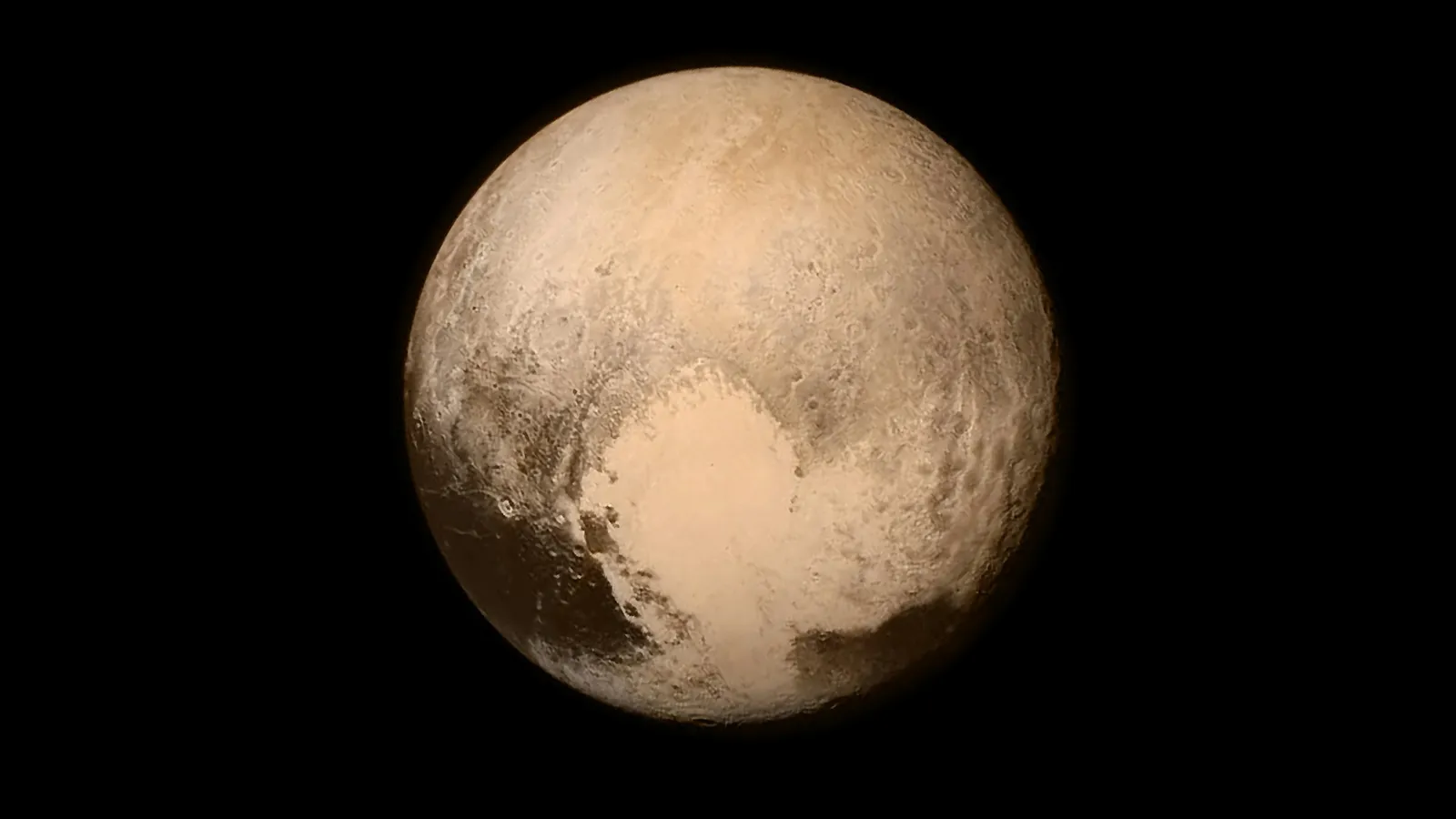
NASA notes that the International Astronomical Union reclassified Pluto as a dwarf planet in 2006, after similar worlds were found in the Kuiper Belt beyond Neptune. NASA's New Horizons spacecraft flew past Pluto on 14 July 2015. The Academy profile adds that it carried an ounce of Tombaugh's ashes.
What else did he do?
The same profile lists hundreds of new variable stars, hundreds of asteroids, two comets and a count of more than 29,000 galaxies, all found as by-products of the planet search. After teaching navigation during the Second World War, he worked on optical tracking instruments at White Sands, New Mexico, and taught at New Mexico State University from 1955 until he retired in 1973. Like William Herschel before him, he went from building his own telescopes to finding a new world.
What can a student take from his way of working?
Decide in advance what a real result looks like. Tombaugh had worked out how far a planet beyond Neptune should shift before he found one, so he recognised it in seconds.
Check before you celebrate. He looked for a third plate before telling anyone.
Careful, boring work finds things. He said others had missed the planet because "they were not careful enough."
Try it now: repeat the worked example for Neptune at 30.07 AU and check that you get about 100 arcseconds a day.


