

On this page
In the early 2000s, astronomical surveys began uncovering numerous icy bodies in the outer solar system. In 2005, astronomers Michael E. Brown, Chad Trujillo and David Rabinowitz published the discovery of a planetary-sized object in the scattered Kuiper belt, a distant region of the solar system beyond Neptune (Brown et al., 2005). Originally nicknamed "Xena" but eventually named Eris, this distant, icy world would ultimately force astronomers to redefine what makes a planet and reclassify Pluto as a dwarf planet.
The name Eris, taken from the Greek goddess of discord, proved fitting. Initially, Eris appeared to be larger than Pluto based on its brightness. This observation created an immediate problem for the scientific community: if Pluto was considered the ninth planet, then Eris should logically be classified as the tenth. Conversely, if Eris was not a planet, what did that make Pluto?
Brown's team had found a world that would force a definitive decision about how we classify the largest objects in our solar system. The debate spilt out of academic circles and into public view, as people realised the solar system map they had learned in school was about to change.
How do astronomers measure the mass of a distant world?
To truly compare Eris to Pluto, astronomers needed to know its exact mass. They achieved this by observing Dysnomia, a small moon orbiting Eris.
Why does a moon reveal a planet's mass?
By tracking how long it takes Dysnomia to complete one orbit and its distance from Eris, researchers could use the laws of gravity to calculate the mass of the parent body. Because a moon's mass mathematically cancels out of the equations, its orbital period depends only on the distance and the mass of the much larger world it orbits.
Here is the framework astronomers use to weigh a distant world like Eris, relying on Newton's version of Kepler's third law:
Measure the orbital period (T): Using the Hubble Space Telescope and Keck Observatory, the team found Dysnomia takes 15.774 days to orbit Eris (Brown and Schaller, 2007).
Measure the orbital radius (r): They determined Dysnomia orbits at a distance of 37,350 kilometres.
Apply the mass formula: The mass M of Eris is given by the equation M = 4π²r³ / GT², where G is the universal gravitational constant.
By plugging in these values, Brown and Emily Schaller published their findings in 2007. They proved that Eris has a mass of 1.67 × 10²² kilograms. This meant Eris was 1.27 times as massive as Pluto, confirming it as the most massive known body in the Kuiper belt (Brown and Schaller, 2007). (If you are working through similar gravitational physics, you can read how to derive Kepler's second law from angular momentum or use the Fermi Problem Library, which provides a step-by-step solver that explains the reasoning rather than just printing an answer.)
What exactly is a dwarf planet?
The realisation that Eris was significantly more massive than Pluto meant astronomers could not maintain the status quo. If they kept Pluto as a planet, they would have to add Eris, and likely dozens of other large Kuiper belt objects discovered in the future.
To resolve this, the International Astronomical Union (IAU) formally met in 2006 to define what makes a planet. They created a strict three-part checklist (IAU, 2006). To be considered a full planet, a celestial body must:
Orbit the Sun directly (not as a moon of another object).
Be massive enough that its own gravity pulls it into a nearly round shape.
Have cleared the neighbourhood around its orbit of other debris and smaller objects.
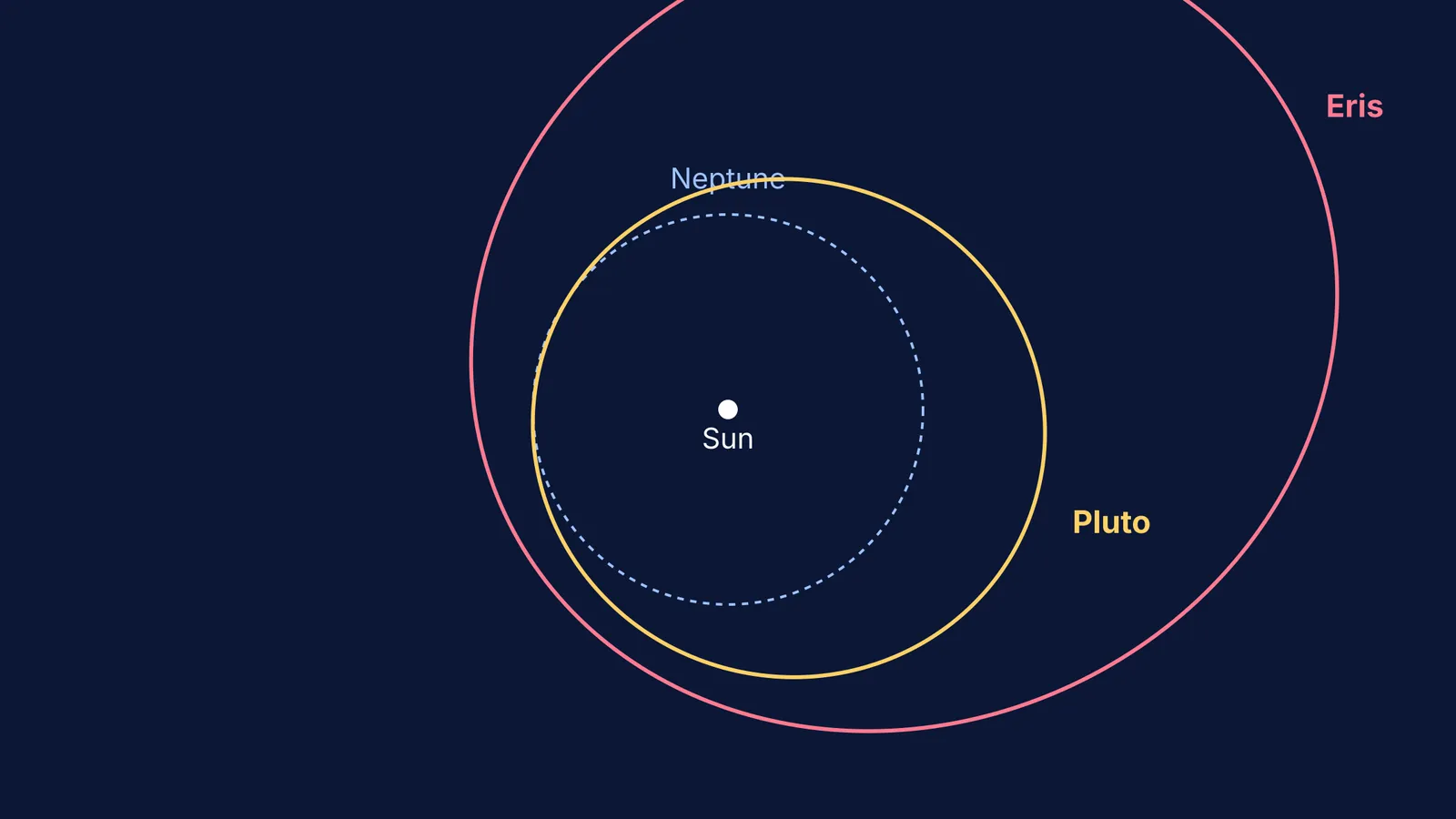
Pluto and Eris meet the first two criteria beautifully. However, because they share their orbits with thousands of other icy bodies in the scattered disc and the Kuiper belt, they fail the third requirement.
Today, Pluto and Eris are the most famous members of this new category of dwarf planets. Because Eris and Pluto have highly elliptical orbits that take them far from the Sun, mapping their paths requires understanding conic sections and energy conservation. Fermi's AI tutor can help you work out what you already know about gravitation and build a plan for the session, so you sit down to a clear next step when studying these distant worlds. You can also see how they behave much like the Hulse-Taylor binary pulsar and other systems governed by orbital mechanics.
By discovering Eris, Mike Brown's team forced the scientific community to confront an inconsistent definition. While Pluto lost its planetary status, the rigorous scientific process ultimately gave us a much clearer and more accurate model of our solar system's structure.


