

On this page
In 1907, Prague doctor Jan Janský went looking for a link between mental illness and blood, found none, and showed instead that human blood falls into four groups. He called them I, II, III and IV. You know them as O, A, B and AB.
Who was Jan Janský and what did he find in 1907?
Janský (1873–1921) studied medicine at Charles University and worked as a serologist, neurologist and psychiatrist at a psychiatric clinic in Prague, according to Radio Prague International. The same profile says he collected more than 3,000 blood samples.
His paper, *Haematologické studie u psychotiků* (Haematological study of psychotics), appeared in the Prague journal Sborník klinický, volume 8, pages 85–139, in 1907, as recorded in the Garrison-Morton bibliography entry for the paper. It found no link between mental disorders and blood conditions (his biography on Wikipedia).
He was not the first to see blood groups. Karl Landsteiner described three in 1901 (Landsteiner's paper in English translation), and his students Alfred von Decastello and Adriano Sturli found a fourth type in 1902 without naming it as a group (history of the ABO system). Janský put all four into one numbered scheme.
How do Janský's groups I to IV match O, A, B and AB?
Janský's numerals map onto today's letters like this (Radio Prague International), with antigens and antibodies from the NHS guide to blood groups:
Group I = O: no A or B antigen on the red cells; anti-A and anti-B antibodies in the plasma.
Group II = A: A antigen on the cells; anti-B in the plasma.
Group III = B: B antigen on the cells; anti-A in the plasma.
Group IV = AB: both antigens on the cells; neither antibody in the plasma.
Radio Prague International notes that his numbering is still used in Russia and some other former Soviet states, so a report there may say group II where one in Delhi says A.
Why did two numbering systems cause trouble?
In 1910 the American physician William Lorenzo Moss published his own four groups in the Johns Hopkins Hospital Bulletin (Garrison-Morton entry for Moss). Moss's group I was AB and his group IV was O (history of the ABO system). A 1922 paper in JAMA put it plainly: Moss "transposed the Groups I and IV of the Jansky classification" (JAMA, 1922).
So "group IV" meant O to a doctor trained on Janský's scheme and AB to one trained on Moss's. Those are opposite ends: group O red cells carry no A or B antigen, while group AB cells carry both (NHS).
In 1921 the American Association of Immunologists, the Society of American Bacteriologists and the Association of Pathologists and Bacteriologists jointly recommended Janský's numbering on grounds of priority (history of the ABO system, citing Doan's 1927 review). Janský died that year, aged 48. In 1927 Landsteiner suggested replacing both sets of numerals with the letters O, A, B and AB; by the early 1950s the letters were universal, the same source says.
Landsteiner received the 1930 Nobel Prize in Physiology or Medicine "for his discovery of human blood groups" (Nobel Prize summary page). In the Czech Republic and Slovakia, frequent voluntary blood donors receive the Janský medal (his biography on Wikipedia).
How can you sort blood into four groups yourself?
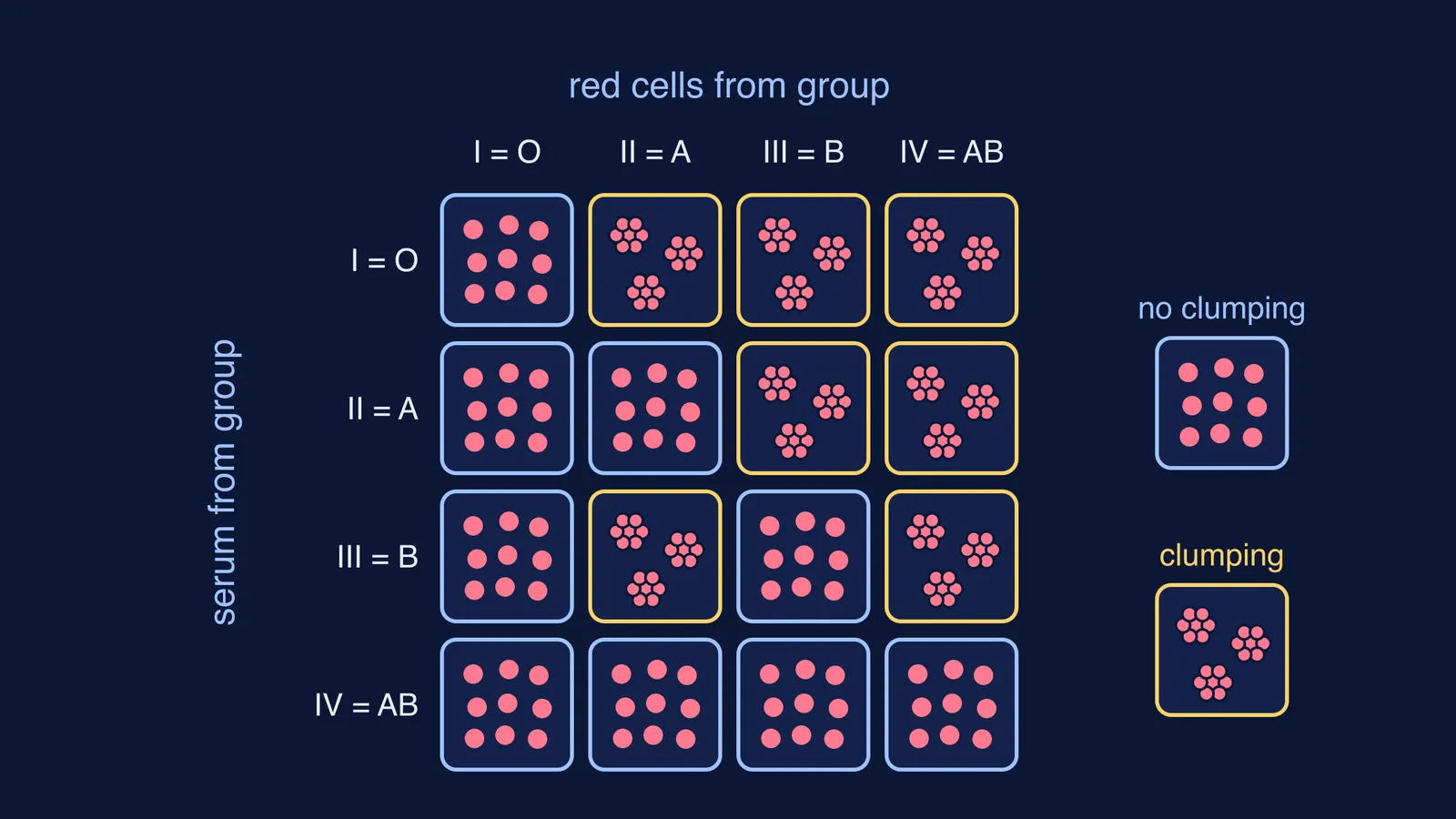
The logic fits in a 4-by-4 grid, like the one above. Mix red cells from each group with serum (the liquid left after blood clots) from each group. Cells clump when the serum carries an antibody matching an antigen on them, which is how labs still read blood groups (NHS). Row by row:
Serum from group I (O) has anti-A and anti-B, so it clumps cells from II, III and IV, but not I.
Serum from group II (A) has anti-B, so it clumps cells from III and IV.
Serum from group III (B) has anti-A, so it clumps cells from II and IV.
Serum from group IV (AB) has no anti-A or anti-B, so it clumps nothing.
Now read the columns. Group I cells never clump; group IV cells clump with every serum except their own. Janský's order runs from the cells that never clump to the cells that clump most.
Test yourself: cover the grid, rebuild the four rows from memory, then check. If antigens and antibodies still blur, the Fermi Concept Library has its own lesson for each concept in biology, so you can fix the idea before going back to the grid.
What should you remember for biology exams?
1901: Landsteiner describes three groups.
1902: Decastello and Sturli find the fourth type, now called AB.
1907: Janský classifies all four and numbers them I to IV.
1910: Moss publishes the same four, with I and IV swapped.
Today: the letters O, A, B and AB, as in your textbook.
Read how Karl Landsteiner discovered the ABO blood groups, then try predicting which blood group can donate to which. The next chapter is how Landsteiner and Wiener found the Rh blood group in 1940.


