

On this page
By 1939 doctors could match blood by ABO group, yet some patients still reacted badly to blood of the right group, and some babies were born with their red cells being destroyed. In 1940 Karl Landsteiner and Alexander Wiener found a missing piece of the puzzle: a second blood group system, named Rh after the rhesus monkey whose blood revealed it.
How was the Rh blood group discovered in 1940?
Landsteiner and Wiener reported the finding in a short 1940 paper titled An agglutinable factor in human blood recognized by immune sera for rhesus blood, in Proceedings of the Society for Experimental Biology and Medicine. A fuller study followed in the Journal of Experimental Medicine in 1941.
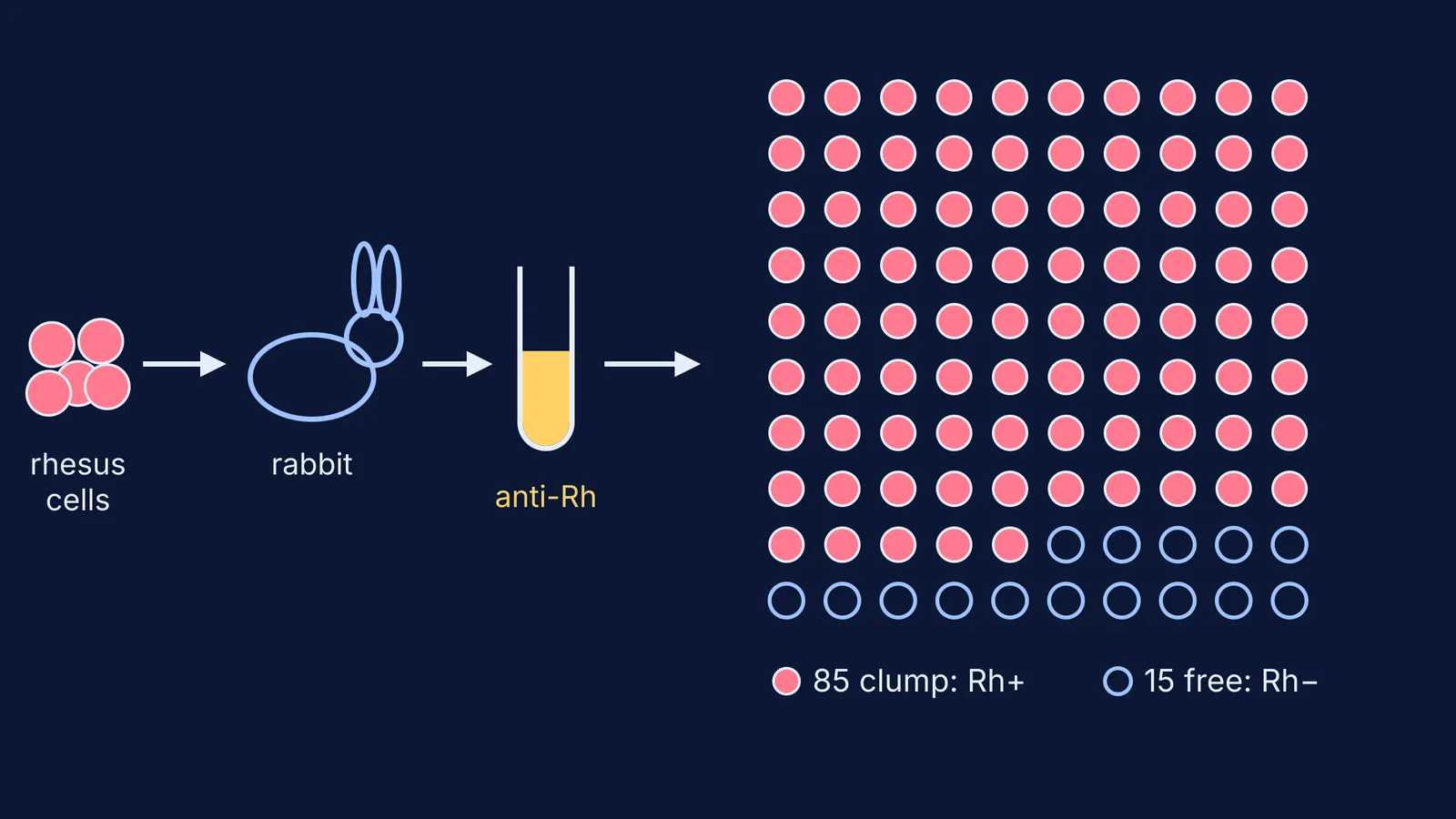
The logic runs in four steps:
Inject rabbits and guinea pigs with red blood cells from rhesus monkeys (Macacus rhesus).
The animals' immune systems treat the monkey cells as foreign and make antibodies against them.
Collect the animal serum, which now contains those antibodies (called anti-rhesus or anti-Rh).
Mix the serum with human red cells and watch which samples clump together (agglutinate).
According to the EBSCO Research Starters history of the Rh factor, the animals' serum clumped about 85 percent of blood samples from people in New York City. A 2023 review in Annals of Blood gives the same figure: the antiserum agglutinated about 85% of the human red cells tested.
If human cells clump with an antibody raised against monkey cells, those human cells must carry something the monkey cells also carry. People whose cells clumped were called Rh-positive; the rest were Rh-negative.
Why did the Rh factor explain transfusion reactions?
The same year, Wiener and H. Raymond Peters published three cases of haemolytic reactions after transfusions of blood of the same ABO group in Annals of Internal Medicine, in which the same agglutinogen (red cell antigen) was responsible. The EBSCO history says Wiener and Peters set out to show that the antibody in the rabbits matched the antibody found in people who had reacted to transfusions that ABO typing could not explain.
The idea: an Rh-negative patient given Rh-positive blood can make anti-Rh antibodies, so a later Rh-positive transfusion is attacked. ABO matching alone could not catch this.
For the earlier half of the story, read Karl Landsteiner and the discovery of the ABO blood groups; for what came next, Charles Drew and the science of storing blood plasma.
What does Rh incompatibility mean in pregnancy?
A clue had already arrived in 1939. Philip Levine and Rufus Stetson described an unusual case of intra-group agglutination in JAMA: a mother who had a stillborn baby. The EBSCO history notes her blood reacted with 80 of 104 ABO-compatible donors. The antibody behind it was later linked to Rh.
MedlinePlus, from the US National Library of Medicine, explains the mechanism. Rh incompatibility develops when a pregnant woman has Rh-negative blood and the baby has Rh-positive blood. Her immune system can treat the baby's red cells as foreign and make antibodies. Those antibodies can cross the placenta and destroy the baby's red cells. First babies are often not affected, because it takes time for the mother to make antibodies.
MedlinePlus adds that Rh incompatibility is almost completely preventable, and that special immune globulins, called RhoGAM, are used for mothers who are Rh-negative. If someone in your family is Rh-negative and pregnant, their obstetrician is the right person to ask.
What did later scientists correct?
The Annals of Blood review explains that the anti-rhesus antibody Landsteiner and Wiener found was later shown to be anti-LW. The LW antigen is more strongly expressed on Rh-positive cells than on Rh-negative ones, which is why the results lined up so well. According to the EBSCO history, Levine suggested calling the factor in the monkeys LW, after Landsteiner and Wiener.
Today, Rh-positive or Rh-negative means the presence or absence of the D antigen, one of five main Rh antigens (D, C, c, E and e), as the Annals of Blood review describes. The name Rh stuck anyway.
How common is Rh-negative blood in Bangalore?
A study of 36,964 blood donors in and around Bangalore, published in the Asian Journal of Transfusion Science, found 94.20% were Rh-D positive and 5.79% Rh-D negative.
Turn that into numbers you can picture:
In that study: 5.79% of 36,964 is about 2,140 Rh-negative donors.
In a class of 40: 5.79% of 40 is about 2.3, so you would expect two or three Rh-negative students.
Compare with 1940 New York: the EBSCO history says the remaining 15 percent did not clump with the animal serum, a much larger share than in Bangalore.
If the antigen and antibody idea still feels slippery, the Fermi Concept Library gives each biology concept its own lesson and its place in the map, so you can see how blood groups connect to immunity. For the NEET syllabus view, read our guide to body fluids and circulation, including blood groups.


