On this page
On January 23, 1960, the bathyscaphe Trieste became the first crewed vessel to reach the bottom of the Challenger Deep in the Mariana Trench. Piloted by Swiss oceanographer Jacques Piccard and U.S. Navy Lieutenant Don Walsh, the vessel descended to a record depth of approximately 10,916 meters.
At this extreme depth, the pressure is crushing. The craft was designed to withstand 1,250 kilograms per square centimetre. To survive without being crushed or relying on a surface tether, the Trieste used a brilliant application of physics designed by Jacques's father, Auguste. The secret was an incompressible petrol float for buoyancy and a fail-safe iron shot ballast system.
Why did the Trieste use a petrol float?
Standard submarines use highly compressible air tanks. At the trench's bottom, water pressure would crush an air-filled tank instantly (Wikipedia). For context on how fast ocean pressure builds, every 10 metres of water adds one atmosphere of pressure.
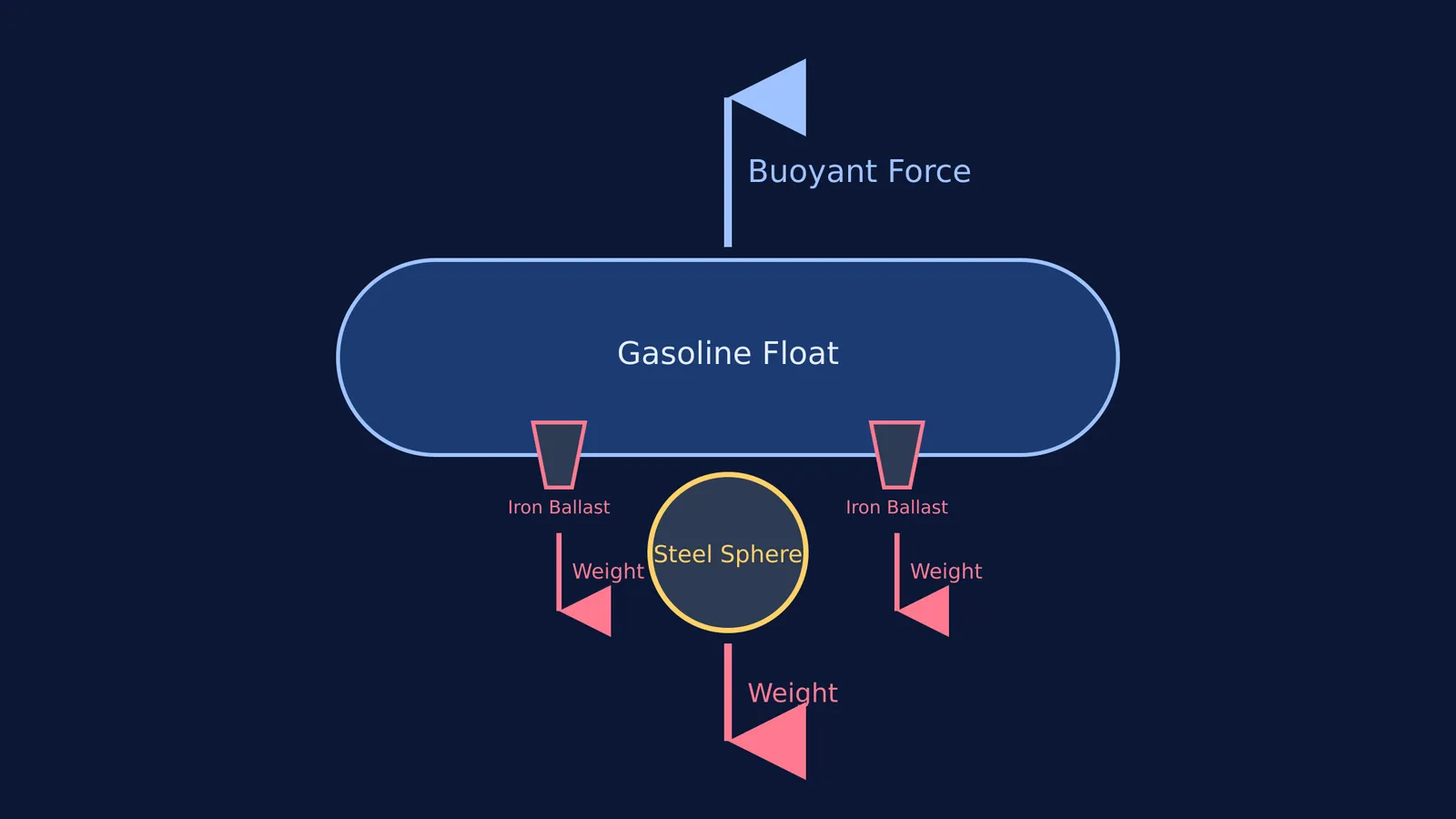
To solve this, the Trieste suspended its heavy steel crew cabin from a massive hull filled with gasoline (petrol). Gasoline is significantly less dense than seawater, so it provided the upward buoyant force needed to keep the heavy craft afloat. More importantly, gasoline is relatively incompressible.
The float was left open at the bottom. As the Trieste descended, seawater entered the float to equalize the inside and outside pressure. This allowed the float to be built from thin metal rather than heavy armor. The two pilots sat safely below in a 14.25-ton Krupp steel sphere with walls 127 mm thick to withstand the crushing depth. The sphere had a single acrylic glass porthole.
What did the crew see at the bottom of the trench?
Upon reaching the seafloor, the pilots reported an unexpected sight: what appeared to be flatfish swimming in the freezing depths. They noted the bottom was composed of diatomaceous ooze, a soft sediment. Because the unheated cabin temperature dropped to a chilling 7 °C (45 °F), their stay was brief.
They communicated with their support ship using a sonar voice system, but every message took about seven seconds to reach the surface due to the immense distance.
How did the iron shot ballast work?
To sink, the Trieste needed to become heavier than the water it displaced. It flooded small water tanks and carried 18 metric tons of iron shot stored in two conical hoppers. As it descended into freezing depths, the gasoline contracted and became less buoyant, accelerating the sink rate.
To slow their descent or return to the surface, the pilots simply released some iron shot. Dropping the heavy iron reduced the craft's weight, allowing the float's buoyant force to pull them upward. You can see similar principles in experiments such as when you explain buoyancy with clay boats.
The tense descent took 4 hours and 47 minutes. At around 30,000 feet, an outer window pane cracked with a loud bang due to the immense pressure, though the inner sphere held.
How did the Trieste return to the surface?
The most ingenious part of the ballast system was its safety mechanism. The iron shot was held in the hoppers by electromagnets rather than mechanical doors.
This provided an automatic fail-safe. If the Trieste lost electrical power at the ocean bottom, the electromagnets would turn off. The iron shot would instantly pour out, and the gasoline float would pull the vessel to the surface. When learning how forces balance out, Fermi Simulation Lab provides interactive simulations for ideas that are easier to see than to read.
How do you solve a buoyancy problem?
If you are studying fluid mechanics, the engineering of the Trieste is a perfect example of Archimedes' principle in action. Use this checklist when solving sink-or-float problems in physics:
Identify the forces: Draw a free-body diagram showing the downward weight (gravity) and the upward buoyant force.
Check the densities: Does the object's overall density (mass divided by volume) exceed the fluid's density? The Trieste's petrol float lowered its overall density.
Account for volume changes: Does the fluid or object compress? The Trieste's petrol was chosen specifically because it does not compress under pressure, ensuring its volume remained constant.
Determine the net force: Subtract the weight from the buoyant force to find out if the object accelerates upward or downward.
The Trieste's 1960 dive proved that humans could reach the deepest parts of the ocean. By replacing vulnerable air tanks with incompressible fluid and mechanical locks with fail-safe magnets, the Piccards engineered a vessel that worked in harmony with the ocean's extreme physics.