On this page
In 1962, J. B. Gunn was studying gallium arsenide (GaAs) at IBM when his experiments gave inconsistent results. He refused to write them off as noise. They turned out to be a current oscillating on its own, at microwave frequencies, inside a plain slab of semiconductor. That is the Gunn effect. The Wikipedia biography of J. B. Gunn calls the Gunn diode that came from it "the first inexpensive source of microwave power that did not require vacuum tubes".
Who was J. B. Gunn?
John Battiscombe Gunn was born in Cairo, Egypt, in 1928, according to his Physics Today obituary; friends and family knew him as Ian. He took a degree at Trinity College, Cambridge, and worked at the Royal Radar Establishment in Malvern, then at the University of British Columbia, before joining IBM's new research lab in Yorktown, New York.
The obituary records that he became an IBM Fellow in 1971, was elected a foreign member of the US National Academy of Engineering in 1978, retired from IBM in 1990 and died on 2 December 2008.
What did Gunn see in gallium arsenide?
A 1967 Electronics World article describes a 0.005-inch-thick slice of n-type GaAs that oscillated at slightly under 1 GHz, powered by a 6-volt DC supply. The threshold field it gives is about 3,000 volts per centimetre.
No tuned circuit was involved: a steady voltage went in, and an alternating current came out.
Gunn reported the result in "Microwave oscillations of current in III-V semiconductors"90041-3), published in Solid State Communications in September 1963. A longer paper, "Instabilities of current in III-V semiconductors", followed in the IBM Journal of Research and Development in April 1964.
Why does the current in a Gunn diode oscillate?
The explanation had been predicted before anyone saw it. B. K. Ridley and T. B. Watkins asked about the possibility of negative resistance effects in semiconductors in 1961, and C. Hilsum proposed transferred electron amplifiers and oscillators in 1962.
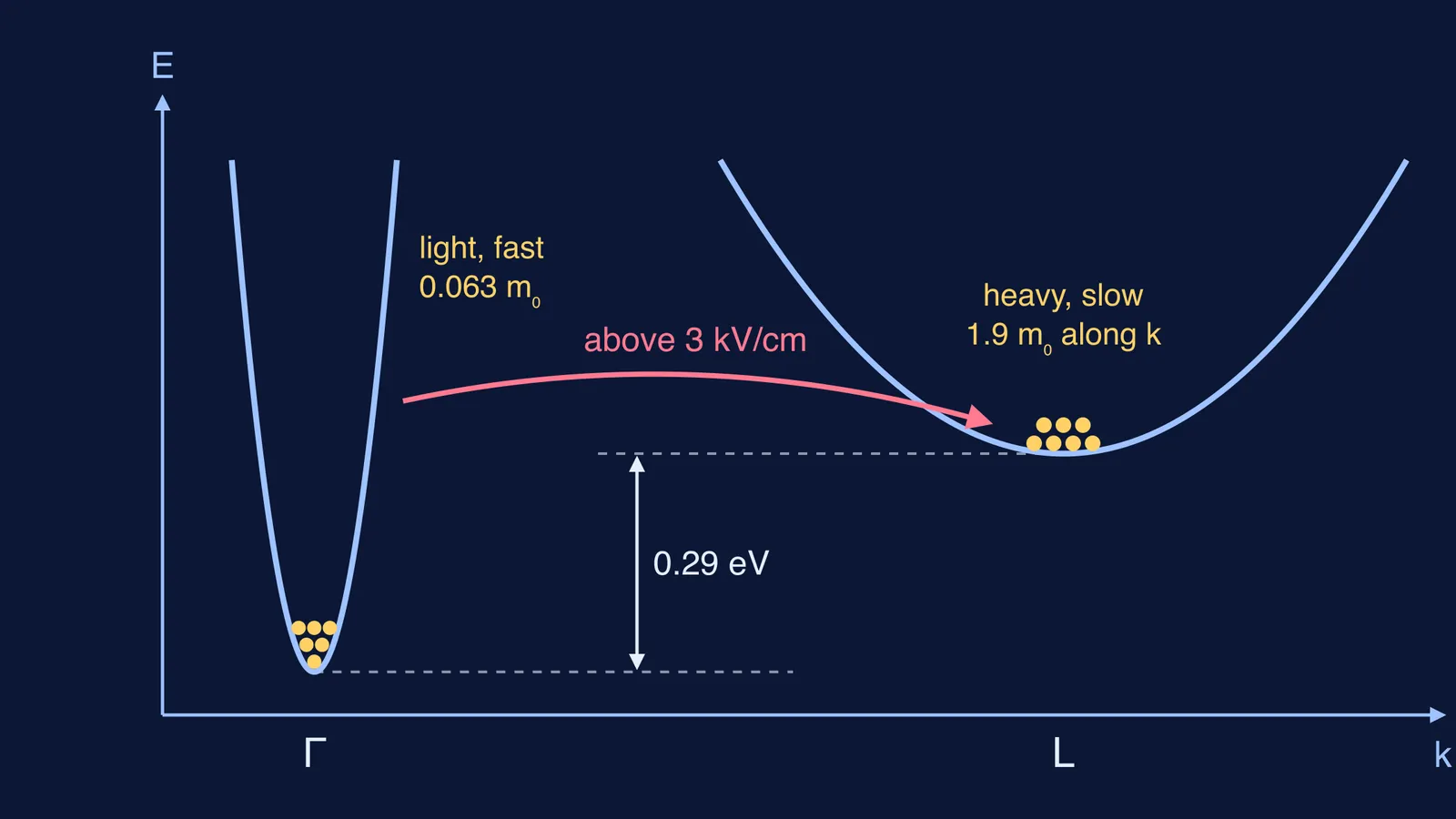
Electrons in the GaAs conduction band can sit in two "valleys". According to the Ioffe Institute's GaAs data, the main valley has an effective mass of just 0.063 times the free-electron mass, while the L valley sits 0.29 eV higher and is far heavier (1.9 times the free-electron mass along its long axis). Light electrons move fast; heavy ones crawl.
At low fields, electrons stay in the light valley. A Trinity College Dublin lecture on semiconductor devices puts the threshold at about 0.3 V per micrometre (3 kV/cm). Above that, electrons gain enough energy to hop into the heavy valley and slow down. So a bigger field gives a smaller current. That is negative differential resistance, and any device with it is unstable.
A zone of slow electrons and high field, called a domain, forms at the cathode, drifts to the anode and disappears; then the next one forms. Each crossing makes one pulse of current.
Herbert Kroemer linked Gunn's oscillations to this transferred-electron picture in a 1964 theory of the Gunn effect. In 1965, A. R. Hutson and colleagues at Bell Labs, including Alan Chynoweth, tested the mechanism by squeezing GaAs under pressure, which changes the spacing between the valleys. The Gunn diode article on Wikipedia says only transferred electrons could explain the results.
Shaky on the basics? Start with drift velocity and Ohm's law and energy bands in conductors, semiconductors and insulators.
How do you estimate a Gunn diode's frequency?
The Trinity College Dublin lecture gives the rule: frequency is roughly the domain speed divided by the length it travels, f ≈ v/L, with the domain moving at about 10^5 m/s in GaAs. Try it:
Device length 10 µm: f ≈ 10^5 / (10 × 10^-6) = 10^10 Hz, or 10 GHz. That matches the lecture's own example.
Gunn's slice: 0.005 inch is 127 µm. If a domain crossed all of it, f ≈ 10^5 / (127 × 10^-6) ≈ 0.79 GHz. That fits the "slightly under 1 GHz" in the 1967 account.
Working backwards: for 20 GHz you need L ≈ 10^5 / (2 × 10^10) = 5 µm. Higher frequency, thinner layer.
Convert inches and micrometres to metres before dividing, and treat v/L as an estimate, not an exact frequency.
If domains drifting through a slab are hard to picture, the Fermi Simulation Lab has interactive simulations for ideas that are easier to see than to read.
Where are Gunn diodes used today?
The same Wikipedia article lists radar speed guns, microwave relay links and automatic door openers, and notes GaAs devices working up to about 200 GHz. Before solid-state sources, microwaves came from vacuum tubes such as the magnetron, as in the story of Percy Spencer and the first microwave oven.
If the band theory behind all this has gaps, the Fermi Concept Library gives each concept in physics its own lesson, so you can fill them one at a time.