On this page
In the spring of 1799, a young chemist in Bristol breathed pure nitrous oxide from a silk bag and wrote down exactly what happened. Humphry Davy's record of laughing gas contains a one-sentence idea that surgeons took decades to act on.
What did Humphry Davy do with laughing gas in 1799?
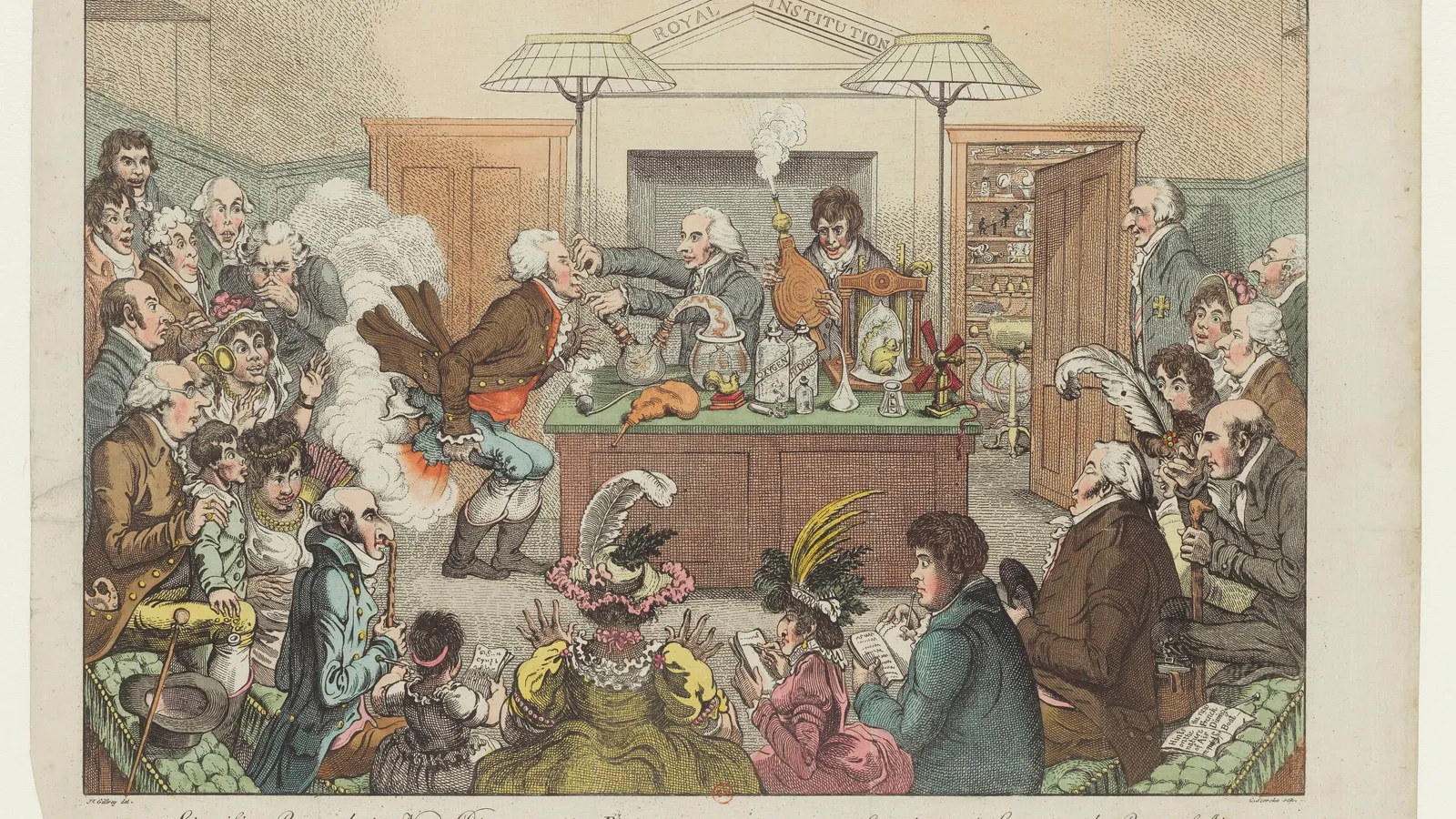
Davy was born on 17 December 1778, according to the Linda Hall Library, so he was 20 when the experiments began. He worked at the Pneumatic Institution in Bristol, which the physician Thomas Beddoes founded in the hope that new gases could treat disease, as the Public Domain Review explains.
His own account is his 1800 book, Researches, Chemical and Philosophical; Chiefly Concerning Nitrous Oxide. Davy made pure nitrous oxide in April 1799 and saw "no other way" to find out whether it was breathable than to try it himself.
11 April 1799: his first breath of the pure gas, which caused no uneasy feeling in his lungs.
16 April: three quarts from a silk bag, with Dr Kinglake feeling his pulse.
17 April: four quarts, with Beddoes in the room.
26 December: an hour and a quarter in an airtight breathing box, then 20 quarts of the pure gas.
What did nitrous oxide feel like, in Davy's words?
On 17 April, Davy felt a "highly pleasurable thrilling, particularly in the chest and the extremities", and objects around him became "dazzling". He remembered only vaguely what followed: "my motions were various and violent." All quotations here come from Davy's 1800 book, with the old spelling modernised.
After the December session he told Kinglake: "Nothing exists but thoughts! — the universe is composed of impressions, ideas, pleasures and pains!"
Davy admitted that without "remarks written immediately after the experiment", he "should have even doubted of their reality". Worried that excitement was colouring his report, he ran two more trials the same day "with scepticism" before deciding the effects came from the gas itself.
Did Davy say laughing gas could be used in surgery?
Yes, in one hedged sentence. While a wisdom tooth was coming through, Davy breathed three large doses of the gas on the worst day of the gum pain, as he describes in his book. "The pain always diminished after the first four or five inspirations," he wrote. He was honest that it came back, and that he "once imagined that the pain was more severe after the experiment than before".
He also used the gas to clear two headaches. Near the end of the book, he wrote: "As nitrous oxide in its extensive operation appears capable of destroying physical pain, it may probably be used with advantage during surgical operations in which no great effusion of blood takes place."
When was laughing gas first used to stop pain?
On 10 December 1844, the dentist Horace Wells watched a laughing-gas show in Hartford, Connecticut, and saw a man injure his legs without noticing, the Linda Hall Library records. The next morning, his former student John Riggs pulled one of Wells's wisdom teeth while he breathed the gas. Read more on Horace Wells and nitrous oxide in dentistry.
Wells's public demonstration in Boston in January 1845 went badly when the patient groaned and the crowd called Wells a "humbug". The breakthrough went to ether instead, demonstrated at Massachusetts General Hospital on 16 October 1846, according to the Linda Hall Library. Chloroform came next, as our story on James Young Simpson and chloroform explains.
A warning: the UK drug advice service FRANK says too much nitrous oxide can make you pass out from lack of oxygen, and heavy regular use can cause nerve damage that may last. India's free 24x7 mental-health helpline, Tele MANAS, is on 14416, as listed on IIT Kanpur's Tele MANAS page.
How can you write up an experiment the way Davy did?
Davy's book is a good model for a school lab record. Use this five-line template:
Date and setup: what you used and how much (Davy wrote "four quarts" and "a silk bag").
Measurements: numbers taken during the experiment, not afterwards.
Observations, written at once: before your memory edits them.
Repeat with scepticism: run it again and look for reasons you might be wrong.
Claim, sized to the evidence: use words like "may" and set limits.
Worked example. Say you heat copper carbonate twice and the mass drops both times. A weak claim is "Heating always makes things lighter." A Davy-style claim is "In two trials, heating copper carbonate reduced its mass; we think a gas escaped, and we would test this by collecting it." Davy's evidence on pain was thin, a sore tooth and two headaches, so he wrote "may probably" and limited the idea to operations with little bleeding.
If the step from observation to conclusion is where you lose marks, the Fermi Problem Library has worked problems with a step-by-step solver that explains the reasoning rather than printing an answer.
Next time you write up a practical, copy Davy's best habit: write it down the moment you see it.