

On this page
Japan's space programme did not start with a giant launch pad. It started with a rocket the size of a pencil, fired sideways through a row of paper screens strung with thin wires. According to ISAS/JAXA, the Pencil group was led by Prof. Hideo Itokawa of the University of Tokyo, "the so-called Father of Japanese Rocketry".
What was Hideo Itokawa's pencil rocket?
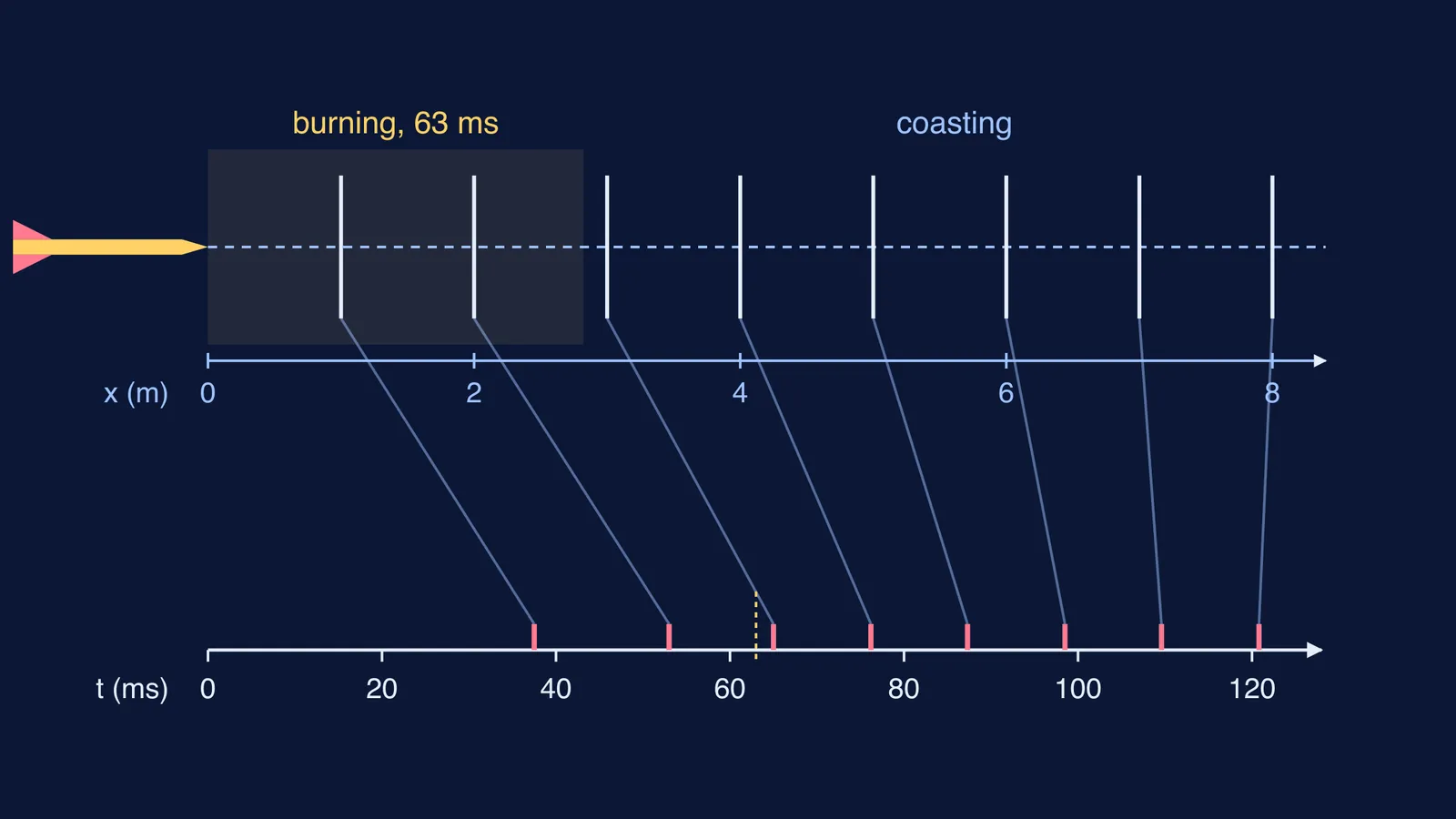
The Pencil was a solid-fuel rocket 1.8 cm in diameter, 23 cm long and 200 g in weight, according to JAXA's account of the early experiments. Its propellant was a "double base" smokeless powder made of nitroglycerine and nitrocellulose, and it burned for 63 milliseconds with a thrust of 29 kg (kilogram-force). The team first fired it horizontally on 11 March 1955 in a gun-firing pit at Kokubunji, Tokyo, followed by an open firing test on 12 April.
The Pencil launch of April 1955 "is usually counted as the start of rocket development after the War in Japan", says ISAS.
How did a 23 cm rocket give useful results?
The trick was measurement. JAXA's history says the Pencil flew through a series of thin-wired paper screens, and the team estimated how its speed changed by timing when each wire was cut, using an oscillograph (JAXA). Gap between two screens divided by time between cuts gives a speed; a row of screens shows the rocket speeding up, then coasting. The same page reports that these horizontal tests lasted 10 days and the results of all 29 flights were satisfactory.
How fast was the Pencil rocket?
You can rebuild the main numbers with Class 11 physics from JAXA's published figures. This rough model ignores air drag and burned-off fuel, so treat the answers as estimates.
Convert thrust to newtons: 29 kgf × 9.8 m/s² ≈ 284 N.
Average acceleration: a = F/m = 284 N ÷ 0.2 kg ≈ 1,420 m/s², about 145 times g.
Impulse: J = F × t = 284 N × 0.063 s ≈ 17.9 N s.
Speed at burnout: v = J/m ≈ 17.9 ÷ 0.2 ≈ 90 m/s.
Distance while burning: s = ½at² ≈ ½ × 1,420 × 0.063² ≈ 2.8 m.
Now the wire trick. Suppose two screens are 1.0 m apart in the coasting part of the flight and the oscillograph shows cuts 11 ms apart. Then v = 1.0 m ÷ 0.011 s ≈ 91 m/s, which matches step 4. A much lower measured speed would tell you drag or a weak motor mattered.
If impulse and thrust problems trip you up, our step-by-step guide to rocket thrust, u dm/dt goes further, and how a balloon rocket moves shows Newton's third law with something you can build at home. When you get the method wrong on a problem like this, the Fermi Problem Library has worked problems with a step-by-step solver that explains the reasoning rather than printing an answer.
How did the pencil rocket lead to Japan's first satellite?
The team kept scaling up. On 8 August 1955, a longer version called Pencil 300, 300 mm long, was launched at Michikawa; after a first attempt failed, a second flight reached a peak altitude of 600 m and a horizontal range of 700 m, with a flight time of 23 s (JAXA).
Fifteen years later, Japan reached orbit. In February 1970, on the fifth attempt, a four-stage solid-propellant L-4S rocket put a 24 kg payload into an elliptical orbit; it became Japan's first satellite and was later renamed Ohsumi after its launch site (ISAS).
Why is asteroid Itokawa named after him?
Asteroid 1998 SF36 was renamed Itokawa by the International Astronomical Union after "the Father of Space Development in Japan", because it was the destination of the Hayabusa spacecraft launched on 9 May 2003 (ISAS, 2003).
NASA describes Itokawa as only 0.5 km along its longest dimension and says it was discovered on 26 September 1998 by the LINEAR team at Socorro, New Mexico (NASA). Hayabusa touched down twice, collected a small amount of dust, and delivered the sample to Earth on 13 June 2010, making Itokawa the first asteroid from which samples were brought back to Earth. NASA gives Hideo Itokawa's dates as 1912 to 1999, so he did not live to see the asteroid named.
What can you take from Itokawa's way of working?
Use his pattern on your next tough chapter:
Build the smallest version first: one solved problem, not the whole chapter.
Decide what you will measure before you start, such as time taken or the step where you got stuck.
Run it many times. JAXA records 29 horizontal Pencil flights over 10 days (JAXA).
Scale up only when the small version works.
If you find a topic hard to picture, the Fermi Simulation Lab has interactive simulations for the ideas that are easier to see than to read. Then rerun the worked example: double the mass and predict the burnout speed before you calculate it.


