

On this page
In June 1923, Hermann Oberth published a 92-page book at his own expense: *Die Rakete zu den Planetenräumen*, usually translated as *The Rocket into Interplanetary Space* (Wikipedia biography, with its sources). Oberth, born on 25 June 1894 in Hermannstadt (now Sibiu, Romania), was trying to show with equations that a rocket could leave Earth. One idea in that book, building a rocket in stages that drop away, is easy to check with school physics, and we do that below.
What did Hermann Oberth's 1923 book say?
The book began as a doctoral dissertation on rocket flight, which the University of Heidelberg rejected in 1922 as too speculative, according to the US Centennial of Flight Commission. The same source says the book explained the mathematical theory of rocketry, applied it to designs for practical rockets, and considered space stations and human travel to other planets.
The Linda Hall Library's profile sums up its main conclusions:
A rocket could be built that escapes Earth's gravitational pull.
Human passengers should be able to survive the journey.
Liquid-fuel rockets were the better vehicle for spaceflight.
Space rockets should be multi-stage.
Why does a rocket need more than one stage?
The answer is in the ideal rocket equation, which NASA Glenn Research Center gives as Δu = Veq × ln(MR), where MR is the full mass divided by the empty mass: the speed gained equals exhaust speed times the natural log of full mass divided by empty mass. Because of the log, doubling the mass ratio adds only a fixed amount of speed. Every empty tank you carry makes the ratio worse.
The target: a stable low Earth orbit needs about 7.8 km/s (Wikipedia, low Earth orbit). Real launches need extra to fight gravity and air, but 7.8 km/s works for a comparison.
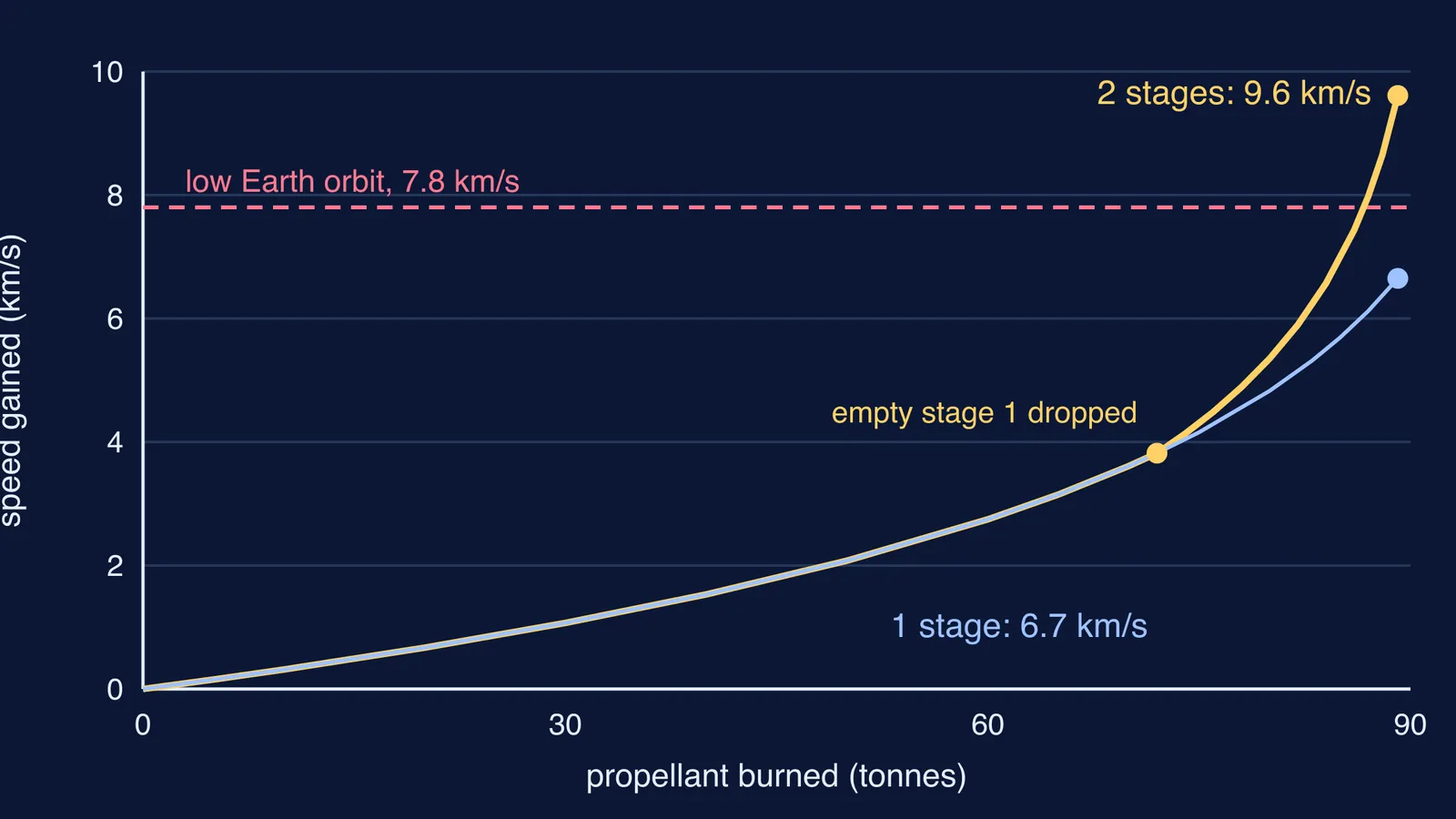
A worked example, with illustrative numbers: exhaust speed 3 km/s, a 1-tonne payload, and tanks plus engines weighing 10% of each stage.
One stage. The rocket weighs 100 t at launch: 89.1 t of propellant, 9.9 t of structure, 1 t of payload. Empty, it weighs 10.9 t. Speed gained = 3 × ln(100 / 10.9) = 3 × 2.217 = 6.65 km/s. Short of orbit.
Two stages, same totals. Stage 1 holds 72 t of propellant in 8 t of structure; stage 2 holds 17.1 t in 1.9 t. Stage 1 burns from 100 t down to 28 t: 3 × ln(3.571) = 3.82 km/s.
Drop the empty 8 t stage. The rocket now weighs 20 t.
Stage 2 burns from 20 t down to 2.9 t: 3 × ln(6.897) = 5.79 km/s.
Total: 3.82 + 5.79 = 9.61 km/s. Above orbital speed.
Our post on Konstantin Tsiolkovsky and the rocket equation derives it, and the thrust formula u dm/dt shows where the push comes from. If the mass ratio is hard to picture, the Fermi Simulation Lab has interactive simulations for ideas that are easier to see than to read.
How did one book start the rocket societies?
The Verein für Raumschiffahrt (VfR, Society for Space Travel) was founded in Breslau in 1927 by Johannes Winkler with Max Valier and Willy Ley; it grew to about 500 members and from 1930 it launched rockets from an abandoned ammunition dump at Reinickendorf, the Raketenflugplatz Berlin (Wikipedia, Verein für Raumschiffahrt). Oberth joined in 1927, and the society took great inspiration from his book (Wikipedia, Hermann Oberth).
The Centennial of Flight Commission says rocket clubs sprang up all over Germany, with the VfR the most important, and calls Oberth something of a godfather to it, encouraging Valier, Ley and a young Wernher von Braun. Oberth also advised on Fritz Lang's film *Frau im Mond* (*Woman in the Moon*), which opened on 15 October 1929 (Linda Hall Library). By 1929 he had expanded his book to 429 pages as *Wege zur Raumschiffahrt* (Ways to Spaceflight) (Wikipedia, Hermann Oberth). Von Braun later led development of the Saturn V, which our post on Wernher von Braun and the physics of lift-off works through.
What can you learn from how Oberth worked?
Oberth's method works on a physics numerical as well as a spaceship. Try this check when something seems impossible:
Write the governing equation before anything else.
Put in honest numbers, even rough ones.
Find the bottleneck. For Oberth it was dead weight; for you it may be one quantity you keep forgetting.
Change one thing in the design and recompute.
Write it up clearly enough that someone else can check you.
If you keep slipping on the logarithm or the mass bookkeeping, the Fermi Problem Library has worked problems with a step-by-step solver that explains the reasoning rather than printing an answer.
Next time you watch a launch, look for the first stage falling away: Oberth's 1923 argument in action.


