

On this page
The Saturn V carried astronauts to the Moon, and the man most linked with it is Wernher von Braun. His story is also one of the hardest in the history of science, because the rocket skills he used for NASA were first built for Nazi Germany, with prisoners forced to make the weapons. This post sets out the record from NASA and the Smithsonian, works through the physics of the Saturn V lift-off, and ends with what a student can take from both halves of the story.
Who was Wernher von Braun?
According to his NASA biography, von Braun (1912-1977) became interested in spaceflight as a teenager after reading Hermann Oberth's 1923 book on rockets, and that book pushed him to master calculus and trigonometry so he could follow the physics. He joined the German Society for Space Travel in 1928, began working for the German army on liquid-fuel missiles in late 1932, and received a doctorate in physics from the university in Berlin on 27 July 1934.
What was his part in the V-2 and the Nazi regime?
NASA's biography is direct. Von Braun was a member of an SS riding unit in 1933-34, joined the Nazi Party in 1937 and became a junior SS officer in 1940. His team at Peenemünde built the V-2, a ballistic missile first launched successfully in October 1942 and fired at London, Paris and Antwerp from September 1944.
After a bombing raid in August 1943, production moved to the underground Mittelwerk factory, which used enslaved labour from the Mittelbau-Dora concentration camp. NASA states that von Braun "was well aware of the terrible conditions and was involved in decision-making about the use of slave labor." The Smithsonian's National Air and Space Museum records that at least 10,000 concentration camp workers died making the V-2, about half of the roughly 20,000 deaths at Mittelbau-Dora.
How did he end up building a Moon rocket?
At the end of the war von Braun surrendered to the Americans. Under Project Paperclip he and his team went to the United States, first to Fort Bliss, Texas, and in 1950 to the Redstone Arsenal in Huntsville, Alabama. There they built Army missiles, and a Jupiter C rocket put the first US satellite, Explorer 1, into orbit in 1958. In 1960 the group moved to NASA, and von Braun became director of the Marshall Space Flight Center and chief architect of the Saturn V, as the NASA biography explains.
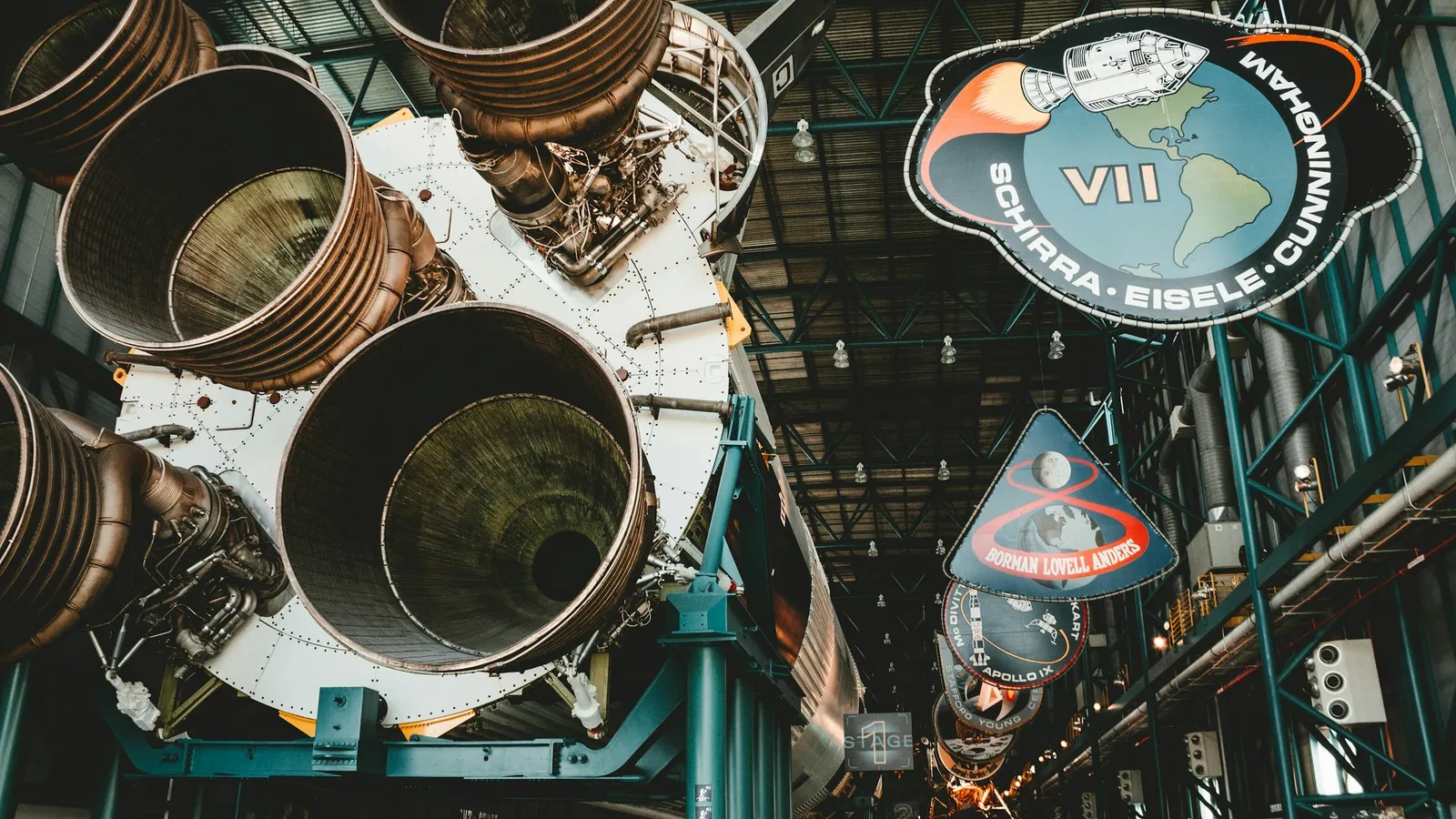
The first Saturn V flew on 9 November 1967 as the uncrewed Apollo 4 mission. NASA describes a 363-foot rocket whose five F-1 first-stage engines produced 7.5 million pounds of thrust. Less than two years later, on 20 July 1969, Apollo 11 landed on the Moon.
How fast did the Saturn V accelerate at lift-off?
This is a Newton's second law problem of the kind in the NCERT Class 11 chapter Laws of Motion. Before Apollo 11, NASA's launch commentator, recorded in the Apollo Flight Journal, said the rocket had "some 7.6 million pounds of thrust" pushing up "a vehicle that weighs close to 6½ million pounds." Those are rounded figures, so treat the answer as an estimate.
Convert to SI. Mass m = 6.5 million lb × 0.4536 kg/lb = 2.95 × 10⁶ kg.
Thrust T = 7.6 million lbf × 4.448 N/lbf = 3.38 × 10⁷ N.
Weight W = mg = 2.95 × 10⁶ kg × 9.8 m/s² = 2.89 × 10⁷ N.
Newton's second law, taking up as positive: T − W = ma.
a = (3.38 × 10⁷ − 2.89 × 10⁷) / 2.95 × 10⁶ = 4.9 × 10⁶ / 2.95 × 10⁶ ≈ 1.7 m/s².
That is only about one sixth of g. The thrust beats the weight by roughly 17 per cent, which is why the Saturn V seemed to rise so slowly at first.
What mistakes do students make here?
Forgetting the weight. Writing a = T/m gives 3.38 × 10⁷ / 2.95 × 10⁶ ≈ 11.5 m/s², almost seven times too large. Draw the free body diagram first; our guide to Newton's second law and free body diagrams shows how.
Mixing pounds of mass and pounds of force. A pound of mass is 0.4536 kg; a pound of force is 4.448 N. Convert each one with its own factor.
Assuming the acceleration stays fixed. The rocket burns propellant every second, so m falls while thrust stays high. The Apollo Flight Journal notes that the acceleration approached 4g before the centre engine was shut down. For how changing mass enters the equations, see our post on variable mass and rocket thrust.
If you can set up T − W = ma but lose track when the mass changes, the Fermi Problem Library has worked problems with a step-by-step solver that explains the reasoning rather than printing an answer.
What can a student take from von Braun's way of working?
Learn the maths the problem needs. NASA records that a book on rockets drove a teenage von Braun to learn calculus and trigonometry. Interest in a real problem is a strong reason to master a tool.
Test the whole system. NASA's Apollo 4 mission page lists objectives from structural integrity to stage separation and the heat shield, all in one flight. After it, NASA quotes von Braun as saying it was "really an expert launching all the way through" (NASA Kennedy Space Center). Check every part of your answer, not just the final number.
Ask who pays the cost. The V-2 shows that technical skill does not decide whether work is right. Scientists and engineers answer for how their work is done and what it is used for.
Next step: draw the free body diagram for a rocket at lift-off and redo the calculation with 7.5 million pounds of thrust, the figure NASA gives for Apollo 4.


