On this page
In the mid-1800s aluminium was a luxury metal. According to the Science History Institute, Napoleon III gave his most important guests aluminium cutlery while the rest ate with silver. The same source puts the 1859 price at around $17 a pound, about the same as silver. The man who first made the metal on an industrial scale was the French chemist Henri Sainte-Claire Deville. His tool was sodium.
Who was Henri Sainte-Claire Deville?
Deville was born on 11 March 1818 in St Thomas, then in the Danish West Indies, and died on 1 July 1881 at Boulogne-sur-Seine, near Paris, according to his Wikipedia biography. In 1859 he became a professor at the Sorbonne.
He was not the first to isolate aluminium. The Science History Institute records that Hans Christian Ørsted made a tiny amount in 1825 by heating aluminium chloride with potassium amalgam, and that Friedrich Wöhler got an impure powder in 1827 using metallic potassium.
How did Deville's sodium process work?
The Deville process was the first industrial process for aluminium, and it reacts sodium metal with aluminium chloride (Wikipedia: Deville process). In 1854 Deville announced that aluminium chloride could be reduced by sodium, "a metal more convenient and less expensive than potassium" (History of aluminium).
The reaction is a displacement:
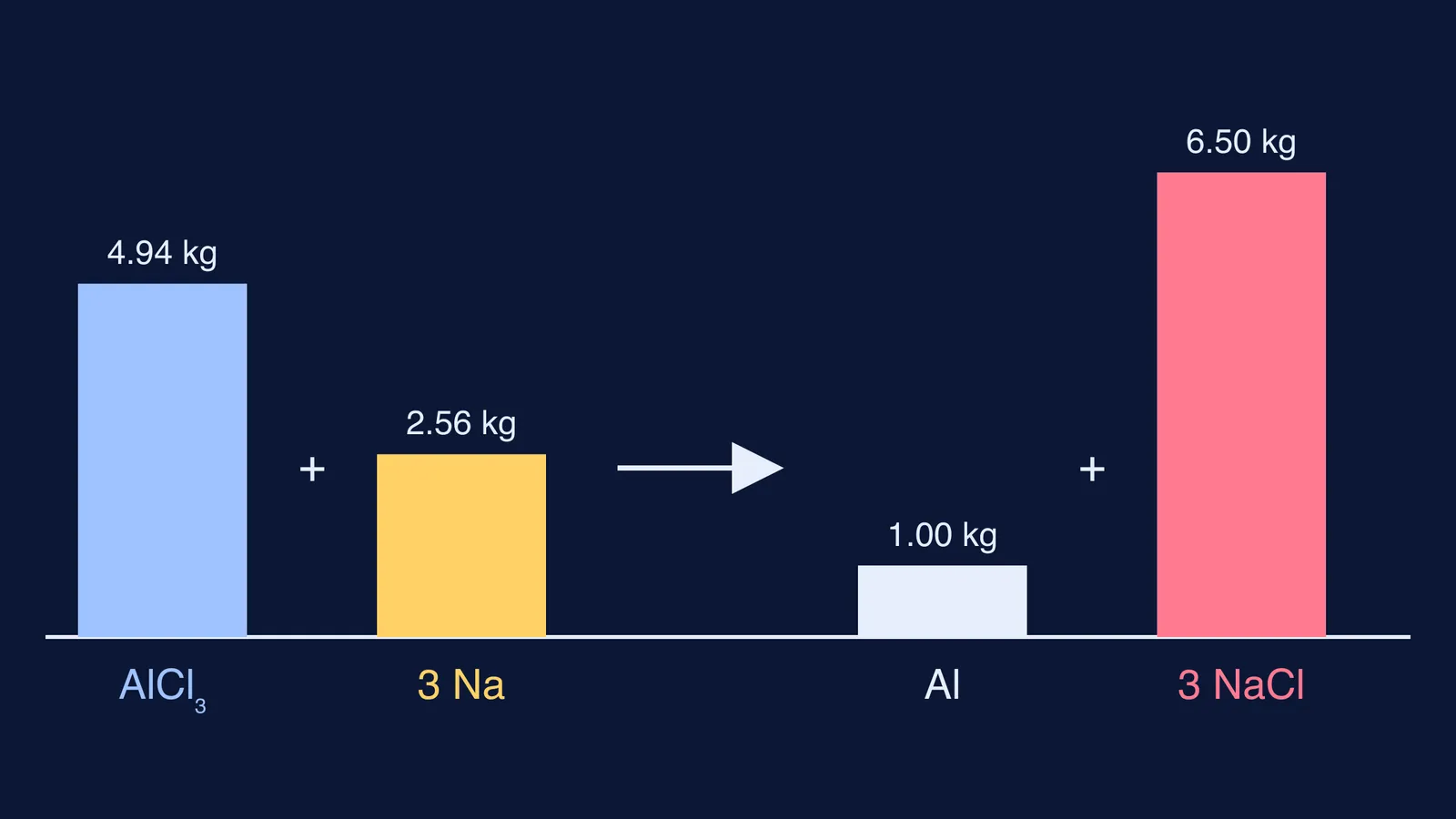
AlCl₃ + 3Na → Al + 3NaCl
Sodium sits above aluminium in the reactivity series, so it gives up its electrons and takes the chlorine. If you need a refresher on that order, see our mnemonic for the reactivity series of metals.
The catch was sodium itself. Sodium was vastly more expensive than the aluminium ores, so Deville began experimenting with ways to extract sodium as early as 1854 (Total Materia). The aluminium was also not very pure: it typically held about 1% iron and 0.75% silicon (Wikipedia: Deville process).
Worked example: how much sodium for 1 kg of aluminium?
This sum explains Deville's business problem. Use the standard atomic weights from IUPAC's atomic weights commission (CIAAW): Al = 26.98, Na = 22.99, Cl = 35.45.
Moles of aluminium in 1 kg: 1000 ÷ 26.98 = 37.06 mol.
The equation needs 3 mol of sodium per mol of aluminium: 3 × 37.06 = 111.2 mol Na.
Mass of sodium: 111.2 × 22.99 = 2556 g, about 2.56 kg.
Mass of aluminium chloride: 37.06 × 133.33 = 4941 g, about 4.94 kg.
Salt left over: 4.94 + 2.56 − 1.00 = 6.50 kg of NaCl.
So every kilogram of aluminium needed two and a half kilograms of a reactive metal that had to be made first. Cheaper sodium meant cheaper aluminium.
How far did Deville cut the price of aluminium?
Twelve small ingots were shown to the public at the Exposition Universelle of 1855 as "the silver from clay", and Napoleon III backed the work with subsidies of 36,000 francs (History of aluminium). The same source gives the price falling from 300 francs per kilogram in 1855 to 240 in 1859, 200 in 1862 and 120 in 1867. French output was still tiny: about 1 tonne a year in 1860 and 1.8 tonnes in 1872.
World production in 1884, the year a 6-pound aluminium cap went on the Washington Monument, was only 3.6 tonnes (Science History Institute).
Why did the Hall-Héroult process replace sodium?
In 1886 two young inventors, both born in 1863, found the same answer on opposite sides of the Atlantic. Charles Martin Hall made his first aluminium on 23 February 1886, and Paul Héroult filed his French patent on 23 April 1886 (Science History Institute). Both dissolved aluminium oxide in molten cryolite, Na₃AlF₆, and passed a current through it (Science History Institute profile). The same institute's magazine notes that Deville himself had found in 1859 that cryolite dissolves alumina.
Electrolysis swapped sodium for electrons. You still need 3 mol of electrons per mol of aluminium, so 1 kg needs 111.2 × 96,485 C, about 10.7 million coulombs, using the Faraday constant from NIST. Our post on Faraday's laws of electrolysis walks through that kind of calculation. With no sodium to make first, the company Hall helped found drove the price below $1 a pound by 1891 (Science History Institute).
For the American half of the story, read how Charles Martin Hall made aluminium cheap.
What should you remember for Class 12 and JEE chemistry?
Deville (1854): chemical reduction, AlCl₃ + 3Na → Al + 3NaCl.
Hall-Héroult (1886): electrolysis of alumina dissolved in molten cryolite.
Both routes need 3 electrons per aluminium atom; only the source of electrons changes.
If the mole steps above felt shaky, the Fermi Problem Library has worked problems with a step-by-step solver that explains the reasoning rather than printing an answer. For the electrolysis side, each idea has its own lesson in the Fermi Concept Library.
Try it yourself: redo the worked example for 1 kg of magnesium made from MgCl₂ with sodium, then check that your mass balance adds up.