

On this page
In the 1850s, an instrument maker at the University of Bonn sealed metal electrodes into the ends of a glass tube, pumped out most of the air and connected it to a high voltage. The thin gas inside glowed. That object, the Geissler tube, sits behind cathode rays, the electron and the neon sign.
Who was Heinrich Geissler?
Johann Heinrich Wilhelm Geissler (1814 to 1879) was a German glassblower who made his first discharge tube in 1857 (Wikipedia). The Dictionary of Scientific Biography entry on Encyclopedia.com says he set up an instrument workshop at the University of Bonn by 1852, worked with the physicist Julius Plücker, built a mercury air pump about 1855 and received an honorary doctorate in 1868. The entry says his tubes helped introduce a new branch of physics which "led directly to the discovery of the cathode rays."
Why does a Geissler tube glow?
A Geissler tube is a sealed, partially evacuated glass tube with a metal electrode at each end; a high voltage drives a current through the rarefied gas, which emits light in a colour characteristic of that gas (Wikipedia: Geissler tube). The chain of events:
The voltage accelerates the few free electrons always present in the gas.
A fast electron hitting an atom can knock out another electron: two, then four, then an avalanche.
Positive ions strike the cathode and free more electrons, which keeps the current going.
Other collisions only excite atoms. As they fall back to lower energy levels, they emit light at wavelengths fixed by those levels.
That last step is why colour identifies the gas: neon glows red and argon blue (IAEI Magazine).
Why does the gas have to be at low pressure?
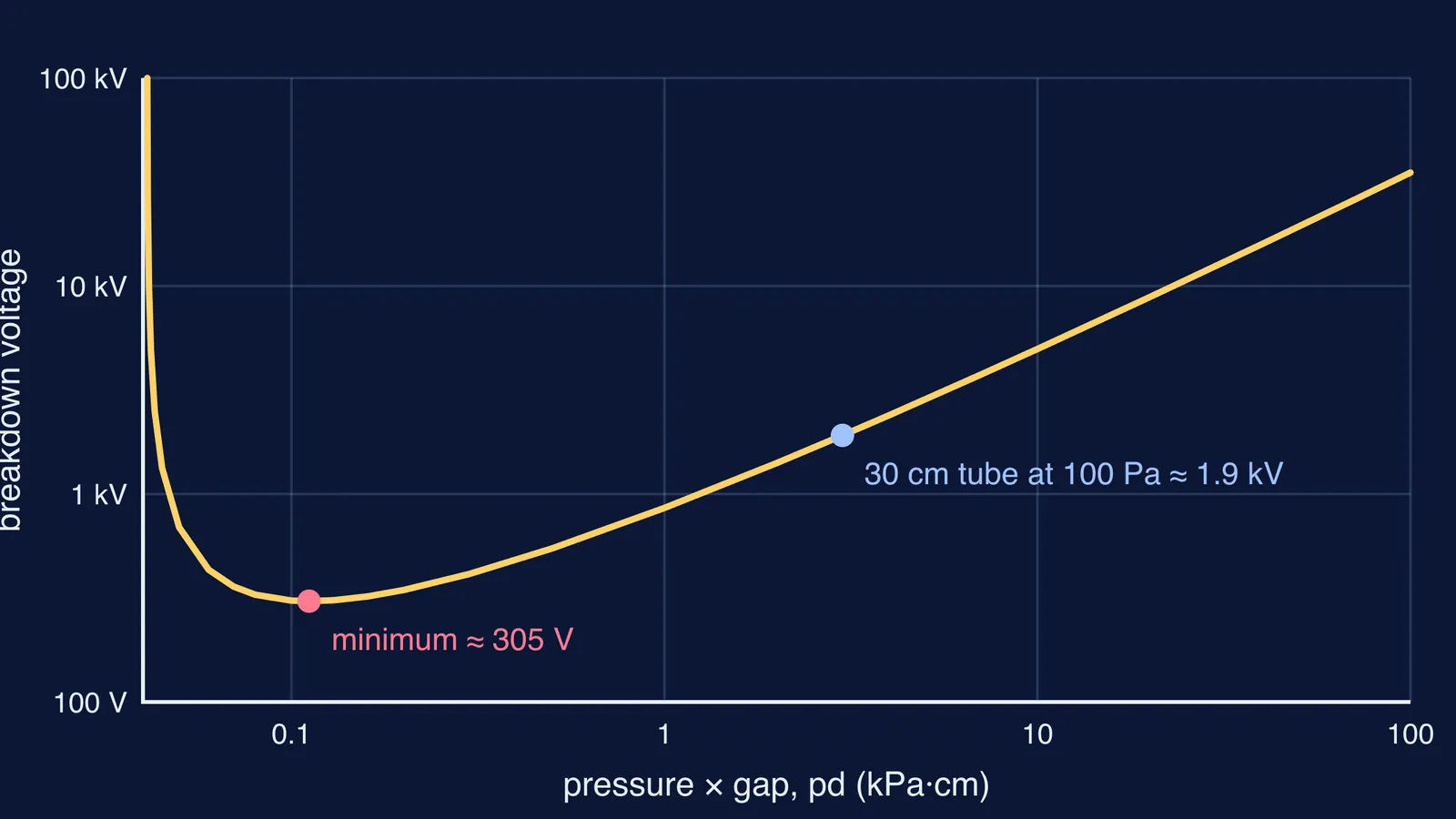
The voltage needed to start a discharge depends on pressure times gap, a result called Paschen's law (Wikipedia: Paschen's law). In dense gas, an electron collides so often that it never gains enough energy to ionise. In very thin gas, it gains plenty of energy but makes too few ionising collisions. In between lies a minimum: for air, 327 V across a gap of about 7.5 micrometres at atmospheric pressure, the same page says.
How much voltage does a 30 cm Geissler tube need?
The Paschen page gives constants for air, A = 112.5 per kPa·cm and B = 2737.5 V per kPa·cm, from a 1982 paper by E. Husain and R. S. Nema of the Indian Institute of Science, Bangalore. Take a 30 cm tube at about 100 Pa, a typical Geissler tube pressure (Wikipedia: Crookes tube).
pd = 0.1 kPa × 30 cm = 3 kPa·cm.
Assume a secondary-emission coefficient γ = 0.01, so ln(ln(1 + 1/γ)) = ln(4.615) ≈ 1.53.
ln(A × pd) = ln(337.5) ≈ 5.82.
V = B × pd / (5.82 − 1.53) = 8212.5 / 4.29 ≈ 1,900 V.
Now fill the same tube with air at normal pressure. Air breaks down at about 3 MV per metre (Wikipedia: dielectric strength), so 0.3 m needs roughly 900,000 V. Pumping out the gas cuts the voltage several hundred times, which is why Geissler's pump mattered as much as his glass.
How did Geissler tubes lead to cathode rays and neon signs?
In 1869, Johann Hittorf was the first to recognise that something travels in straight lines from the cathode, and by the 1870s William Crookes was pumping tubes down to a millionth of an atmosphere or less (Wikipedia: Crookes tube).
In 1895, Wilhelm Röntgen noticed a faint glow on a nearby screen while studying cathode radiation and found X-rays (Nobel Prize: Röntgen facts). In 1897, J.J. Thomson showed that cathode rays are made of particles, electrons (Nobel Prize: Thomson facts). Our explainer on cathode ray properties and how e/m was measured goes through Thomson's method, and how X-rays show bones follows Röntgen's rays into the hospital.
In December 1910, Georges Claude lit part of the Grand Palais in Paris with two 12-metre red neon tubes at the Paris Motor Show (Wikipedia: neon sign). In 1923, the Los Angeles Packard dealer Earle C. Anthony brought two of Claude's signs home from Paris, which introduced neon signs to the United States (IAEI Magazine).
How should you study gas discharge for exams?
Answer each question in two sentences without notes.
Why must the tube be at low pressure, and what goes wrong if the pressure is too low?
Where do the first free electrons come from, and what keeps the current going?
Why does neon glow red but argon blue?
What did Thomson measure, and why did it show cathode rays are particles?
How do cathode rays differ from the X-rays Röntgen found?
If the avalanche is hard to picture, the Fermi Simulation Lab has interactive simulations for ideas that are easier to see than to read. For the third question, link colours to line spectra with our post on how Johann Balmer found the hydrogen spectrum formula. If the worked example lost you, the Fermi Problem Library has a step-by-step solver that explains the reasoning rather than printing an answer.
Next time you pass a glowing shop sign, read its colour as a clue to the gas inside.


