On this page
In the 1960s, receiving a blood transfusion was a gamble with your liver. Doctors knew about Hepatitis A and B. However, even after screening blood for the newly discovered Hepatitis B virus began, many patients still fell ill.
It took decades of meticulous research by Harvey J. Alter at the US National Institutes of Health to prove that another, stealthier virus was hiding in the blood supply—a discovery that ultimately saved millions of lives and earned him a share of the 2020 Nobel Prize in Physiology or Medicine 1.
Why was there a hidden risk in blood transfusions?
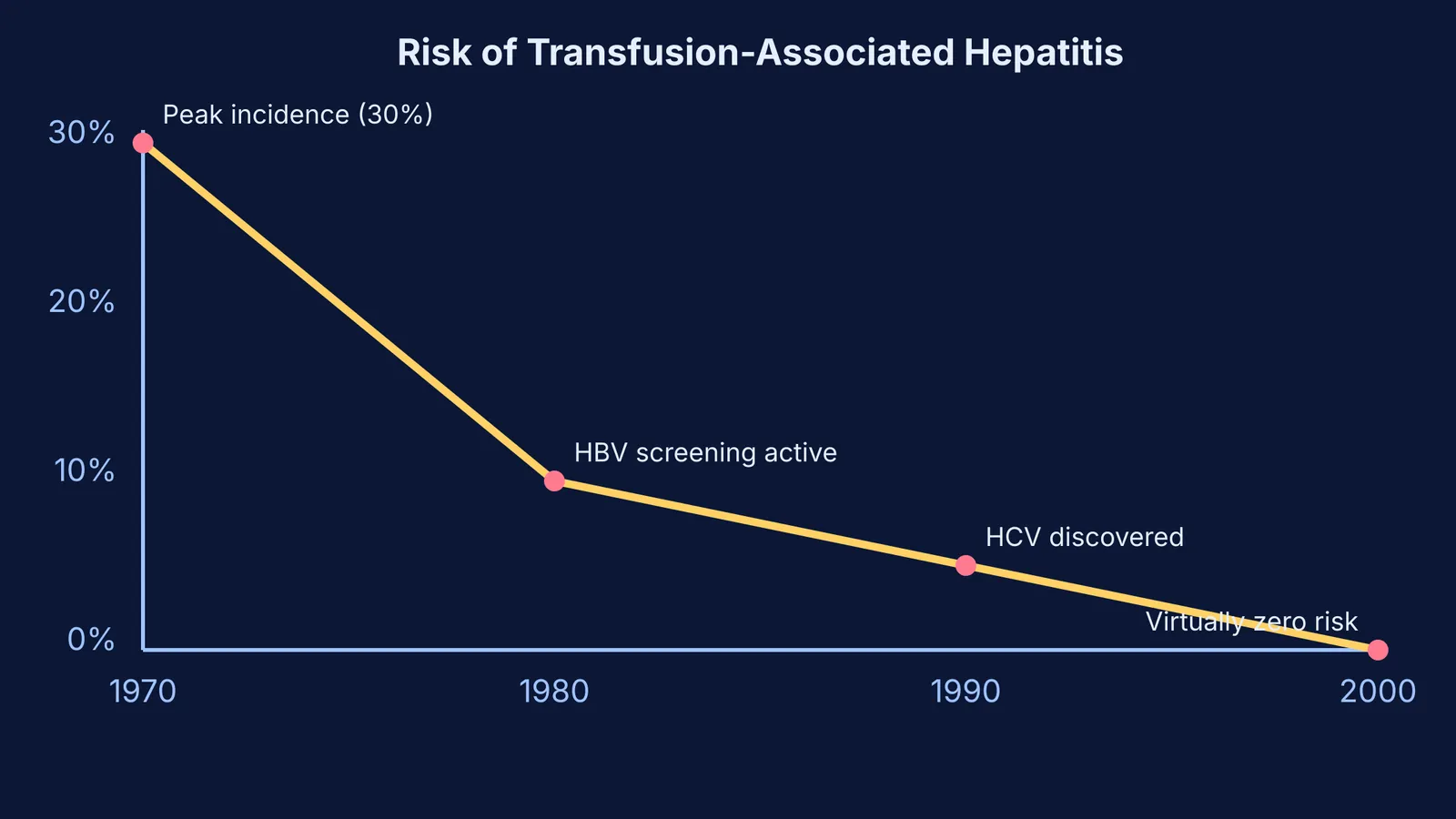
Before modern screening, the blood supply carried a silent threat. In 1970, approximately 30% of patients receiving blood transfusions developed hepatitis 2.
The medical community initially assumed Hepatitis B was the primary culprit. However, Alter and his team observed that even after Hepatitis B screening was introduced, the rate of post-transfusion hepatitis remained alarmingly high. There was a gap between the expected results of screening and the reality in the clinic. Much like Charles Drew and the science of storing blood plasma, Alter saw a systemic problem in how blood was handled and set out to make it safer.
What is "non-A, non-B" hepatitis?
Alter systematically tested the blood of patients who developed hepatitis after transfusions. He demonstrated that their illnesses were not caused by the Hepatitis A or B viruses.
He coined the term "non-A, non-B hepatitis" to describe this mysterious condition. Naming the unknown was the first step toward solving it. It defined a specific, testable target for researchers worldwide: an infectious agent that was neither A nor B, but was firmly present in human blood.
How did chimpanzees prove it was a virus?
To find a cure, scientists first had to prove the agent could be transmitted. Alter achieved this breakthrough by injecting blood from infected human patients into chimpanzees, which were found to be susceptible to the disease 2.
The chimpanzees developed the same clinical symptoms and liver inflammation as humans. This animal model provided the essential proof that "non-A, non-B hepatitis" was caused by a transmissible infectious virus. Through further experiments, his team showed the agent had the physical characteristics of a virus.
This foundation allowed other scientists to eventually isolate the genetic sequence of the virus—renamed Hepatitis C—and prove it caused the disease. Today, thanks to the blood screening tests developed from this work, the risk of contracting hepatitis from a blood transfusion has dropped from 30% to virtually zero 2.
How can finding a clear problem lead to a clear answer?
Alter did not sequence the Hepatitis C virus himself. Instead, he did the rigorous, unglamorous work of proving that a problem existed and defining its exact boundaries. By isolating what the virus *was not* and how it behaved, he made it possible for others to finally identify it. (For a similar story of identifying a mysterious pathogen, read about Carlos Chagas: a new parasite, its insect carrier and its disease.)
In science and learning, identifying exactly what you do not know is half the battle. When you are stuck on a difficult biology or chemistry concept, having a system that diagnoses your specific gaps is crucial. Fermi's AI tutor works on this principle: rather than just giving you the final answer, it works out what you already know and builds a plan for the session, so you sit down to a clear next step.
Harvey Alter's methodical pursuit of an unseen enemy reminds us that clear, structured problem-solving is the bedrock of discovery.