On this page
Before the 1880s, moving trains could not communicate with each other or with rail stations, which led to dangerous situations, according to the National Inventors Hall of Fame. Granville T. Woods, an inventor from Ohio, changed that with a patent granted on 29 November 1887. His idea used the same physics you meet in the electromagnetic induction chapter of Class 12: a changing current in one circuit induces a current in a nearby circuit, even when the two never touch.
What did Granville Woods invent in 1887?
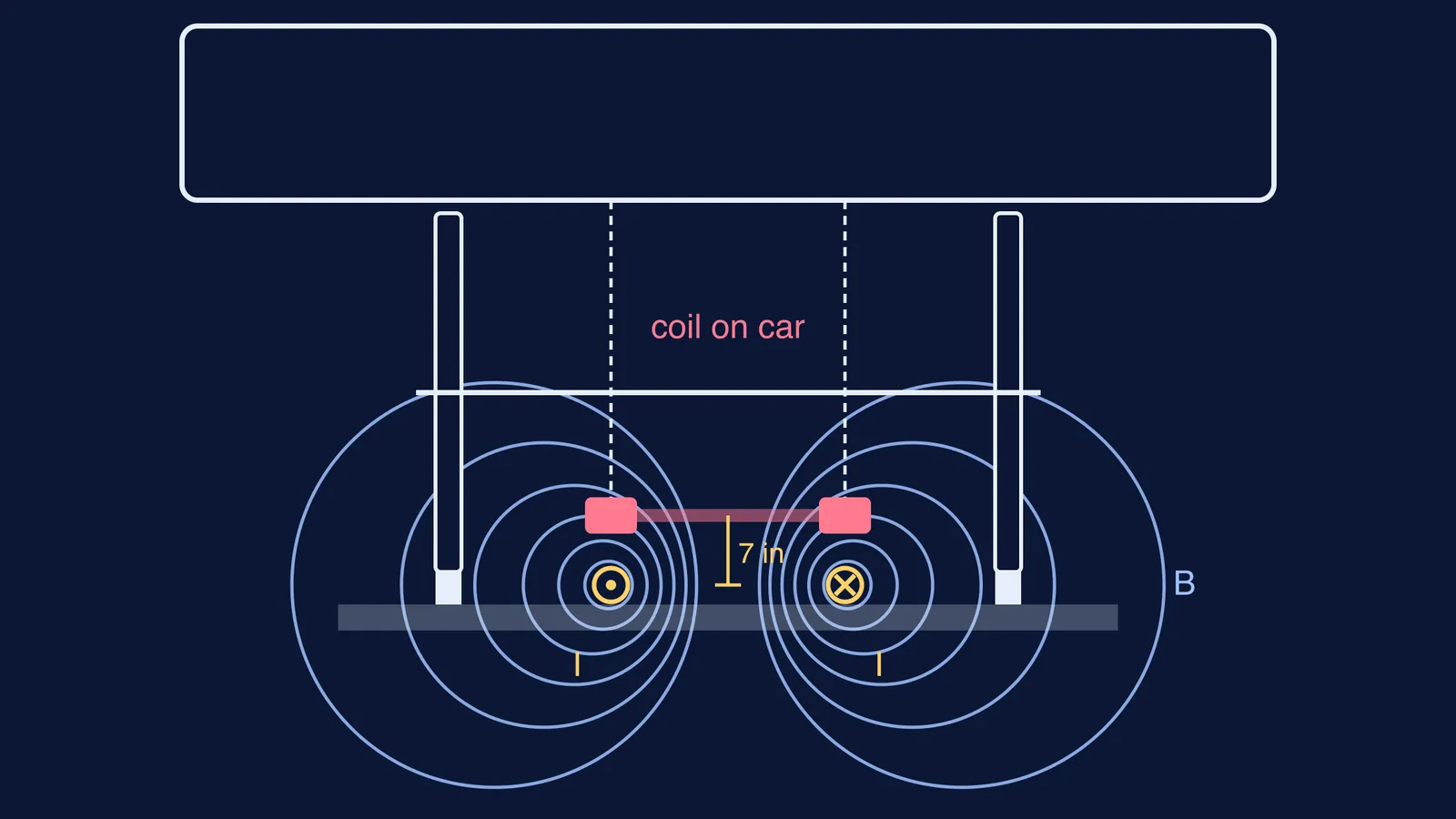
Woods was granted US patent 373,915, titled Induction-Telegraph System, on 29 November 1887. It describes a double conducting path forming one continuous circuit alongside the track, which could be laid between the rails, and an oblong coil hung from the railway car with its long sides parallel to those conductors.
A second patent, US 373,383 for Railway Telegraphy, filed on 3 November 1886 and granted on 15 November 1887, took a different route: it used the metal roof of the car as one plate of a condenser (a capacitor), coupled to the telegraph wires beside the track.
Woods was born on 23 April 1856, and his formal schooling ended at age 10, according to the National Inventors Hall of Fame, which inducted him in 2006 and says he earned nearly 60 patents in his lifetime.
How did the induction telegraph work?
The patent states the principle in one line: when two electromagnets are close enough and one is suddenly excited, "the other magnet is excited inductively by the first", and no direct electrical connection between the coils is needed (US 373,915).
In modern words, this is mutual induction. A station operator tapping a telegraph key switches the current in the track conductors on and off. Each change in that current changes the magnetic flux through the coil under the train, and a changing flux induces an emf in the coil. The receiving instrument on the train responds to those pulses, and the same link works in reverse when the train sends.
A biography published in 1887, William J. Simmons' Men of Mark.htm), described it as a system that "does not rely upon contact at all", with the coil on the moving train at least seven inches from the conductor lying between the track.
If you want the older story behind this law, read our piece on how Faraday discovered electromagnetic induction in 1831.
Why did trains need to talk to stations?
Men of Mark.htm) called it a system for communicating to and from moving trains, "intended to diminish the loss of life and property". It said Woods' aim was to avert accidents by keeping each train informed of the whereabouts of the one immediately ahead of it or following it, and also to let moving trains communicate with stations.
Who challenged Woods' patent?
Woods had to defend his claim. Lucius Phelps patented a similar system first, in 1884, and Woods secured his own patent in 1887 using notes, sketches and a working model, as Wikipedia's article on Woods summarises. Thomas Edison also claimed the invention. In 1887, Men of Mark.htm) reported that the patent office had "twice declared Mr. Woods prior inventor of the induction railway telegraph as against Mr. Edison".
Can you solve Woods' problem as a Class 12 numerical?
Here is a worked example with illustrative numbers.
Suppose the mutual inductance between the track loop and the train's coil is M = 2 mH. The station operator lifts the key and the track current falls from 0.5 A to zero in 0.01 s.
Rate of change of current: dI/dt = (0 - 0.5) / 0.01 = -50 A/s.
Induced emf in the train's coil: e = -M (dI/dt) = -(2 x 10^-3)(-50) = 0.1 V.
When the key is pressed again and the current rises at the same rate, the emf has the same size and the opposite sign, as Lenz's law predicts.
While the current stays steady, dI/dt = 0, so the emf is zero.
Now test yourself with three follow-ups:
If the operator switches the same current twice as fast, what happens to the emf?
If the coil hangs farther from the track, does M go up or down, and why?
Why would a single loop of wire under the train give a weaker signal than a coil of many turns?
If any of these feels shaky, our explainer on self and mutual inductance goes through the definitions step by step. When the picture of changing flux is what is missing, the Fermi Simulation Lab has interactive simulations for ideas that are easier to see than to read. For more numericals like this one, the Fermi Problem Library has worked problems with a step-by-step solver that explains the reasoning rather than printing an answer.
Woods' problem, keeping trains aware of each other, is still an engineering job; see our guide to railway signalling engineering as a career.