On this page
When you think of the railways, you might picture heavy civil engineering and mechanical trains. However, the most critical part of a modern railway network is invisible. It is a web of radio signals, digital logic and sensors that ensures trains never collide.
A career in railway signalling involves designing and testing these safety-critical digital systems. With the shift from mechanical levers to electronic networks, railway companies are aggressively hiring Electronics and Communication Engineering (ECE) graduates.
If you are choosing between ECE or EEE: Which Engineering Branch Should You Choose?, signalling is one of the most stable and high-stakes paths available to electronics students.
What does a railway signalling engineer do?
A signalling engineer designs the rules and hardware that keep trains apart. The core of this is "interlocking" — the fail-safe logic that prevents a signal from showing green if the track ahead is occupied or if the track points are set to a conflicting route.
In the past, this logic was handled by rooms full of mechanical levers and physical relays. Today, it uses Electronic Interlocking (EI), where programmable logic controllers (PLCs) make the decisions in milliseconds.
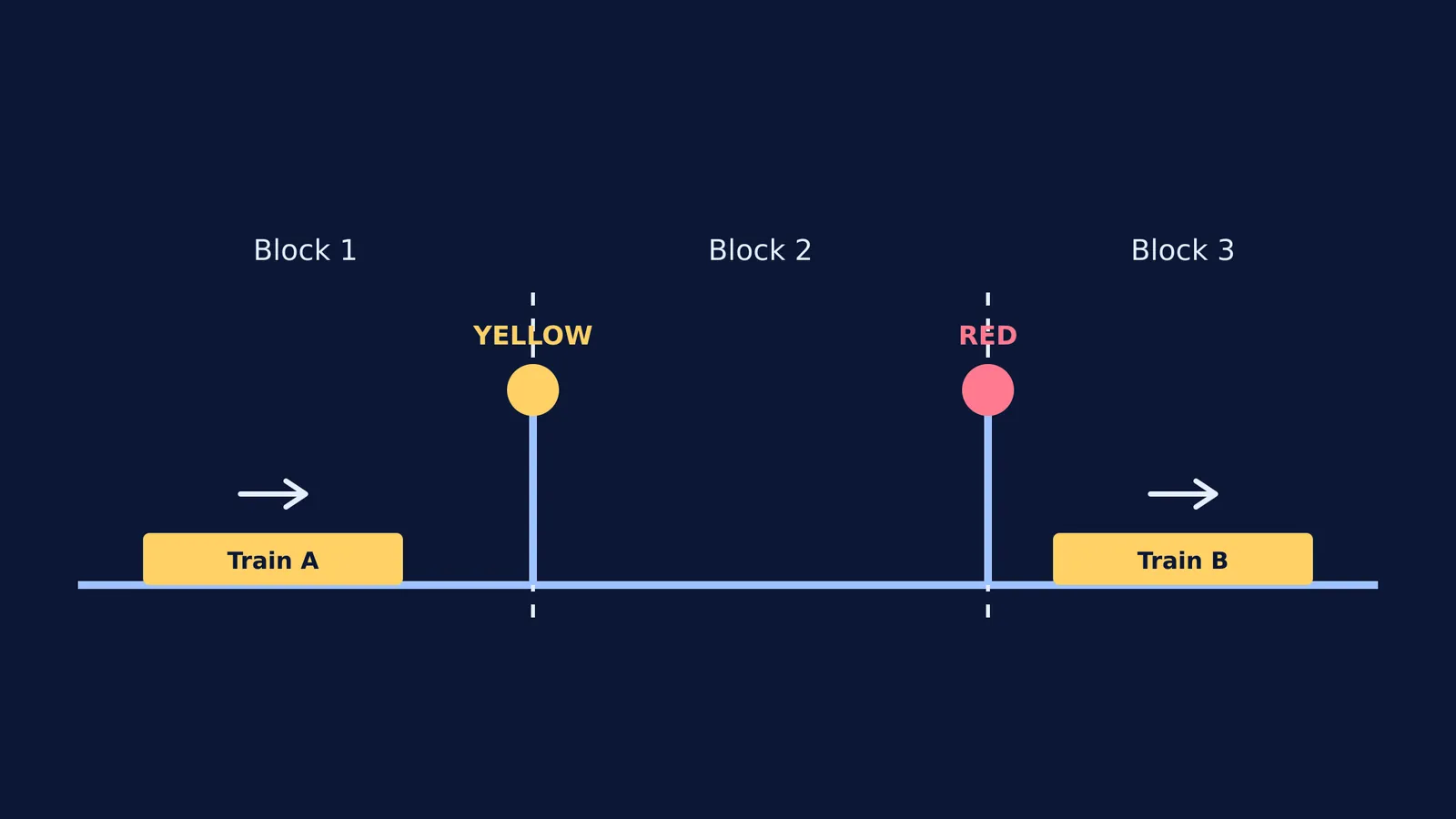
Engineers also design Automatic Block Signalling systems, which divide the track into discrete sections called blocks. To know if a block is occupied, engineers use track circuits. A low voltage is applied to the rails. When a train enters the block, its metal wheels and axles short-circuit the track, dropping the voltage. The sensors detect this drop and the system automatically turns the signal behind the train red.
Why do railways hire electronics students?
Modern signalling is essentially a massive telecommunications and embedded systems project. It is one of the most in-demand core jobs for electrical and electronics graduates.
Historically, signalling was a civil and mechanical discipline. Now, it relies on microprocessors, fibre optics and radio transmission. Instead of straining to see trackside lights in thick fog, modern train pilots receive continuous signal updates directly on displays inside their cabin. This is known as cab signalling, and it requires continuous track-to-train communication using UHF (Ultra High Frequency) radio or dedicated LTE networks.
Engineers also work with transponders, called balises, placed between the rails to transmit location data to the train as it passes over them.
If you find yourself stuck while studying the digital logic circuits or radio wave propagation required for these networks, the Fermi Concept Library has every concept in physics and computing, each with its own lesson and its place in the map.
What is the Kavach system?
In India, the most significant modern signalling project is Kavach, the indigenous Train Collision Avoidance System. It acts as an active safety net, automatically applying the brakes if a loco pilot misses a red signal or exceeds the speed limit.
The Kavach system costs approximately ₹50 lakh per kilometer to install (Source)). This makes it highly cost-effective compared to European equivalents, while still being certified to Safety Integrity Level 4 (SIL-4).
SIL-4 is the highest international standard for functional safety in electronic systems. Achieving SIL-4 certification means the system has a probability of failure of roughly one error in 10,000 years of operation (Source).
When you work on systems like Kavach, your job is not just to make the system work. You must mathematically prove that your software and hardware architectures meet this extreme standard, typically using European norms like EN 50129 and EN 50128. You will spend as much time conducting failure mode analyses as you will writing code.
How to build a railway signalling career?
To transition from a general electronics degree to a signalling career, you need to align your college projects with railway technology. Because the industry is so specialised, demonstrating an early interest sets you apart from other candidates.
Here is a checklist of skills to build while you are studying:
Master digital logic: Understand logic gates, flip-flops and microprocessors, which are the absolute foundation of Electronic Interlocking.
Study communication networks: Learn how radio frequencies, data packets and LTE work, as these form the backbone of modern cab signalling.
Read the standards: Look up the EN 50129 standard to see how safety is documented and tested in the real world.
Major employers include public bodies like the Indian Railways and metro corporations, as well as technology giants such as Siemens Mobility, Alstom and Thales. These companies often run multi-year graduate schemes specifically for electronics students, allowing you to learn the trade on the job and rotate through design, testing and commissioning roles.
If you are preparing for exams to enter these companies and want to practice your technical problem-solving, Fermi's AI tutor can walk you through practice questions on microprocessors and fail-safe logic, checking your understanding as you go.
Start by mastering your core subjects, and you will be ready to engineer the systems that keep millions of passengers safe every day.