

On this page
What core career paths exist in electrical engineering?
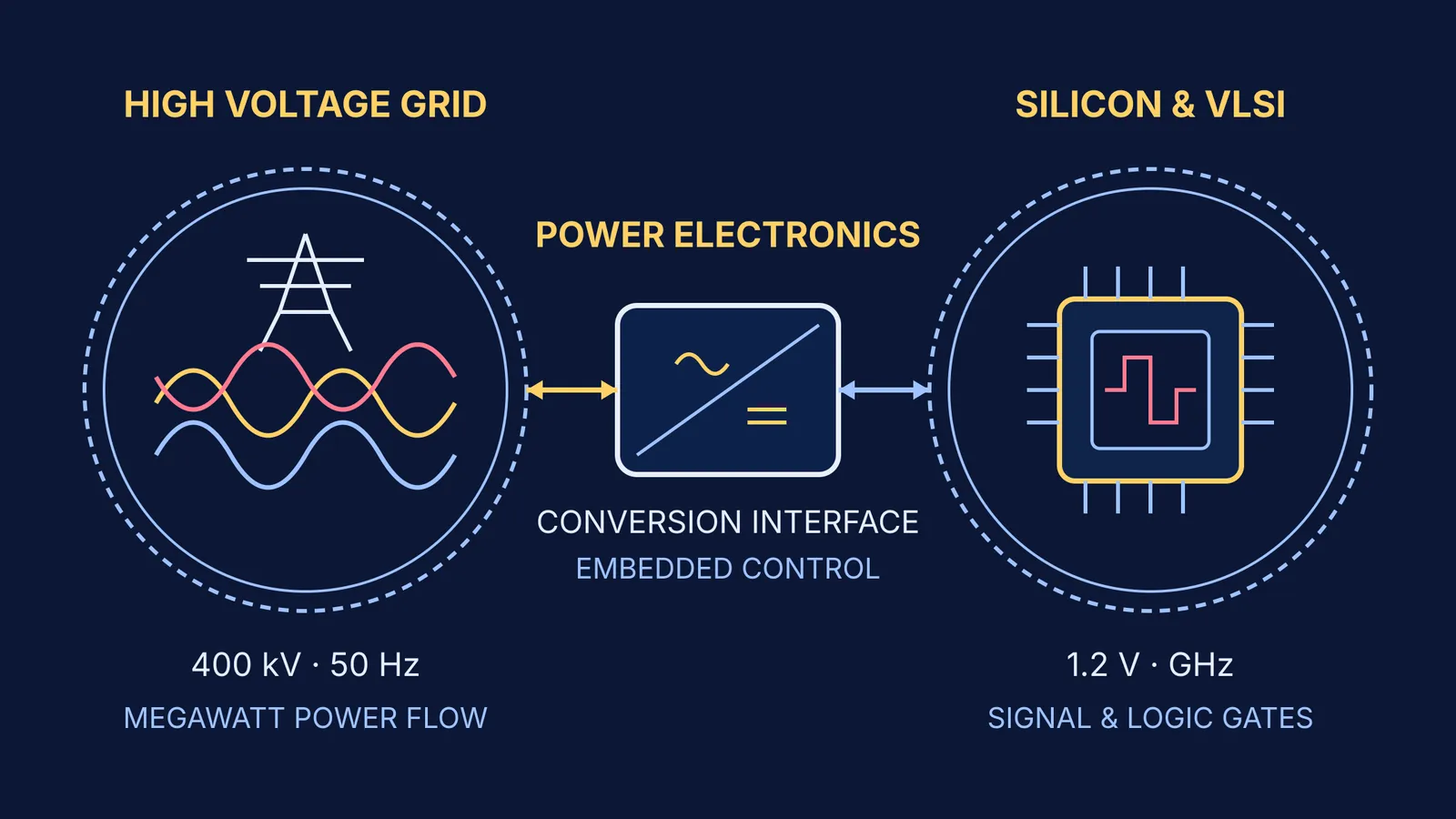
Electrical engineering focuses on generating, transmitting, distributing, and converting electrical energy at scale. If you choose this branch, your work centres on high-voltage machinery, transformers, and large-scale transmission networks rather than computer software.
India's power sector is expanding rapidly. According to the Central Electricity Authority, the National Electricity Plan projects India's total installed power capacity to reach 609,591 MW by 2026-27 and 900,422 MW by 2031-32, requiring ₹33.60 lakh crore in generation funding. Non-fossil energy sources will rise from 42.5% in 2023 to 68.4% by 2032.
Core engineering roles in this sector divide into three primary fields:
Power systems and grid operations: Engineers design switchgear, manage substations at 400 kV and 765 kV, and maintain grid stability. Mathematical methods developed by Edith Clarke remain foundational to modern load dispatch analysis.
Renewable integration and storage: Engineers connect solar and wind plants to the national grid, managing battery energy storage systems and pumped storage hydro.
Electric machinery and drives: Specialists design electric vehicle powertrains, locomotive traction motors, and industrial drives for manufacturing.
Because electromagnetic flux and 3-phase alternating current waveforms are difficult to picture on paper, the Fermi Simulation Lab provides interactive simulations for ideas that are easier to see than to read.
Where are the core opportunities in electronics and semiconductors?
Electronics and Communication Engineering deals with low-voltage signals, microcurrents, and solid-state devices. Beyond software coding, the core hardware sector offers careers in chip design, embedded systems, and communications.
National initiatives are expanding domestic hardware capabilities. Under the Chips to Startup programme, the Ministry of Electronics and Information Technology is training 85,000 specialised engineers in Very Large-Scale Integration and embedded system design over five years across more than 100 institutions to develop 175 application-specific integrated circuits and 20 system-on-chip prototypes.
Core hardware electronics careers focus on three main segments:
Very Large-Scale Integration design: Engineers write hardware code in Verilog or SystemVerilog, verify logic, and oversee physical layout at nanometre scales. Designing these devices relies on solid-state physics, including n-type and p-type carrier concentration dynamics in semiconductors.
Embedded systems and firmware: Hardware engineers design circuit boards and write firmware for microcontrollers controlling automotive systems, medical equipment, and industrial robotics.
Telecommunications and radio frequency: Engineers build radio frequency circuits, antennas, and baseband hardware for radar systems and cellular base stations.
How do public sector undertakings recruit core engineers?
For graduates seeking public sector careers, Public Sector Undertakings offer structured recruitment pathways into national infrastructure and aerospace defence.
The Graduate Aptitude Test in Engineering serves as the main screening exam. For example, Power Grid Corporation of India Limited allocates 85% weightage to the Graduate Aptitude Test in Engineering score, 3% to group discussions, and 12% to personal interviews when selecting Engineer Trainees. NTPC recruits electrical engineers for power plant operations, while Bharat Electronics Limited hires electronics specialists for radar and defence systems.
At the central government level, the Union Public Service Commission conducts the Engineering Services Examination, recruiting Group A officers into technical cadres including the Central Power Engineering Service and Indian Radio Regulatory Service.
Competitive technical selection tests emphasize fast circuit analysis. Practising methods like the node potential method builds speed during timed tests. For complex numerical problems, the Fermi Problem Library offers worked problems with a step-by-step solver that explains the reasoning rather than printing an answer.
What four-year roadmap prepares you for core roles?
A successful core engineering career requires deliberate planning across your four undergraduate years, balancing college coursework with practical design skills.
Year 1: Master engineering mathematics, circuit theory, and electromagnetism. The Fermi Concept Library covers every concept in physics, chemistry, biology, mathematics and computing, each with its own lesson and its place in the map, so you can trace prerequisites clearly.
Year 2: Build domain depth. Electrical students should study electrical machines and power systems, while electronics students focus on digital logic, semiconductor devices, and signals. Test physical circuits on breadboards using oscilloscopes.
Year 3: Learn industry software and complete internships. Electrical engineers should use MATLAB/Simulink and power analysis software; electronics engineers should learn hardware description languages and circuit board design. Seek internships at substations, manufacturing plants, or chip design firms.
Year 4: Build a capstone hardware project and prepare for competitive exams. Complete a working prototype with measured test data, such as a motor drive or radio frequency filter. Review past Graduate Aptitude Test in Engineering papers daily if targeting public sector recruitment.


