On this page
In November 1885, a wooden two-wheeler with a small petrol engine under its seat rode from Cannstatt to Untertürkheim, on the edge of Stuttgart. Its engine, by Gottlieb Daimler and Wilhelm Maybach, mattered more than the bike. The secret was speed, and you can work out the physics with Class 11 tools.
What did Daimler and Maybach build in 1885?
Daimler had been technical director at Gasmotoren-Fabrik Deutz, the company that built Nicolaus Otto's four-stroke engine, until he left in June 1882, according to the Mercedes-Benz archive biography of Gottlieb Daimler. In a workshop built onto the greenhouse of his new villa in Cannstatt, he and Wilhelm Maybach, whom he had known since 1864, set out to build, in the archive's words, "a small, light engine powerful enough to serve as a drive for various vehicles".
Their upright engine was nicknamed the "grandfather clock" (Standuhr) for its shape, and Daimler registered it on 3 April 1885 as a "gas or petroleum engine" (Mercedes-Benz archive). The version in the two-wheeler, called the riding car (Reitwagen), had one cylinder of 264 cm³ and gave 0.5 hp at 600 rpm, says the Mercedes-Benz archive page on the riding car. Daimler patented the riding car as DRP 36423, and in November 1885 his son rode it from Cannstatt to Untertürkheim at up to 12 km/h. The archive notes that research has never settled which ideas were Daimler's and which were Maybach's.
Why did a faster engine let it be smaller?
Thanks to hot-tube ignition, patented in 1883, and a controlled exhaust valve, Daimler's engine ran at 600 revolutions per minute, while existing engines topped out at 120 to 180 rpm, the Mercedes-Benz archive records. The American Society of Mechanical Engineers puts it plainly: the engine "spun at 600 rpm, trouncing rival Otto's 120 rpm."
Why does speed shrink an engine? Power is energy per second. Each power stroke does roughly a fixed amount of work, set by how much fuel and air the cylinder holds. Fire more strokes each second and the same cylinder gives more power.
How much work did each power stroke do?
Convert the power. The riding car's engine gave 0.5 hp (Mercedes-Benz archive). One metric horsepower is 735.5 W (NIST conversion factors), so that is about 368 W.
Count power strokes. A four-stroke engine fires once every two turns. At 600 rpm that is 10 turns a second, so 5 power strokes a second.
Work per stroke = 368 W ÷ 5 per second, about 74 J. That is roughly the energy needed to lift a 7.5 kg bag of rice by one metre.
Slow the same engine to 120 rpm: 2 turns a second, 1 power stroke a second, so only about 74 W.
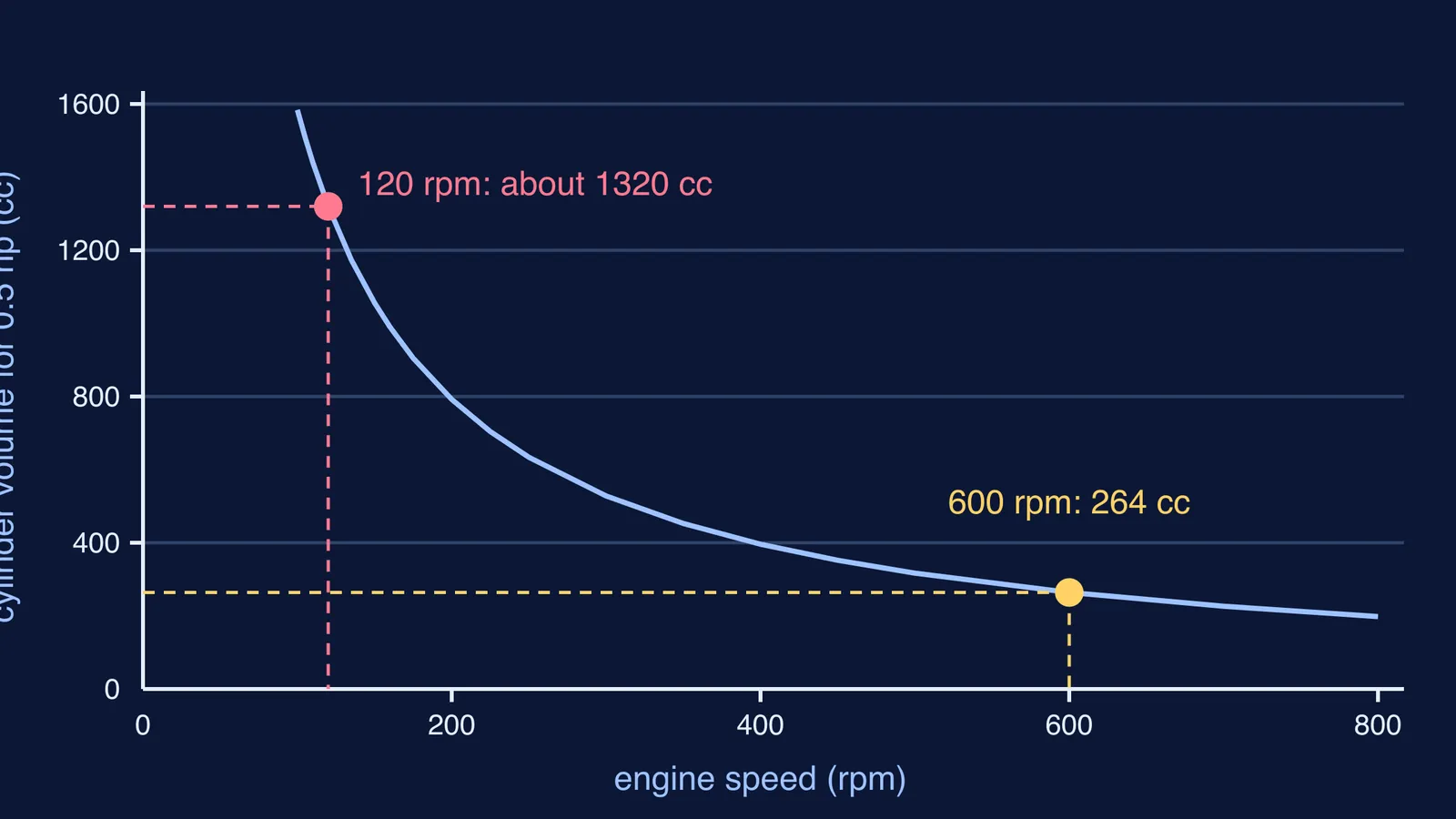
To get 368 W back at 120 rpm, each stroke must do five times the work: a cylinder of about 5 × 264 = 1,320 cm³.
The diagram at the top plots this: the volume needed falls as 1/N as speed N rises.
For the cycle itself, see Nicolaus Otto and the four-stroke cycle inside petrol engines; for what came before, how Étienne Lenoir's 1860 internal combustion engine worked.
Where did the engine go after the motorcycle?
A carriage, 1886. Daimler ordered a horse carriage, delivered ostensibly as a birthday present for his wife Emma (Mercedes-Benz archive biography). For it, the pair almost doubled the cylinder capacity of the riding car's engine and raised the output to 1.1 hp, says the archive page on the motor carriage.
A boat, 1886. In August 1886 the pair tested a motor boat powered by the grandfather clock engine on the Neckar near Cannstatt (archive biography). The Maybach heritage site describes it as a seven-metre wooden boat named Neckar.
The archive says Carl Benz's patent motor car came a few months before Daimler's carriage; compare it with how Karl Benz built his 1886 patent Motorwagen.
How can you use this in a physics problem?
Any engine question with power and rpm uses the same four steps:
Write the power in watts.
Turn rpm into turns per second; halve it for a four-stroke.
Divide power by strokes per second to get joules per stroke.
Decide what stays fixed and what changes, then redo the division.
Try one. The 1886 carriage engine gave 1.1 hp (archive page on the motor carriage). Assume it also ran at 600 rpm (the archive does not give its speed). What work did each power stroke do? You should get about 162 J, roughly double the riding car's 74 J, which fits a cylinder almost twice as big. The usual slips: forgetting to turn minutes into seconds, or that a four-stroke fires every second turn.
If a step like this trips you up, the Fermi Problem Library has worked problems with a step-by-step solver that explains the reasoning rather than printing an answer. If the four strokes are hard to picture, the Fermi Simulation Lab has interactive simulations for ideas that are easier to see than to read.