On this page
Étienne Lenoir was born on 12 January 1822 in Mussy-la-Ville, Belgium, and became a French citizen in 1870 (Wikipedia: Étienne Lenoir). In 1860 he received patent no. 43624 for "an air motor expanded by gas combustion" (same source).
Factories then ran on steam engines, which burn fuel in a firebox and send steam into the cylinder. Lenoir skipped the boiler and burned the fuel inside the cylinder itself.
What fuel did Lenoir's engine burn?
Lenoir's engine ran on illuminating gas (EBSCO Research Starters), the coal gas then used for lighting. The burnable part of coal gas was mostly carbon monoxide and hydrogen in roughly equal amounts by volume (Wikipedia: Coal gas). Coal gas carried 10 to 20 megajoules of energy per cubic metre, with about 20 typical (same source).
How did Lenoir's 1860 engine work?
An 1898 engineering handbook, Gas and Petroleum Engines, describes the cycle step by step (Project Gutenberg):
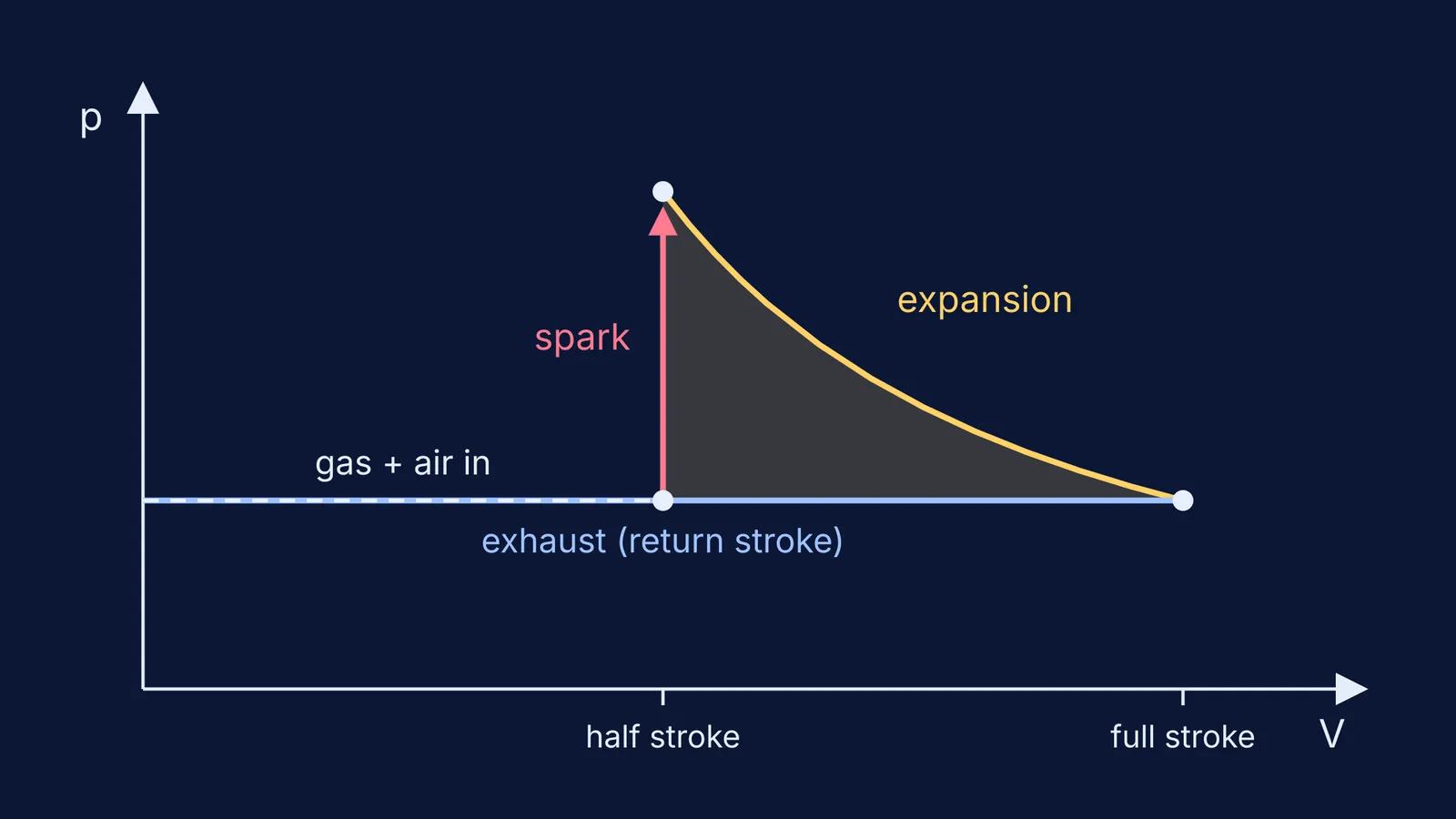
For the first half of the forward stroke, the piston draws in a mixture of gas and air.
The valves close and an electric spark from a Ruhmkorff induction coil lights the mixture.
The burning gas pushes the piston to the end of the stroke.
On the return stroke, the piston pushes the burnt gas out while the same cycle drives it from the other side.
A water jacket around the cylinder stopped the walls from overheating (same source). The engine was double-acting, with a power stroke at each end of the cylinder (Grace's Guide).
The mixture was never squeezed before it was lit: EBSCO notes that the air-gas mixture in the engines was not compressed, which reduced their power (EBSCO Research Starters). Wikipedia sums up the result as "quiet but inefficient" (Wikipedia: Étienne Lenoir).
Why was the Lenoir engine so inefficient?
The efficiency of Lenoir's engines varied between 3 and 5 percent (EBSCO Research Starters). You can check that with Class 11 physics.
Worked example. The original Lenoir engine needed 3,000 litres of gas to produce one horsepower-hour (Gas and Petroleum Engines, 1898).
Energy out: one metric horsepower is about 735.5 watts (Wikipedia: Horsepower), so one horsepower-hour is 735.5 W × 3,600 s ≈ 2.65 MJ.
Energy in: 3,000 litres is 3 cubic metres. At 10 to 20 MJ per cubic metre (Wikipedia: Coal gas), that is 30 to 60 MJ.
Efficiency: 2.65 ÷ 60 ≈ 4.4 percent with typical gas, and 2.65 ÷ 30 ≈ 8.8 percent at the low end of the range.
The typical-gas answer lands inside the 3 to 5 percent range. More than nine-tenths of the fuel's energy was lost, mostly as heat in the exhaust and the cooling water. The same handbook says cooling the cylinder took four times as much water as a steam engine of equal power needed to make its steam, and that a steam engine of equal power was considerably cheaper.
The diagram at the top shows why. The gas was lit at atmospheric pressure and had only half a stroke left to expand. Compressing the mixture first lets the hot gas start at a higher pressure and expand through a bigger ratio, so more of its heat becomes work. Sadi Carnot had already shown that even an ideal heat engine has an efficiency limit; Lenoir fell far short of that limit.
What did Lenoir's engine lead to?
Grace's Guide says fewer than 500 of the early Lenoir engines were built, some under licence in Germany (Grace's Guide). By 1865, 143 had been sold in Paris alone, and in 1863 Lenoir fitted a 1.5 hp engine to a vehicle, the Hippomobile, and drove it the 11 km from Paris to Joinville-le-Pont and back, taking about ninety minutes each way (Wikipedia: Étienne Lenoir).
Its bigger effect was on other inventors. In late autumn 1860, Nicolaus Otto and his brother learned of Lenoir's engine (Wikipedia: Nicolaus Otto). The atmospheric engine Otto built with Eugen Langen burned 1,350 litres of gas per horsepower-hour, against 2,500 or 3,000 for the Lenoir and Hugon engines (Gas and Petroleum Engines, 1898). His 1876 engine compressed the charge before lighting it (Wikipedia), and that four-stroke cycle Otto developed became the basis for engines like the one in Karl Benz's 1886 Motorwagen.
Read any engine like a physicist: four questions
Where does the fuel burn: outside the cylinder, as in a steam engine, or inside it, as in Lenoir's?
Is the mixture compressed before it is lit? If not, expect low efficiency.
How much fuel goes in for a known output? Convert both to joules and divide.
Where does the rest of the energy go: exhaust, cooling water or friction?
If the pressure-volume loop is hard to picture, the Fermi Simulation Lab has interactive simulations for ideas that are easier to see than read, and the Fermi Concept Library gives each thermodynamics concept its own lesson.
Next time a two-wheeler starts, remember its ancestor ran on lamp gas and wasted most of it.