On this page
In the summer of 1913, beside the Nile south of Cairo, long curved mirrors followed the Sun and boiled water into steam to drive an engine. The man behind it was the American inventor Frank Shuman, who lived from 1862 to 1918; historian Frank Dittmann of the Deutsches Museum calls Maadi the world's first large parabolic trough power plant (Dittmann, 2013). Most numbers below come from the engineer who tested it, A. S. E. Ackermann, in "The utilization of solar energy" in the Smithsonian Institution's annual report for 1915.
What did Frank Shuman build at Maadi in 1913?
Shuman began working on solar power in 1906, and by 1907 he had a plant running that boiled ether in black pipes inside a glass-topped water box, Ackermann reports (Smithsonian report, 1915). That first engine was in Tacony, Philadelphia, according to the Hagley Museum and Library. Toward the end of 1911 the physicist C. V. Boys joined as a consultant and suggested the key change: stand the boilers on edge inside a mirror channel with a parabolic cross-section, so sunlight reached both faces of each boiler.
That design was built at Meadi (now Maadi), 7 miles south of Cairo, in 1912. Its first boiler, made of thin zinc, failed before the official tests, and a cast-iron one replaced it in 1913. Ackermann then spent July and August 1913 at the plant and ran more than 35 trials.
Why Egypt? Ackermann argued that sun-power plants suit irrigation pumping, because the sunniest places need the most water.
How did the curved mirrors make steam?
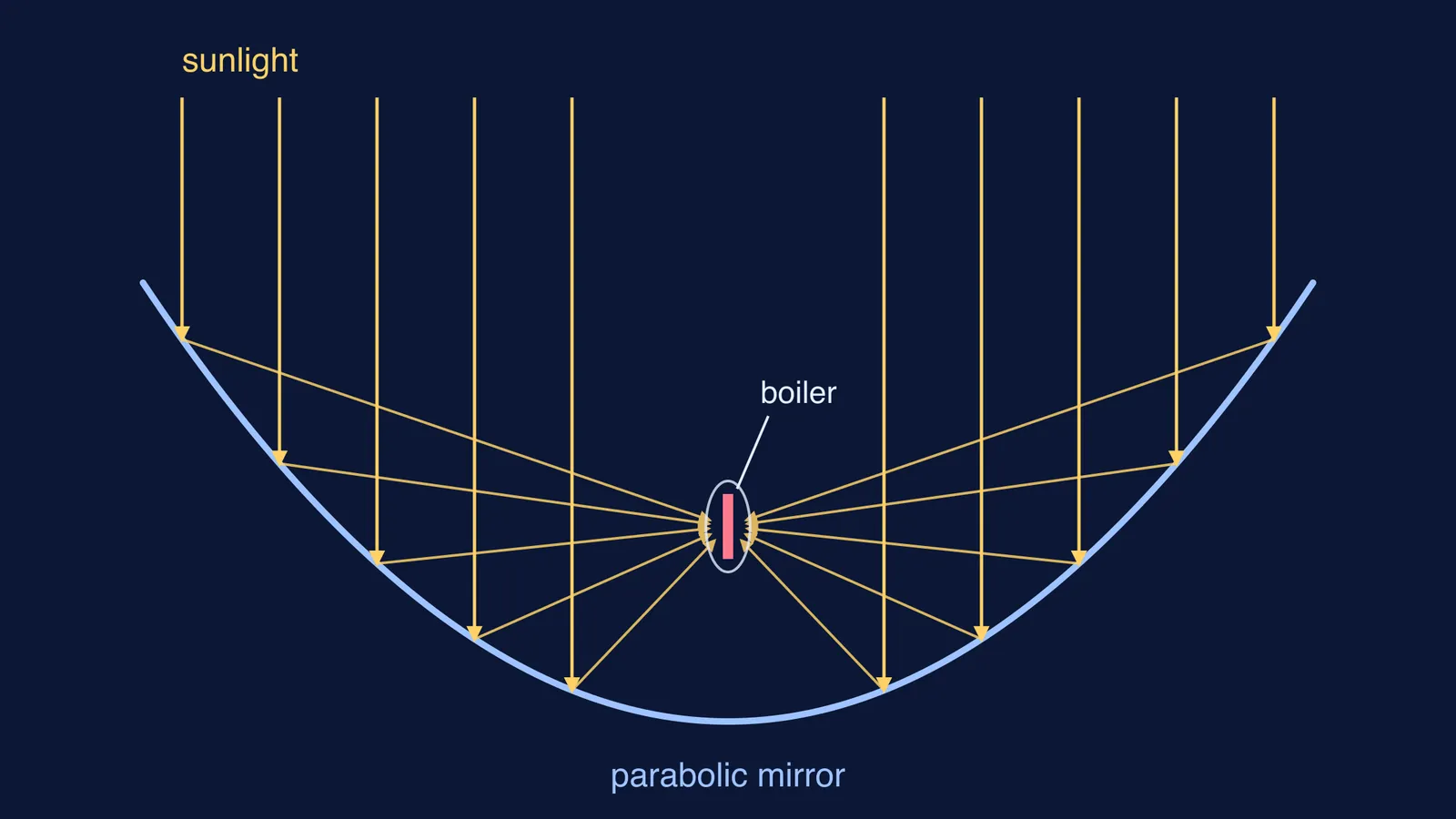
A parabola has one property that makes it useful here: every ray arriving parallel to its axis reflects through a single point, the focus. Our post on why a parabolic reflector works lets you test it yourself.
Maadi stretched that idea into long channels. According to Ackermann's report:
There were five mirror channels side by side, each 205 feet long.
Each boiler sat at the focus, covered by a single layer of glass that enclosed an air space around it.
The concentration was 43 to 1.
The channels ran north to south and tilted automatically from east in the morning to west in the evening, so they followed the Sun all day.
The total area of sunshine collected was 13,269 square feet.
Humidity mattered too: when humidity fell by 20 per cent, steam output rose by about 30 per cent.
How much power did the Maadi plant produce?
The best hour's run made 1,442 pounds of steam. Allowing 22 pounds of steam per brake-horsepower-hour for Shuman's engine, Ackermann worked this out as 55.5 brake horsepower, about 10 times anything previously attained, and equal to 63 brake horsepower per acre of land (Smithsonian report, 1915). The best efficiency of the sun-heat absorber was 40.1 per cent, against 75 per cent for the best coal-fired boiler. The best overall thermal efficiency, from sunlight to engine work, was only 4.32 per cent.
Where did the rest go? Work it through:
Sunlight to steam: the best absorber efficiency was 40.1 per cent.
Sunlight to work: the best overall figure was 4.32 per cent.
So the engine turned roughly 4.32 / 40.1, or about 11 per cent, of the steam's heat into work (rough, as the two best figures may come from different runs).
Now find the ceiling. The steam was at atmospheric pressure, so about 100 °C, or 373 K. Take the surroundings as a hot Egyptian afternoon at 35 °C, or 308 K. The Carnot limit is 1 − 308/373, which is about 17 per cent.
Both stages lost energy, but low-pressure steam capped what any engine could do. Ackermann gave two chief reasons for the low overall figure: "the steam pressure was so low", and the absorber reached only 40.1 per cent. If step 4 tripped you up, our post on why Carnot temperatures must be in kelvin shows the common mistake.
Why did Shuman's solar plant stop?
World War I derailed the project, and Shuman died in 1918, the Hagley Museum and Library notes. The basic idea outlived him: linear concentrating solar power plants today still use rows of mirrors that focus sunlight onto receivers, as the US Department of Energy explains. Shuman was not first: in the 1860s, Augustin Mouchot built a solar steam engine in France.
How can you use Shuman's plant to revise physics?
The plant packs three Class 11 and 12 topics into one machine:
Optics: draw a parabola y = x²/4f, pick three points and show each reflected ray passes through (0, f). If the rays are hard to picture, the Fermi Simulation Lab has interactive simulations for ideas easier to see than to read.
Thermodynamics: redo step 4 above with steam at 150 °C and see how much the ceiling rises.
Units: convert 55.5 horsepower to kilowatts (1 hp is about 746 W) and compare it with a household pump.
If you get stuck on a step, the Fermi Problem Library has worked problems with a step-by-step solver that explains the reasoning rather than printing an answer.