On this page
Most students meet the parabola as y² = 4ax. That hides the idea that makes the curve useful: one point, one line and a rule about distance. Move those two and the shape, the latus rectum and the reflector property all follow.
What do the focus and directrix actually control?
NCERT defines a parabola as the set of all points in a plane equidistant from a fixed line (the directrix) and a fixed point not on that line (the focus) (NCERT Mathematics Class 11, Chapter 10: Conic Sections).
The axis is the line through the focus perpendicular to the directrix.
The vertex sits halfway between focus and directrix, since that midpoint is equally far from both.
If the focus–directrix gap is 2a, the latus rectum (the chord through the focus, parallel to the directrix) has length 4a, as the chapter shows.
So the directrix sets which way the parabola faces, and the gap sets how wide it opens. NCERT leaves a focus at any point with any line as directrix beyond its scope; moving them yourself shows that general case.
What happens when you move the focus or the directrix?
Predict first, then check. Start from x² = 4ay, with focus (0, a) and directrix y = −a. Make each prediction before reading the answer.
Pull the focus away from the directrix, so a doubles. The curve gets wider. With a = 1 it is x² = 4y, latus rectum 4; with a = 2 it is x² = 8y, latus rectum 8. At height y = 2 the first is about 5.7 units across, the second exactly 8.
Push the focus towards the directrix. The curve narrows into a thin spike. If the focus lands on the line, NCERT notes the set of points becomes a straight line through the focus perpendicular to the directrix, a degenerate case.
Slide both together, keeping the gap. The shape stays the same and just moves. All parabolas are geometrically similar, so any one is a scaled copy of any other (Wikipedia: Parabola).
Tilt the directrix. The axis tilts with it, staying perpendicular to the directrix, and the curve no longer fits the standard forms, which keep the directrix parallel to a coordinate axis.
A worked check: take (4, 4) on x² = 4y. Its distance to the focus (0, 1) is √(16 + 9) = 5. Its distance to the directrix y = −1 is 4 + 1 = 5. Equal, as the definition requires.
Why do rays parallel to the axis reflect through the focus?
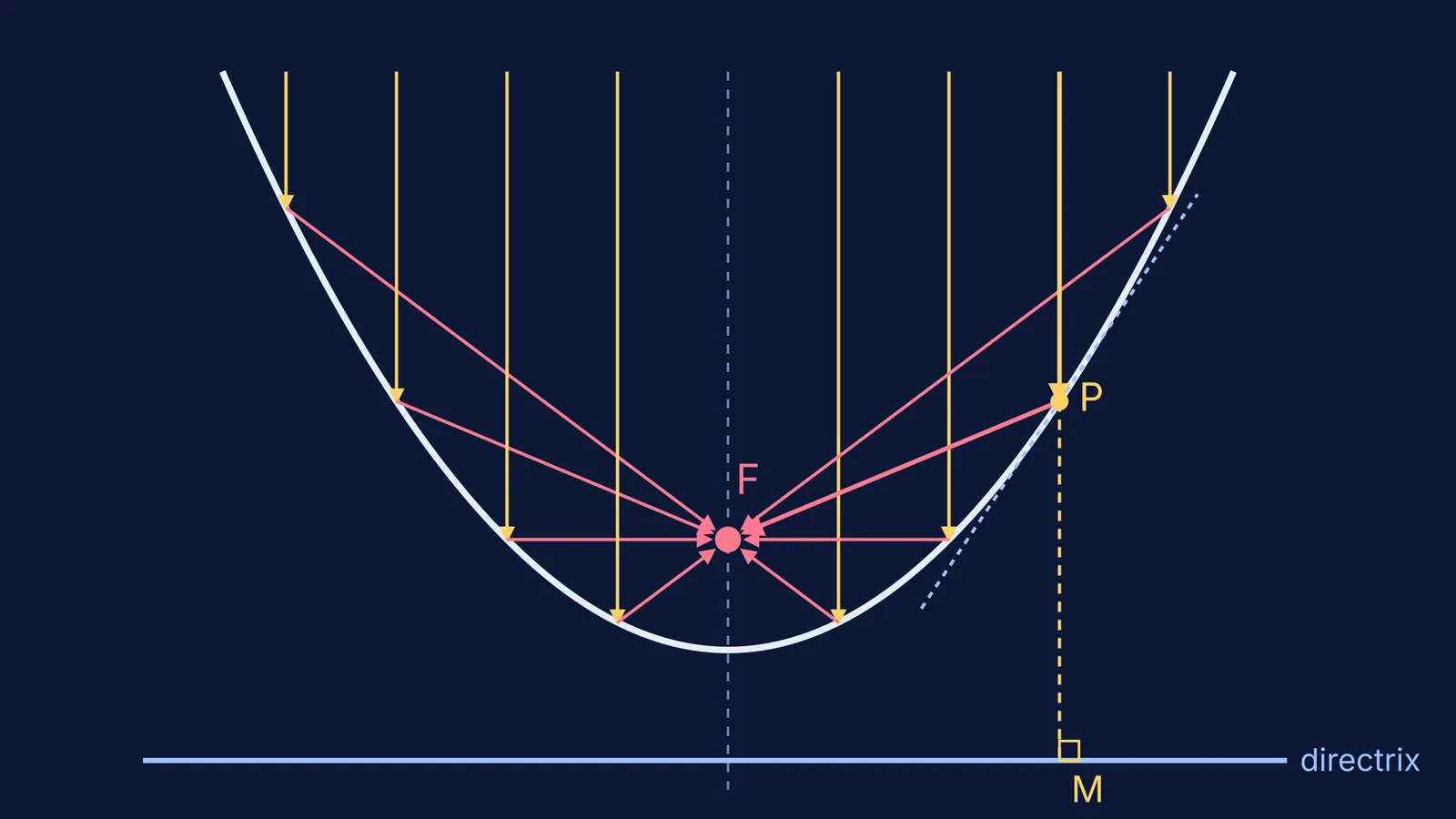
Light travelling parallel to the axis that strikes the concave side is reflected to the focus, wherever it hits (Wikipedia: Parabola). The same holds for sound and other waves, which is why the shape appears in satellite dishes, radar receivers and parabolic microphones. NCERT lists telescopes, antennas, flashlight and headlight reflectors among the uses of conic sections (NCERT Class 11, Chapter 10).
The proof needs one tangent fact and the law of reflection. Take any point P on the parabola, and let M be the foot of the perpendicular from P to the directrix.
By the definition, PF = PM.
The tangent at P bisects the angle between PF and PM, the tangent property stated in the Wikipedia article.
A ray parallel to the axis travels along line MP, arriving from the other side of P. Vertically opposite angles are equal, so it meets the tangent at the same angle PF does, on the opposite side.
Equal angles with the mirror is the law of reflection, so the ray leaves along PF, through the focus. P was any point, so every parallel ray does the same.
Run it backwards and you have a headlight: a bulb at the focus sends out a beam parallel to the axis.
How can you test it yourself with a ruler and compass?
Draw a line near the bottom of a page for the directrix, and mark a focus F 2 cm above it.
Draw lines parallel to the directrix at 1, 2, 3, 4 and 5 cm above it.
For each line at distance d, set your compass to d, put the point on F and mark where the arc crosses that line. Each mark is d from F and d from the directrix, so it lies on the parabola.
Join the marks. Then move F to 3 cm, predict the new shape, redraw and compare.
When you want to drag things and watch them respond, the Fermi Simulation Lab has interactive simulations for ideas that are easier to see than to read. If the definition still feels shaky, the Fermi Concept Library gives each mathematics concept its own lesson.
Next time you pass a dish antenna on a rooftop, you are looking at this proof in metal.