On this page
More than twenty years before Cooke and Wheatstone patented their telegraph in 1837, a young man in west London tried something that sounds almost comic: he wound kilometres of wire back and forth across his family's garden to see whether electricity could carry a message. It could.
What did Francis Ronalds build in his garden in 1816?
Francis Ronalds was born on 21 February 1788 and died in 1873, according to the Linda Hall Library's profile of Ronalds.
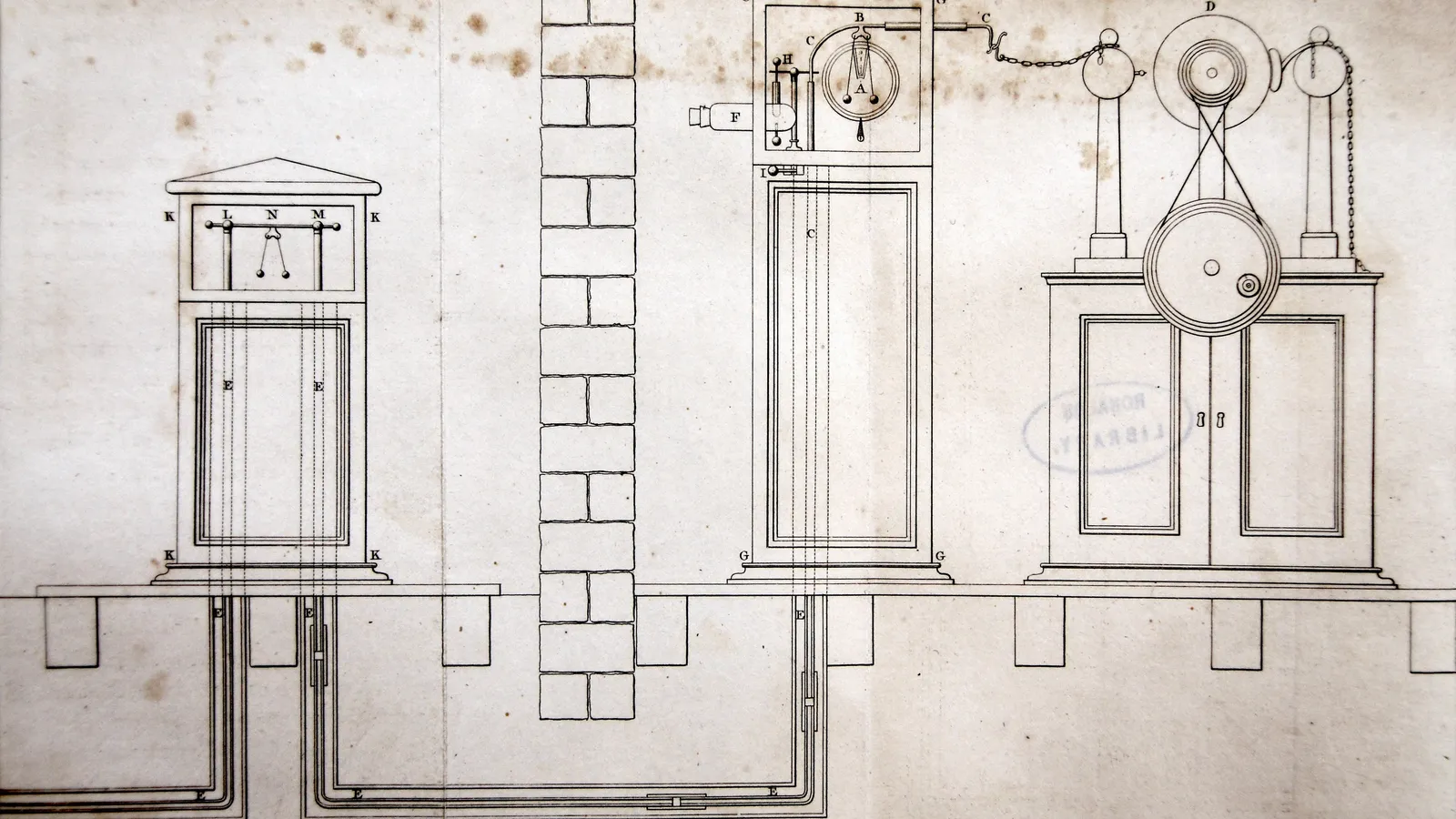
In 1816, while in his twenties, he passed electric signals through a 13-km iron wire strung back and forth between insulated supports on two large wooden frames, as described in a Physics Today bicentennial article by Beverley Ronalds, his great-great-great-niece and biographer.
The garden was behind his home at Upper Mall, Hammersmith, and the IET Archives record that he spent three or four years experimenting with electrostatic devices, encouraged by the octogenarian Swiss meteorologist Jean André De Luc.
He also tested an underground line. The same Physics Today article says he dug a trench 160 m long and 1.2 m deep down the side of the garden and enclosed the wire in narrow glass tubes coated inside and out with sealing wax, to keep moist air away from it.
How did Ronalds' electric telegraph work?
Ronalds used static charge, not a battery current. The IET Archives describe the system in four parts:
A frictional electricity machine kept the wire continuously charged.
At each end, two pith balls hung from the wire on silk threads. Charged alike, they stayed apart.
At each end, a clockwork mechanism turned a disc carrying letters, the two discs revolving in step.
To send a letter, the sender earthed the wire at the moment the dial showed it. At the far end the pith balls fell together, and the receiver noted the letter on their own dial at that instant.
The Physics Today article adds that each dial was a brass plate that turned with the second hand of a clock and was marked into 20 subdivisions, each with a letter, a digit and a short message. The IET is frank about the weakness: the system was slow and depended on the two dials staying in step.
Why did the Admiralty reject the telegraph?
The long war with France had ended at Waterloo in 1815. On 5 August 1816 the Admiralty told Ronalds that a telegraph was "wholly unnecessary", and the government was content to rely on the semaphore, according to Physics Today. The rejection came from John Barrow, Secretary of the Admiralty, as the Linda Hall Library notes.
Semaphores were signal towers capable of sending only two or three words per minute, according to the Cambridge University Press description of Ronalds' catalogue.
Ronalds did not give up. In 1823 he printed *Descriptions of an Electrical Telegraph, and of Some Other Electrical Apparatus*, which Physics Today quotes: "Let us have electrical conversazione offices, communicating with each other all over the kingdom".
What physics does Ronalds' telegraph teach?
Ronalds' telegraph is a school electrostatics question in disguise. Work through it like this.
Why do the pith balls spread? Both balls share charge from the same wire, so their charges have the same sign, and like charges repel.
Why do they fall when the wire is earthed? Earthing lets the charge flow away. With no charge there is no repulsion, so gravity pulls the balls back together.
Why glass tubes underground? Glass and wax are insulators. Damp soil and moist air conduct, and a leak would drain the charge.
Why was it slow? A dial turning with a clock's second hand takes 60 s per turn, so each of its 20 positions lasts 3 s. Just miss your letter and you wait almost a minute; on average about 30 s. So a five-letter word like INDIA takes about 2.5 minutes on average (our estimate, not a sourced figure).
Why must the clocks agree? If the receiver's dial runs one position ahead, every letter is read as its neighbour. The physics works; the message is still wrong.
If the picture of charges pushing apart is still fuzzy, the Fermi Simulation Lab has interactive simulations for ideas that are easier to see than to read. To revise charging by conduction and earthing, each with its own lesson, try the Fermi Concept Library.
Did Francis Ronalds invent the electric telegraph?
He was knighted at 82, according to Wikipedia's biography of Ronalds, and Physics Today records that the honour recognised him as "the original inventor of the electric telegraph".
The same article notes that William Cooke, a family friend, had operated the Hammersmith telegraph, and that Charles Wheatstone apparently witnessed the experiments. Read about Charles Wheatstone's telegraph and his bridge, the telegraph Gauss and Weber built in Göttingen, and Samuel Morse's code and first message.