

On this page
In May 1844, an electrical signal flashed across the 64-kilometer (40-mile) wire between Washington, D.C., and Baltimore, Maryland. This test proved that urgent text could be sent faster than a physical courier, making electrical telegraphy the first electrical telecommunications system, developed in the same era as early power sources like William Grove and the first working fuel cell. Before electricity, urgent messages relied on optical telegraph systems, where operators used telescopes to spot mechanical semaphore arms waving from distant hilltops. These older networks were entirely dependent on clear line-of-sight and daylight. Morse's electrical system solved this by sending invisible current down a continuous wire, operating continuously through the night.
Who invented the first telegraph code?
The system was driven by American inventor Samuel Morse and his engineer, Alfred Vail. In 1843, the United States Congress appropriated $30,000 to Morse to construct a telegraph line along the right-of-way of the Baltimore and Ohio Railroad. To send messages, Vail developed an alphabet-based code that translated letters into standardized sequences of electrical pulses.
The pulses were formed by closing and opening a circuit to send electric current, relying on principles similar to those used in solving circuits by assigning voltages. Short pulses were called dots or "dits," and longer pulses were called dashes or "dahs."
To increase transmission efficiency, Vail designed the original code so that the duration of each symbol was approximately inversely proportional to how often the character appeared in English text. The most common letter, E, has the shortest possible code: a single dit. Because the code's elements are defined by relative proportions rather than fixed times, skilled operators could transmit messages at incredibly high speeds.
How did they build the 1844 telegraph line?
Morse initially planned to lay the telegraph wires safely underground. He hired Ezra Cornell, who had developed a special plow that could dig a 50-centimetre-deep trench, lay a pipe containing the wires, and rebury them in one integrated operation. However, after laying about 15 kilometers (9.5 miles) of wire, the underground insulation failed, forcing a complete halt to the project.
Realising the underground method was flawed, Morse looked to the British needle telegraph systems built by Cooke and Wheatstone, which used overhead wires. In early 1844, Morse's team switched to stringing two copper wires on 7-metre (23-foot) chestnut poles spaced 90 metres apart. (When calculating the properties of such setups, physicists often examine stretching a wire: how its resistance changes with length.)
When physics students struggle to picture how changing electric currents carry signals over long wires, Fermi's AI tutor can work out what they already know, build a plan for the session, and teach through it — drawing the figure and checking understanding as it goes.
What was the first telegraph message in 1844?
On May 24, 1844, Morse gathered a crowd in the old Supreme Court chamber of the United States Capitol in Washington, D.C. He tapped out a phrase that was received instantly by Vail, who was stationed at the Mount Clare railroad depot in Baltimore. The message was "What hath God wrought", a verse from the Bible's Book of Numbers.
The phrase was suggested by Annie Ellsworth, the daughter of a friend who had supported Morse's work and knew he was religious. The next year, U.S. Postmaster General Cave Johnson reported doubtfully that the line's importance would not yield enough income, which led to the invention being returned for private commercial development. Within decades, commercial telegraph networks spanned continents, and the dot-dash system became the standard for global communication.
How does Morse code timing work?
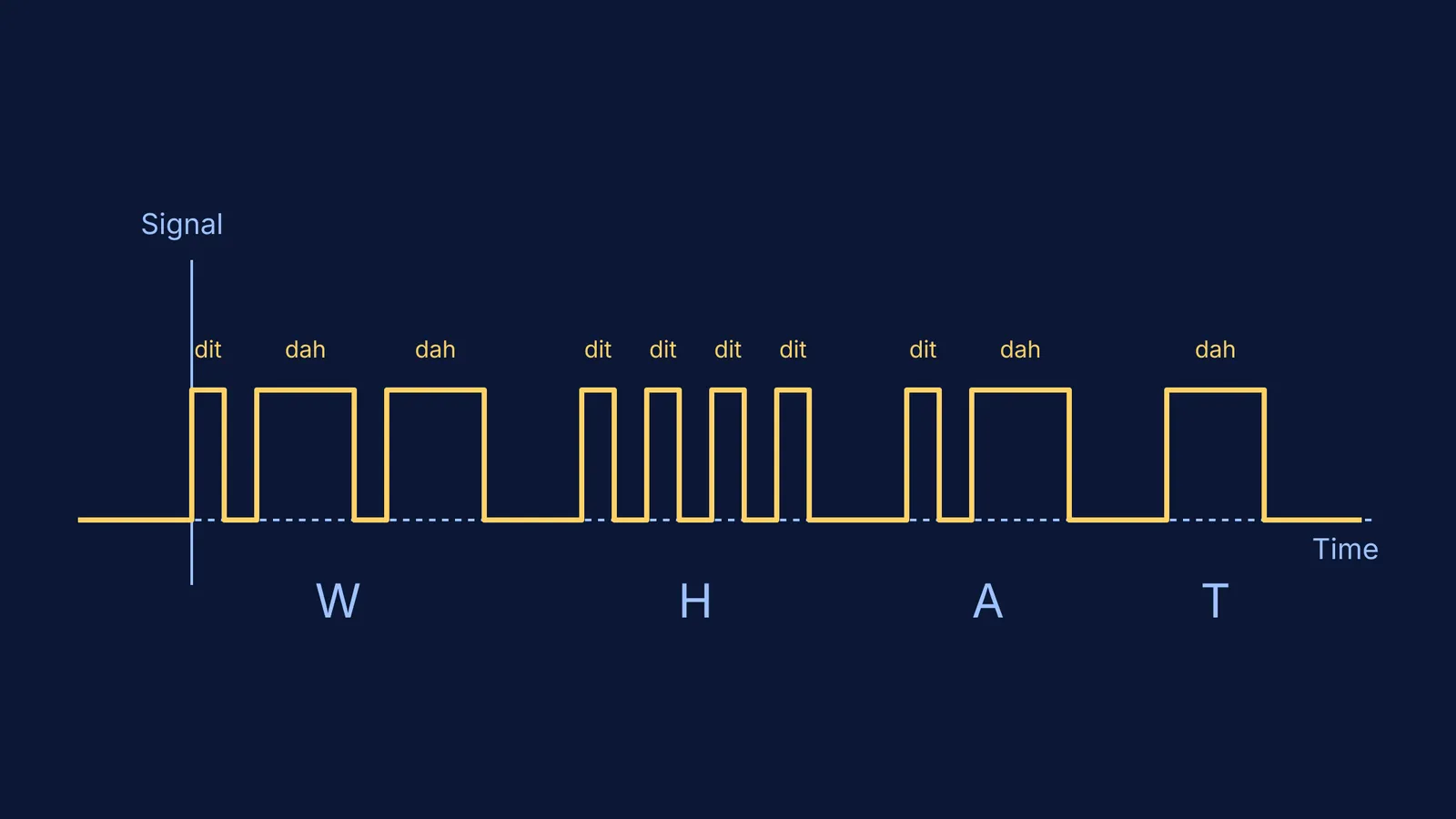
If you want to read or tap a message, the gaps between the sounds are just as important as the sounds themselves. The basic unit of time is the length of one dit.
Dit: One unit of time.
Dah: Three units.
Intra-character gap: One unit of silence between the dits and dahs of a single letter.
Letter gap: Three units of silence between complete letters.
Word gap: Seven units of silence between complete words.
Using these rules, the word "WHAT" took 33 units of time to tap out, proving that electricity could carry human language across any distance.


