On this page
In 1974, a Budapest teacher of architecture and design set himself a building problem: could many small blocks move on their own and still stay one solid object? Here is how Ernő Rubik's answer is built, why its layers turn, and how to count its positions with Class 11 maths.
Why did Ernő Rubik invent the cube?
Guinness World Records records that Rubik, a professor of architecture, invented the cube in Budapest in 1974 while trying to build an "impossible object" to engage his students. In the mid-1970s he worked in the Department of Interior Design at the Academy of Applied Arts and Crafts in Budapest, according to Wikipedia's history of the cube.
He did not set out to make a toy. In an interview recorded in 2018 and published by the Gathering 4 Gardner foundation, Rubik said: "The cube was not created as a puzzle. I discovered the potential of a puzzle, creating an object, which contains many pieces which work together, which remains one unit." His first prototype was wooden. Guinness says it took him three months to solve his own invention.
How does the Rubik's Cube mechanism work?
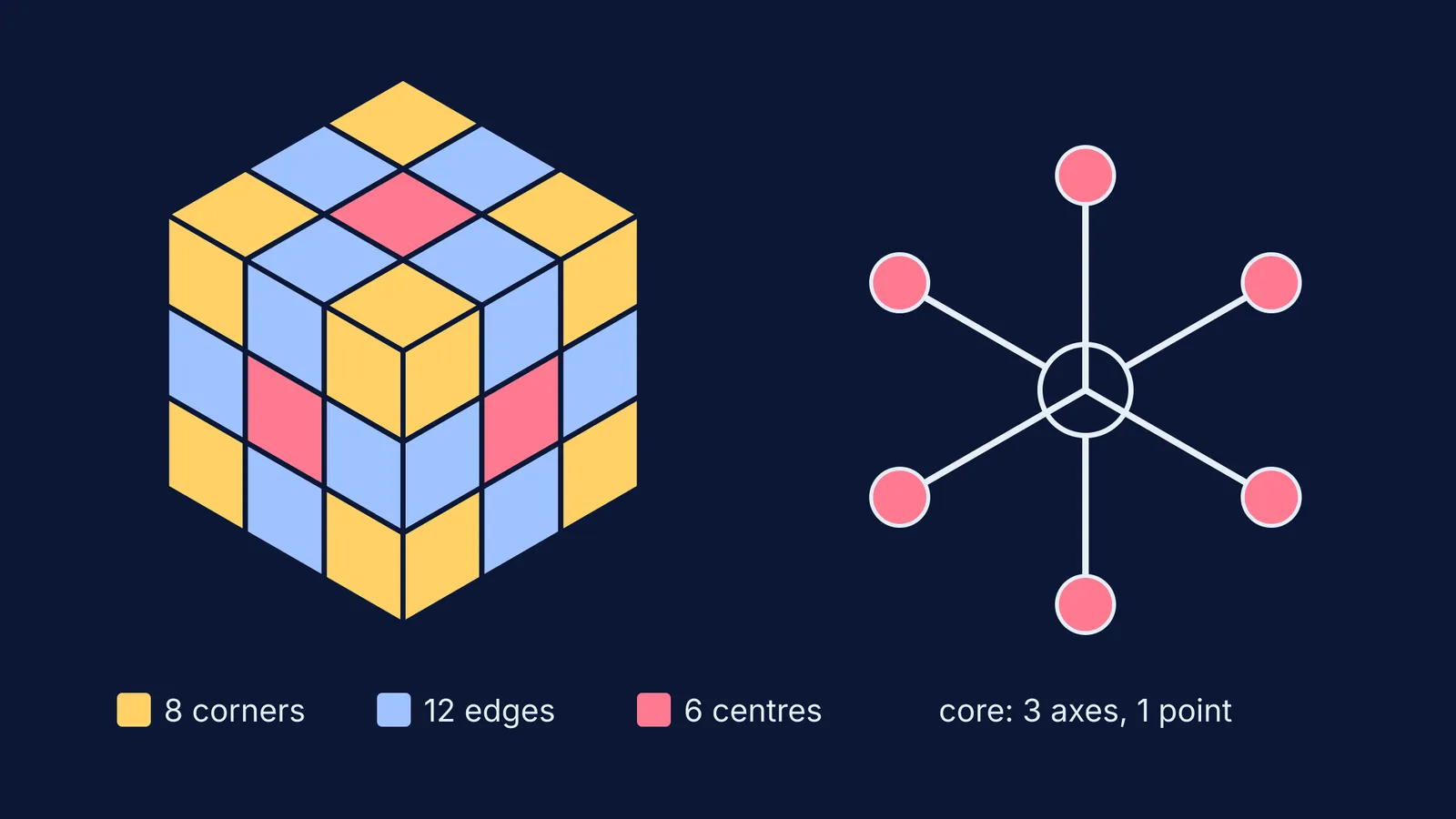
The cube is not really 27 small cubes. The middle one does not exist; in its place sits a core.
The core. Rubik's Hungarian patent, filed on 30 January 1975 as HU170062, is classed on Google Patents as a puzzle with a central element, such as an invisible core, that stays fixed in the centre, and groups of elements that rotate about three axes meeting in one point.
6 centre pieces. One sits on each end of the core's three axes, held in by a fastener and a spring (Wikipedia). Centres spin in place but never change position relative to each other.
12 edges and 8 corners. These are not fixed to the core. Each has a concealed inward extension that interlocks with its neighbours, so the centres and the interlocking hold everything in.
Turn a face and its centre spins in place, carrying a ring of 4 edges and 4 corners with it. In the same interview, Rubik separated the cube's complexity from its mechanism: "I'm not speaking about the structure because it's simple."
How many positions does a Rubik's Cube have?
The count is 8! × 3^7 × (12!/2) × 2^11 = 43,252,003,274,489,856,000, about 43 quintillion, as given by Wikipedia and cube20.org. You can build it yourself with the multiplication principle for counting, in five steps:
Place the corners. 8 corners fill 8 corner slots in 8! = 40,320 ways.
Twist the corners. Each corner can sit 3 ways. Choose 7 twists freely; the last is forced, because no legal move twists a single corner. That gives 3^7.
Place the edges. 12 edges in 12 slots is 12!, but only half are reachable, 12!/2: a quarter-turn swaps corners and edges together, so their parities must match.
Flip the edges. Each edge can sit 2 ways. Choose 11 freely; the last is forced. That gives 2^11.
Multiply. The four factors give the 43 quintillion figure.
Take the cube apart and reassemble it at random, and those three restrictions vanish: Wikipedia notes that only one-twelfth of such arrangements can be solved, since 3 (corner twist) × 2 (edge flip) × 2 (parity) = 12. Rules that stay true however you move are called invariants; see the invariant method in olympiad maths.
What is God's number for the Rubik's Cube?
God's number is the fewest moves that are always enough to solve any position, counting any twist of any face as one move. In July 2010, Tomas Rokicki, Herbert Kociemba, Morley Davidson and John Dethridge showed it is exactly 20, using about 35 CPU-years of computer time donated by Google (cube20.org). Their peer-reviewed paper, "The Diameter of the Rubik's Cube Group Is Twenty", appeared in the SIAM Journal on Discrete Mathematics in 2013.
How can you use the cube to practise 3D thinking?
Try this 20-minute plan with any 3x3 cube:
Predict, then turn (5 minutes). Before each quarter-turn, say which 8 pieces will move and where one chosen corner will land. Then check.
Count by type (5 minutes). Find every piece with 3, 2 and 1 colours. You should get 8, 12 and 6.
Test a cycle (5 minutes). Repeat one face turn and predict how many turns bring it home (4). Then repeat a pair of turns, such as right face then top face, and count how many repeats it takes.
Redo the count (5 minutes). Close this page and rebuild the five-step count from memory. Where you stall shows the idea to revisit.
If factorials or parity feel shaky, the Fermi Concept Library gives every concept in mathematics its own lesson and its place in the map. For ideas easier to see than read, try the interactive simulations in the Fermi Simulation Lab. And for another famous puzzle and the mathematician behind it, read how Édouard Lucas created the Tower of Hanoi.